

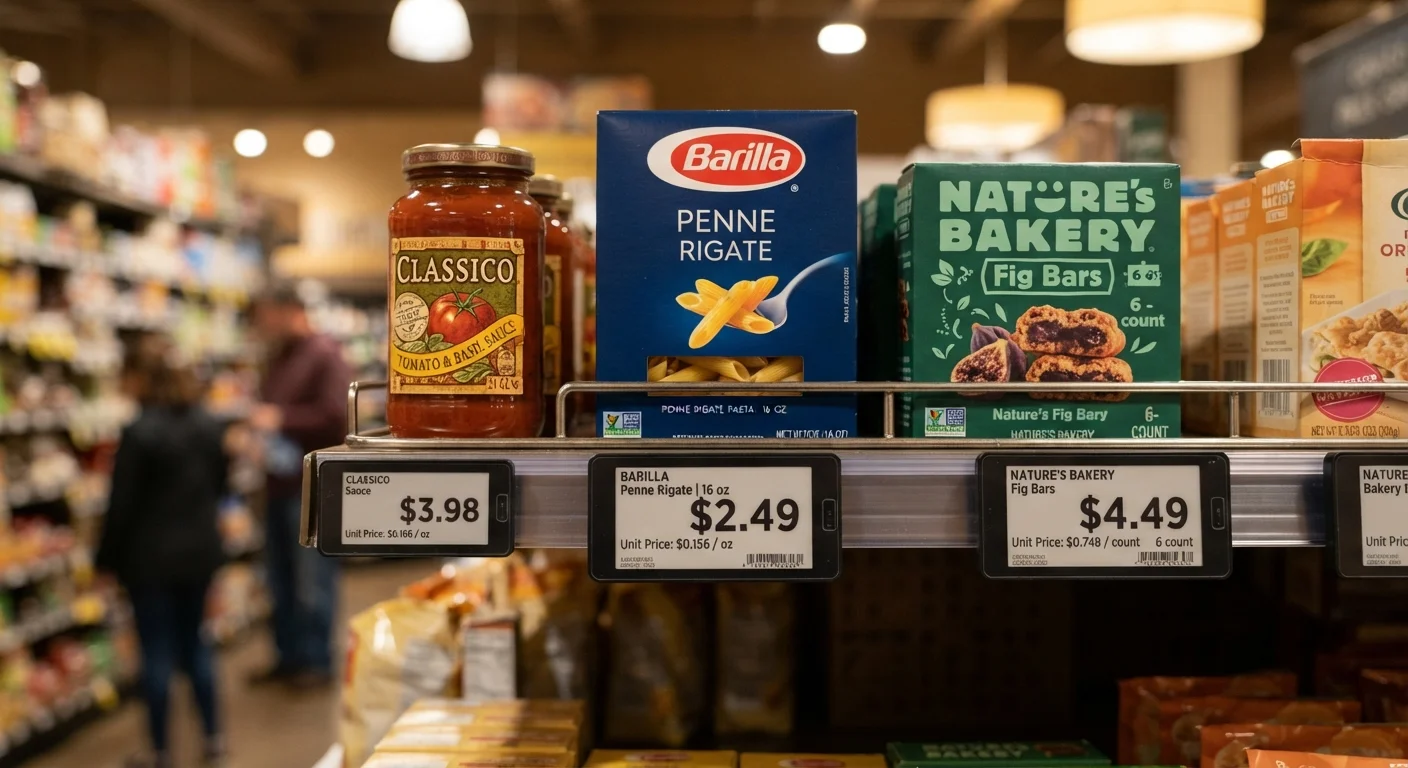
What Unit Pricing Actually Tells You
Every grocery shelf tag carries two numbers: the total package price and a smaller figure — the unit price — expressing cost per ounce, per count, per liter, or per sheet. Most shoppers focus exclusively on the first number. That habit can quietly cost a family hundreds of dollars a year.
Unit pricing strips away the packaging and lets you compare apples to apples. A 32 oz bottle of dish soap priced at $4.99 costs about $0.156 per ounce. A 16 oz bottle at $2.89 costs $0.181 per ounce. The smaller bottle looks cheaper — and it is, upfront — but you pay more for each ounce of actual product.
Retailers aren't required to display unit prices uniformly across all product categories, so the denominator (ounce, count, 100 sheets) can shift between competing items on the same aisle. Always confirm that two labels are using the same unit before drawing a conclusion. For a broader look at how sticker prices obscure real costs, see our guide to total cost of ownership.
How to Read a Label — and When the Math Flips
Reading a unit price label takes about three seconds once you know the pattern: find the small-print line (often in the lower-left corner of the tag), note the denominator, and compare that figure across competing sizes or brands — not the shelf price.
Unit price
The cost of a product expressed per standardized measure — such as per ounce, per 100 sheets, or per count — allowing fair comparisons across different package sizes.
Denominator
The unit of measure used in a unit price calculation (e.g., ounce, liter, or count). For a comparison to be valid, both items must share the same denominator.
Price per unit
Another term for unit price. Calculated by dividing the total shelf price by the total quantity in the package.
Shrinkflation
When a manufacturer reduces the quantity inside a package while keeping the price the same or raising it slightly. Unit pricing exposes this practice because the cost per ounce rises even if the shelf price appears unchanged.
When bulk genuinely wins: Non-perishable staples your household uses consistently — paper towels, canned tomatoes, laundry detergent — almost always have a lower unit price in larger sizes. The savings are real as long as you'll use the product before it expires or degrades.
When bulk quietly loses: Perishables, personal-care items with short shelf lives, and products you're trying for the first time can cost more per unit if part of the purchase goes to waste. A gallon of specialty salad dressing at a low unit price is no bargain if half of it spoils. Bulk buying has clear winning and losing conditions — unit pricing is the tool that reveals which side you're on.
Store-brand vs. name-brand: Unit pricing frequently shows that store-brand products are meaningfully cheaper per unit even when the total price difference looks small. On commodity products like flour, sugar, or basic cleaning supplies, this comparison is especially useful.
Sale Prices Can Scramble the Size Hierarchy
Promotional pricing sometimes makes a medium-sized item cheaper per unit than the large size that normally wins. Never assume the jumbo or club-pack size has the lowest unit price — verify it against the sale tag. Retailers occasionally run promotions precisely on mid-sized products, temporarily reversing the usual bulk advantage.
Sales and promotional pricing can temporarily reverse the usual size hierarchy — a "sale" on a medium-sized item sometimes produces a lower unit price than the jumbo version. Always check the unit price on sale items rather than assuming the promoted product is the better deal. This is also where anchor pricing tactics do their most effective work against shoppers.
Building the Habit Into Your Shopping Routine
Unit pricing only helps if you actually look for it. A few practical ways to make it routine:
- Check before grabbing. Pause at size variants and scan the unit price before placing any item in your cart.
- Use your phone's calculator. When labels use different denominators — one shows per ounce, another per pound — convert them manually. Divide total price by total quantity in the same unit.
- Build a personal price book. Note unit prices on items you buy repeatedly. Over a few shopping trips you'll know your baseline and can spot genuine deals instantly.
- Question "value" sizes at warehouse clubs. They often have strong unit pricing — but verify rather than assume, and factor in membership cost when evaluating overall value.
For deeper context on how this connects to reading shelf labels effectively, our label-reading walkthrough covers the full skill set. And if you want to apply the same logic beyond groceries, unit pricing math for household purchases extends the framework to cleaning supplies, personal care, and more.
Unit pricing isn't a trick or a shortcut — it's basic arithmetic applied consistently. Families who use it routinely make fewer impulsive size choices and avoid the common trap of confusing a lower shelf price with a lower actual cost.