

Key Takeaways
Option A
Engine Air Filter
The engine's first line of defense against dirt and debris.
Best for: Protecting your engine's combustion process from airborne contaminants that reduce performance and cause wear.
Option B
Cabin Air Filter
The barrier between road pollutants and the air your family breathes.
Best for: Keeping pollen, dust, exhaust particles, and other contaminants out of your vehicle's passenger compartment.
If your vehicle feels sluggish or fuel economy has dropped noticeably
Engine Air Filter
A clogged engine air filter restricts airflow to the combustion chamber, reducing power and efficiency. This should be checked first when performance declines.
If allergy sufferers in your family are experiencing increased symptoms in the car
Cabin Air Filter
A saturated cabin filter can no longer trap pollen and fine particles, allowing them to circulate through the HVAC system directly into the passenger space.
If you notice weak airflow from your dashboard vents
Cabin Air Filter
A blocked cabin filter restricts airflow through the HVAC system, making heating and air conditioning significantly less effective.
If you drive frequently on unpaved roads or in dusty rural areas
Engine Air Filter
Heavy dust exposure accelerates engine filter clogging and can allow abrasive particles into the engine if the filter is past its service life.
What Each Filter Actually Does
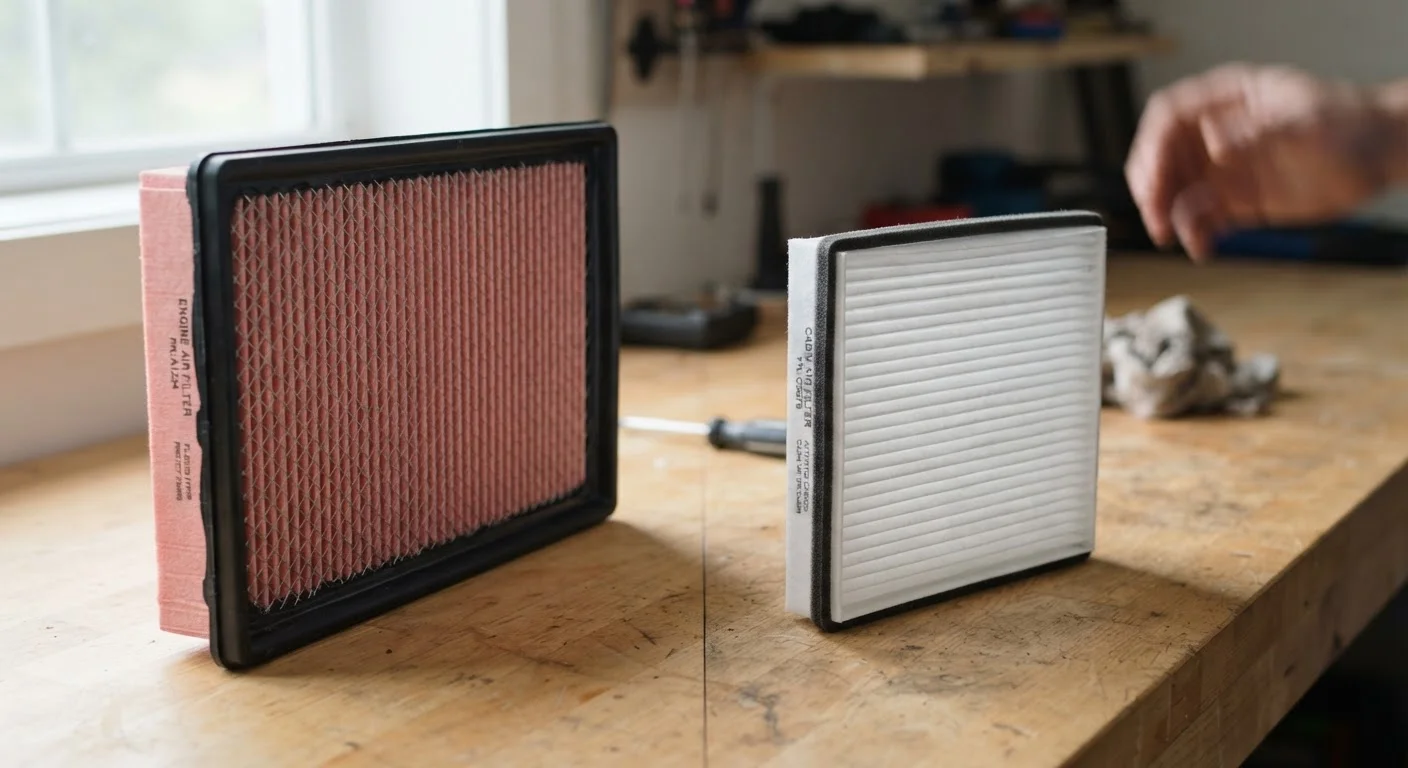
Despite their similar flat, pleated appearance, these two filters operate in entirely separate systems with distinct protective roles.
The engine air filter sits in the engine bay and screens air before it enters the engine's intake system. Your engine mixes air and fuel to create combustion, and that air must be clean. Without filtration, fine particles - road dust, sand, pollen - would enter the cylinders and act as an abrasive, accelerating wear on pistons, rings, and cylinder walls over time.
The cabin air filter is positioned within the vehicle's HVAC (heating, ventilation, and air conditioning) system, typically behind the glove box or under the dashboard. Its job is entirely separate: it filters the air drawn into the passenger compartment. It traps dust, pollen, mold spores, and fine exhaust particles before they reach the vents your family breathes from.
Both use pleated filter media, which is why they're commonly confused at a glance - but replacing one does nothing for the other's function.
| Criterion | Engine Air Filter | Cabin Air Filter |
|---|---|---|
| What it protects | Engine internals | Passenger air quality |
| Location in vehicle | Engine bay / intake system | HVAC system / dashboard area |
| Typical replacement interval | 15,000-30,000 miles | 15,000-25,000 miles |
| Key warning signs | Power loss, poor fuel economy | Weak vent airflow, musty odors |
| Risk of neglect | Engine wear, efficiency loss | Poor air quality, HVAC strain |
| Affected by dusty conditions | Yes - clogs faster | Yes - clogs faster |
Replacement Schedules and Warning Signs
Neither filter has a universal replacement interval, because real-world driving conditions vary considerably. That said, general guidelines give a useful starting point.
Engine air filter: Most manufacturers recommend inspection around every 15,000 miles and replacement between 15,000 and 30,000 miles. Check your owner's manual for the figure specific to your vehicle. Warning signs of a clogged engine filter include reduced acceleration, a drop in fuel economy, or a rough idle. In some cases, a severely restricted filter can trigger a check-engine light.
Cabin air filter: Replacement is typically recommended every 15,000 to 25,000 miles, though again your owner's manual is the authoritative source. Tell-tale signs include reduced airflow from the vents, musty or stale odors when the HVAC runs, or noticeably more dust accumulating on the dashboard.
Check Your Owner's Manual First
Manufacturer-recommended intervals vary meaningfully between vehicles - some turbocharged engines, for instance, are more sensitive to air filter condition than naturally aspirated ones. Your owner's manual lists the service interval specific to your make, model, and engine. When in doubt, a qualified mechanic can inspect both filters and advise based on their actual condition rather than mileage alone.
Drivers in areas with high pollen counts, frequent wildfires, or dusty unpaved roads should expect to replace both filters more frequently than the standard intervals suggest. An annual visual inspection is a reasonable habit regardless of mileage.
15,000-30,000
Miles between engine air filter changes
General industry guidance; always verify with your vehicle's owner's manual as intervals differ by manufacturer.
2 filters
Separate filtration systems in most modern vehicles
Most passenger vehicles built in the last two decades include both an engine air filter and a dedicated cabin air filter as standard equipment.
What Happens If You Neglect Them
Skipping filter replacements is a common form of deferred maintenance - and both filters carry genuine consequences when ignored.
A long-neglected engine air filter restricts airflow to the point where the engine compensates by running richer (using more fuel), hurting efficiency. Extended neglect can allow fine contaminants to bypass a compromised filter element, contributing to premature engine wear. Repairs to address that kind of internal damage are far more expensive than a routine filter replacement.
An overdue cabin air filter stops trapping airborne particles effectively, meaning passengers - particularly children and those with allergies or asthma - are exposed to higher concentrations of pollen, fine dust, and exhaust particulates inside the vehicle. A saturated filter can also develop mold or bacteria growth if moisture is present, creating odor and potential health concerns.
In both cases, the cost of replacement filters is modest compared to the downstream costs of neglect. When you schedule an oil change, ask your technician to inspect both filters - it takes only a few minutes and gives you a clear picture of where you stand.