

Key Takeaways
Why the Sticker Price Sends You the Wrong Signal
Most shoppers make size decisions by comparing total prices - the $3.49 bottle versus the $5.99 bottle. That instinct is understandable, but it routinely leads to paying more per use, not less. Package sizes vary so widely across the same product category that the only fair comparison is price per standard unit of measure.
Consider laundry detergent: a 50-oz bottle at $6.99 costs roughly $0.14 per ounce, while a 32-oz bottle at $5.49 costs about $0.17 per ounce. The smaller bottle looks cheaper at the register, but you pay 21% more for every ounce of cleaning power. Multiply that gap across dozens of weekly purchases and the annual difference is real money.
Unit pricing exists specifically to solve this problem. Understanding how to read it is one of the fastest, highest-return financial habits a family can develop - no budgeting app or coupon clipping required. For a broader look at how purchase decisions hide their true cost, see our guide on total cost of ownership.
Smartphone calculator
Manually calculate unit price when shelf labels are absent or use unfamiliar units.
Shopping list
Keeps you focused on intended purchases so unit-price comparisons stay relevant to your household's needs.
How to Read a Unit Price Label: Step by Step
The process takes under a minute once it becomes habit. Work through the steps below the next time you are in the grocery aisle.
What you will need
Locate the unit price on the shelf label
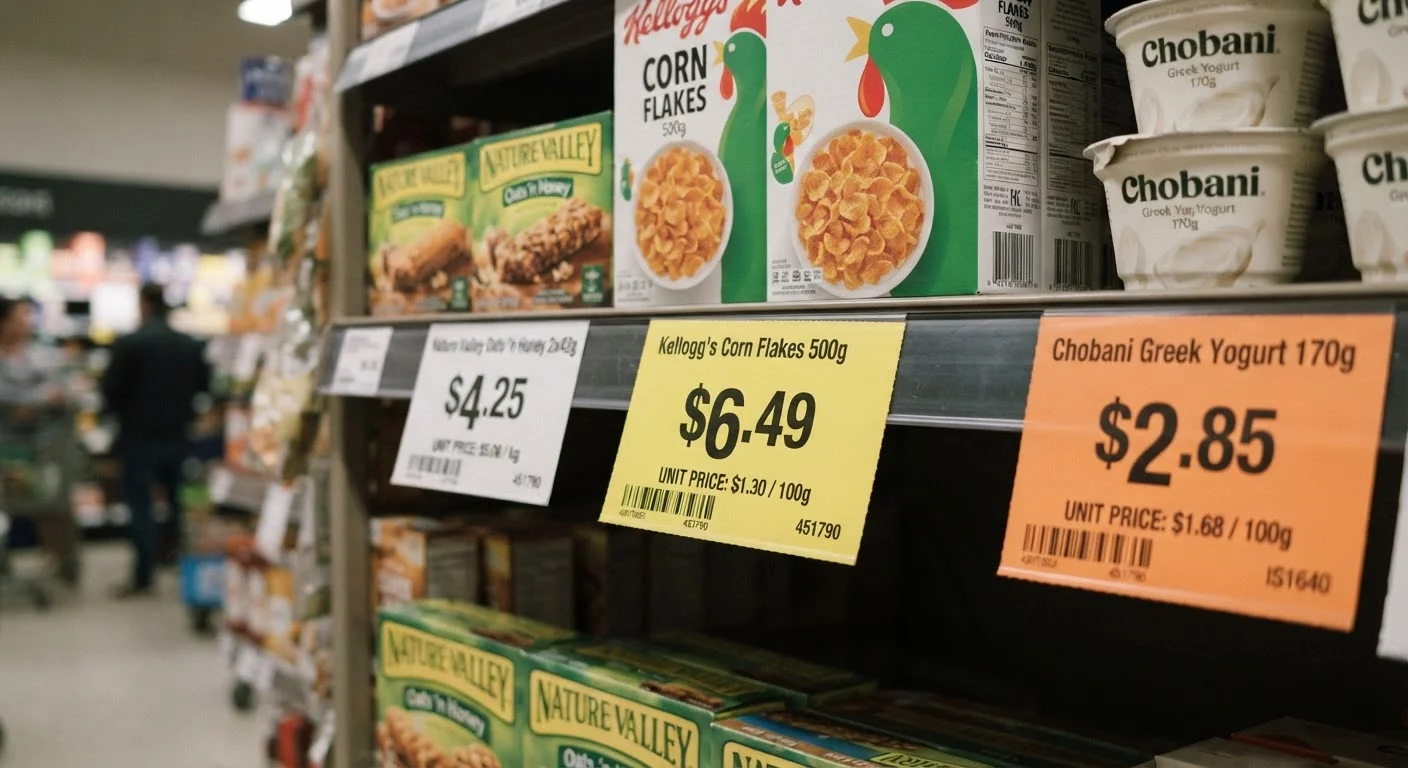
On nearly every shelf edge tag you will find two prices: the retail price (large, prominent) and the unit price (smaller, often in a corner box). The unit price is typically labeled something like $0.18 / oz or $1.24 / 100 ct. If it is not immediately visible, check the lower-left or lower-right corner of the label - retailers place it consistently once you know where to look.
Identify which unit of measure is being used
Note the unit the label uses: weight (oz, lb, g), volume (fl oz, ml, L), or count (sheets, units, servings). Write it down or photograph the label. You can only compare products that share the same base unit - comparing cost per ounce to cost per liter is not a valid comparison without conversion.
Compare unit prices across sizes and brands
Pick up the two or three competing options you are considering - different sizes of the same brand, or similar products from different brands. Read the unit price from each label and note the figures side by side. The lower unit price is the better value on price alone. A 28-oz jar of pasta sauce at $0.18/oz beats a 15-oz jar at $0.23/oz, regardless of which sticker price looks smaller at a glance.
Factor in real-world constraints before deciding
A lower unit price only translates to real savings if your household will actually use the product before it expires, spoils, or goes stale - and if you have space to store it. Ask yourself: Will we use this within its shelf life? Do we have storage space? Is the cash outlay manageable right now? If any answer is no, the technically cheaper unit price may not be the better choice for your family. This is especially relevant for perishables, bulk grains, and large-format cleaning products.
Recalculate when a sale price is involved
If a product is on promotion, the shelf label's unit price may reflect the regular price, not the sale price. Verify which price will actually ring up, then divide that price by the package quantity yourself to get the true promotional unit price. Comparing that figure against competing products ensures you are not fooled by a sale that looks impressive on the sticker but is still a worse per-unit value.
Use Your Phone as a Backup Calculator
If a label is missing or uses an unfamiliar unit, divide the total price by the total quantity right on your phone's calculator. For example, $4.79 ÷ 28 oz = $0.171 per ounce. This takes about 10 seconds and is more reliable than estimating by eye.
Mismatched Units Can Mislead You
Retailers are not required to standardize which base unit they display - one label might show cost per ounce while a competing product shows cost per pound or per 100g. Always confirm you are comparing the same unit before drawing a conclusion. If the units differ, divide the total price by the total quantity yourself to get a common denominator.
For a deeper look at when bulk quantities actually pay off versus when they quietly cost you more, read our companion article on buying in bulk.
Common Situations Where Unit Pricing Matters Most
Unit pricing delivers its clearest payoff in a handful of recurring shopping scenarios:
- Household staples with long shelf lives - paper products, canned goods, cooking oils, dried pasta. These are ideal candidates because spoilage risk is low and usage is predictable.
- Products sold in multiple size tiers - yogurt sold in individual cups, multi-packs, and large tubs; shampoo in travel, standard, and family sizes. The price jumps between tiers are rarely proportional.
- Store-brand vs. name-brand comparisons - unit pricing strips away packaging and marketing to show the raw cost difference, which is often 20-40% on comparable items.
- Sale items - a promoted product is only worth stocking up on if its sale unit price is genuinely lower than the everyday unit price of alternatives. Unit pricing makes that verification quick. See grocery spending patterns that quietly inflate your bill for more on how promotional framing influences decisions.
Sales Can Distort the Unit Price
A promotional sticker price may temporarily make a smaller package look cheaper on a per-unit basis than the shelf label suggests - or vice versa. Always use the price you will actually pay at the register, including any applied discounts or loyalty-card prices, when doing your comparison.
Unit pricing is one piece of smarter label literacy. If you want to apply the same rigorous reading habit to nutrition information, our article on hidden sugars in nutrition labels walks through what packaged food labels are really communicating.
This article provides general financial education and is not personalized financial advice. Consult a qualified professional for guidance specific to your situation.