

Key Takeaways
Anchor Pricing
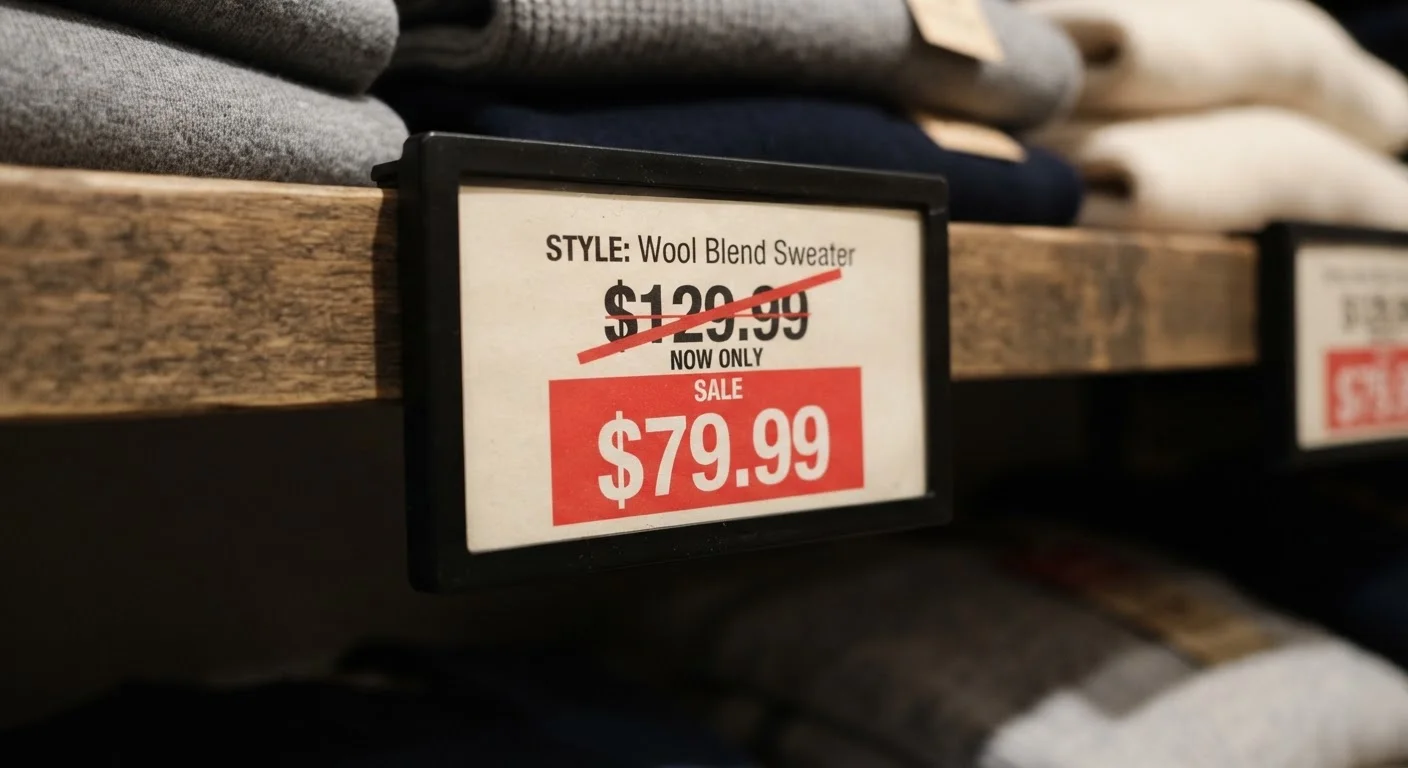
Anchor pricing is a retail strategy where a higher 'original' or 'compare at' price is displayed alongside a lower selling price to make the deal appear more attractive. The first number you see — the anchor — shapes your perception of value for every number that follows. Even when the anchor is inflated or rarely charged, it influences how much you're willing to pay.
In behavioral economics, this exploits 'anchoring bias' — a cognitive tendency where people rely heavily on the first piece of numerical information encountered when making judgments.
How the Anchor Gets Set
Before a single customer walks into the store, retailers make a critical decision: what number will shoppers see first? That number — the anchor — doesn't need to be accurate or fair. It just needs to be visible before the 'sale' price.
Common anchor formats include:
- Crossed-out original price: "Was $89.99, Now $54.99"
- Compare at: "Compare at $120" — typically referencing another retailer's price, which may or may not be standard
- Manufacturer's Suggested Retail Price (MSRP): Often set intentionally high and rarely charged at full value in practice
Once your brain registers that $89.99, the $54.99 feels like a win. You're no longer asking 'is $54.99 a fair price for this?' — you're feeling relief that you're not paying $89.99. That mental shift is exactly what the anchor is designed to create.
Not All Reference Prices Are Deceptive
Anchor pricing exists on a spectrum. Some reference prices genuinely reflect a prior or competitor price. The problem is that shoppers rarely have the information to tell the difference in the moment. Treating all anchors with healthy skepticism — rather than assuming each one is manipulative — is the more balanced and useful default.
Why Your Brain Trusts the Anchor
Anchoring bias is one of the most well-documented effects in behavioral economics. When you encounter an unfamiliar number, your brain uses it as a reference point — even when it's irrelevant or arbitrary. In a retail context, the anchor is never arbitrary; it's engineered to push you toward a purchase.
The effect intensifies when:
- You have no independent price knowledge for the item
- The anchor is presented visually before the sale price (larger font, prominent position)
- The gap between anchor and sale price is large, creating a sense of urgency or rarity
“The first number you see becomes the lens through which you evaluate every number that follows. Retailers know this. Most shoppers don't.”
— Richard Thaler, Nobel Prize-winning behavioral economist and co-author of 'Nudge'
Understanding this isn't about blaming yourself. These techniques are studied, refined, and deliberately applied. The practical response is to build habits that bypass the anchor entirely — before you're standing in the aisle.
Anchor Pricing in the Wild: Where You'll See It
Recognizing the format helps you pause before the anchor does its work.
One especially common pattern is the perpetual sale — where an item's 'original' price is almost never the actual selling price. If a product is on sale every week, the sale price is functionally the real price. Our related article When 'Sale' Means Nothing examines how to evaluate value when discounts are the norm, not the exception.
How to Neutralize the Anchor
The most effective counter isn't willpower — it's process. A few consistent habits make anchor pricing far less effective:
- Establish an independent baseline first. Before shopping, check what an item costs across multiple sellers. This gives you a real-world reference price the retailer didn't set.
- Ignore the crossed-out number. Literally cover it or look away. Ask only: is the actual selling price fair for what I need?
- Calculate cost per use or unit. For household goods especially, unit pricing cuts through anchor-driven confusion by grounding the comparison in concrete math.
- Account for total cost, not just sticker price. A discounted appliance with high energy use or frequent maintenance needs may cost more over time. Total cost of ownership gives you the full picture.
- Watch for 'compare at' language. This phrasing often means the reference price is from another retailer — possibly one that also inflates its anchor.
Build Your Own Reference Price First
Before visiting a store or clicking 'add to cart,' spend two minutes checking the item's price on two or three independent sources. This gives you an anchor of your own — one based on actual market data rather than a retailer's tag. When you arrive with that number in mind, crossed-out prices lose most of their persuasive power.
Anchor pricing works because it replaces your own value judgment with one the retailer supplies. The goal is to bring your own number to the conversation — built from research, not from a crossed-out tag.