

Key Takeaways
Our Verdict
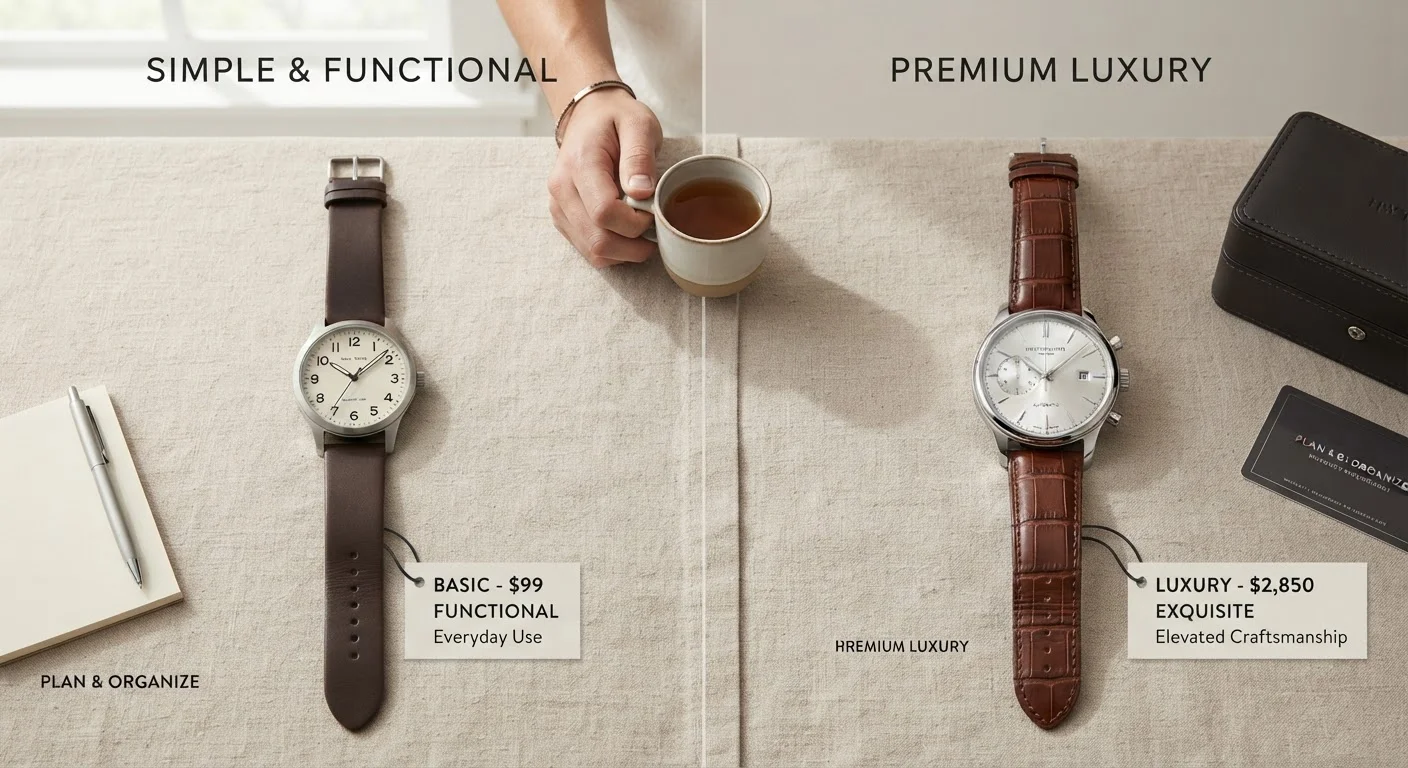
Defaulting to premium is rarely the smartest move, but neither is always buying the cheapest option. The most reliable approach is to match product quality to your actual usage needs, applying higher scrutiny to spending where durability, safety, or daily use amplify the value of getting it right.
Families looking to build consistent purchasing habits that avoid both false economies and unnecessary premium spending.
The Premium Price Myth
Marketing has done a thorough job convincing consumers that a higher price tag signals higher quality. In reality, a significant portion of premium pricing pays for packaging, brand positioning, celebrity endorsements, and retail shelf space — not the product itself.
This doesn't mean premium products are always poor value. It means the price alone tells you very little. Before upgrading, it helps to ask a more precise question: what specifically am I paying more for, and will I actually notice the difference?
Regulated categories are a useful starting point. Over-the-counter medications, for example, must contain the same active ingredients at the same concentrations regardless of brand — so a store-brand pain reliever and its name-brand equivalent are often chemically identical. The same logic applies to many pantry staples and cleaning products. See our breakdown of store brands vs. name brands for a category-by-category look at where the quality gap is real and where it isn't.
When Good Enough Actually Is Good Enough
Several purchase categories reward restraint. Items you use infrequently, items with regulated quality standards, and items where objective performance differences are minor all fall here.
- Occasional-use tools: A drill used twice a year doesn't need professional-grade specs.
- Commodity consumables: Printer paper, cleaning rags, and basic pantry items rarely justify premium pricing.
- Trend-driven purchases: Anything that will be replaced when styles or technology shift shouldn't absorb premium investment.
- Children's gear in fast-growth phases: Shoes, clothing, and some sports equipment are outgrown before they wear out.
A practical test: estimate your cost per use. A $20 item used 200 times costs $0.10 per use. A $60 premium version used 200 times costs $0.30 per use. If neither will be used more than a handful of times, the cheaper option almost always wins. For a deeper look at evaluating real value, see what value actually means when spending family money.
~30%
Average store-brand price discount vs. name brands
Consumer research consistently finds private-label products priced roughly 25–35% below equivalent name-brand items, with comparable performance in many regulated categories.
3–5x
Lifespan difference in high- vs. low-quality tools
Industry durability testing across hand tools and kitchen equipment routinely shows professional-grade items lasting several times longer than entry-level counterparts under regular use.
When Premium Spending Pays Off
The calculation shifts when three factors align: high frequency of use, meaningful performance difference, and durability that stretches cost over time. In these cases, a higher upfront investment often lowers total cost over the life of the product.
Safety equipment is a clear category where cutting corners carries real risk — car seats, helmets, and smoke detectors warrant careful selection beyond price alone. Daily-use items like a primary kitchen knife, a supportive office chair, or a quality mattress accumulate their value across thousands of uses, making incremental quality genuinely noticeable.
Work tools used professionally or semi-professionally are another strong candidate. A contractor's-grade tape measure or a quality set of chisels will outlast budget alternatives many times over. When shopping in these categories, avoid relying heavily on star ratings alone — online star scores can be misleading in ways that aren't always obvious.
A Framework for the Decision
Rather than defaulting to either extreme, a consistent decision framework helps families spend deliberately across categories.
- Define the job: What does this product need to do, and how often? Strip away features you won't use.
- Check whether quality is regulated: If the product category has standardized ingredients or specs, the gap between tiers often disappears.
- Calculate cost per use: Divide the price by realistic expected uses. Higher cost per use demands stronger justification.
- Assess failure cost: What happens if the product underperforms? Low-stakes failure supports buying down; high-stakes failure supports buying up.
- Ignore sale framing: A discounted premium item is only a deal if you needed the premium version to begin with. Perpetual discounting distorts perceived value in ways that can push buyers toward the wrong tier.
Applying this consistently — rather than reacting to price anchors or brand signals — is one of the more reliable ways families can protect their purchasing budget without sacrificing quality where it matters. For a complementary approach to comparing products with different feature sets, see how to evaluate products with different feature sets.
The 'Feature Ceiling' Problem
Many premium products include features the average buyer never uses — extra speed settings, materials tolerances built for industrial use, or app connectivity with limited real-world value. Before upgrading, identify which specific features you'll actually use, and check whether a mid-tier option already covers them. Paying for a feature ceiling you'll never reach is one of the most common ways premium spending fails to deliver proportional value.