

Key Takeaways
Review Manipulation
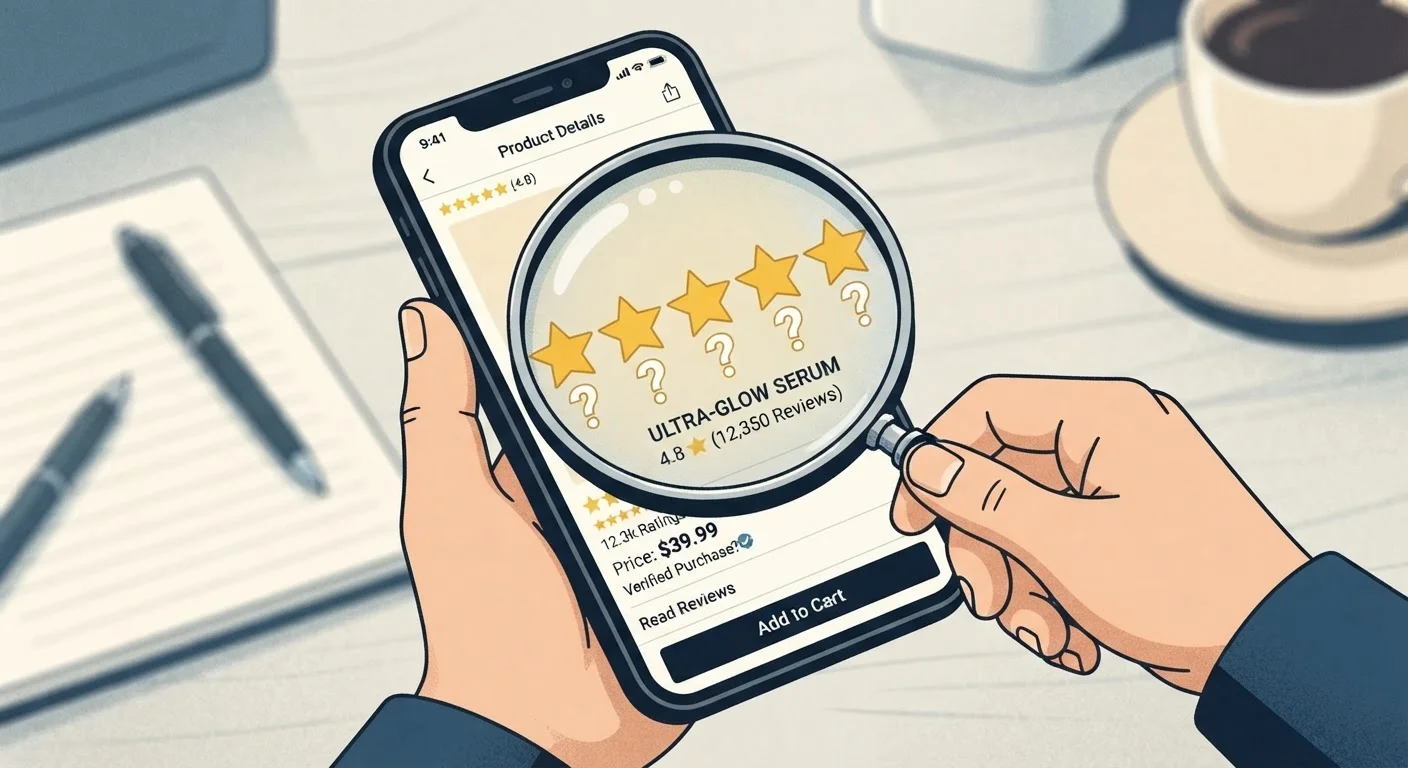
Review manipulation refers to any tactic that artificially inflates or distorts a product's online star rating, making it appear more popular or higher quality than genuine customer experience would support. Common tactics include paying customers for positive reviews, offering free products in exchange for ratings, and suppressing or flagging negative feedback. The result is a star score that measures marketing effort as much as — or more than — actual product quality.
Platforms use algorithmic filters to detect and remove suspicious reviews, but detection is imperfect. A product may display a 4.6-star average while a significant share of authentic reviews have been suppressed or buried.
What Star Ratings Were Designed to Do
Star rating systems were built on a simple idea: aggregate customer feedback into a single, digestible signal that helps shoppers make faster decisions. In theory, a 4.7-star product represents the collective experience of hundreds or thousands of buyers. In practice, the systems that generate those numbers are under constant pressure from sellers who have every financial incentive to push scores upward.
Understanding what a star rating actually measures — and what it doesn't — is one of the most useful skills a family can develop before spending money online. The number itself is a compressed average that strips out context, recency, and the circumstances under which each review was written. That compression is exactly where manipulation hides.
Platform Policies Are Constantly Evolving
Major retail platforms regularly update their policies around incentivized reviews and have removed millions of suspicious ratings in enforcement sweeps. However, detection remains imperfect, and manipulation tactics adapt quickly. Treating any single platform's average score as a static, reliable signal — rather than one data point among several — is a consistently safer approach for shoppers.
The Main Ways Ratings Get Distorted
Sellers use several well-documented tactics to inflate star scores without technically producing a quality product:
- Incentivized reviews: Offering discounts, free products, or cash in exchange for positive ratings. Even when disclosed, these reviews skew higher than organic ones.
- Review gating: Asking customers to leave a review only if they are satisfied, effectively filtering out negative voices before they reach the platform.
- Review clustering: Coordinating groups of buyers — sometimes through third-party services — to post positive reviews in a short window, rapidly lifting an average score.
- Listing hijacking: Attaching a new or lower-quality product to an existing listing with an established high rating, so the score carries over even though the product has changed.
These aren't hypothetical concerns. The FTC has taken enforcement actions against companies for undisclosed incentivized reviews, and major platforms have sued third-party sellers for coordinated manipulation schemes.
42%
Estimated fake reviews on major retail platforms
Analysis by Fakespot, a review-analysis service, has estimated that a substantial share of reviews on large e-commerce platforms show markers of inauthenticity, though figures vary by product category and methodology.
4–5x
Rating boost from incentivized vs. organic reviews
Research published in academic marketing journals has found that incentivized reviewers rate products significantly higher on average than customers who purchased without any compensation or inducement.
94%
Consumers influenced by online reviews
According to survey data from BrightLocal's annual consumer review report, the vast majority of consumers say online reviews affect their purchasing decisions — making rating integrity a significant consumer issue.
Reading a Rating More Carefully
Rather than accepting a star score at face value, treat the full review ecosystem as a data set worth examining:
- Check the rating distribution: A trustworthy product typically shows a natural spread — mostly 4s and 5s, a moderate number of 3s, and some 1s and 2s. An implausible spike of 5-star reviews with almost no middle-ground scores is a red flag.
- Read 1- and 2-star reviews first: Negative reviews tend to be more specific, more detailed, and harder to fabricate in bulk. They often describe exactly the failure mode you're trying to avoid.
- Look for specificity in positive reviews: Genuine buyers typically mention particular features, dimensions, or use cases. Vague praise like "great product, love it!" repeated across many reviews is a sign of coordinated posting.
- Check review recency: A sudden flood of 5-star reviews after a long quiet period often follows a seller-run campaign, not an organic improvement in product quality.
Sort by Most Critical Reviews First
Most platforms let you filter reviews by star level. Make a habit of reading 1- and 2-star reviews before 5-star ones. Critical reviews are harder to produce in bulk and tend to include specific failure details — dimensions, materials, timelines — that tell you far more about real-world performance than enthusiastic but vague praise.
Better Signals to Seek Out
Platform ratings are a starting point, not a destination. A few additional sources reliably deliver less gamed information:
- Independent testing organizations: Consumer-focused organizations that buy products anonymously and test them against standardized criteria are far harder to manipulate than open review platforms.
- Expert and editorial reviews: Category-specific publications often evaluate products in controlled conditions and disclose their testing methodology.
- Forum and community discussions: Niche communities (home improvement forums, parenting groups, outdoor enthusiast boards) surface real long-term experience with products, including failures that appear only after months of use.
Pairing platform reviews with even one of these sources significantly raises the quality of a purchase decision. For more on evaluating products when features don't align neatly, see our guide to comparing products with different feature sets. And when a label on the packaging makes a bold claim, decoding what those terms actually mean is worth the same skeptical lens you'd apply to star scores. Similarly, understanding where store-brand products match name brands can help you skip inflated-rating traps altogether in certain categories.