

Key Takeaways
Unregulated Label Claims
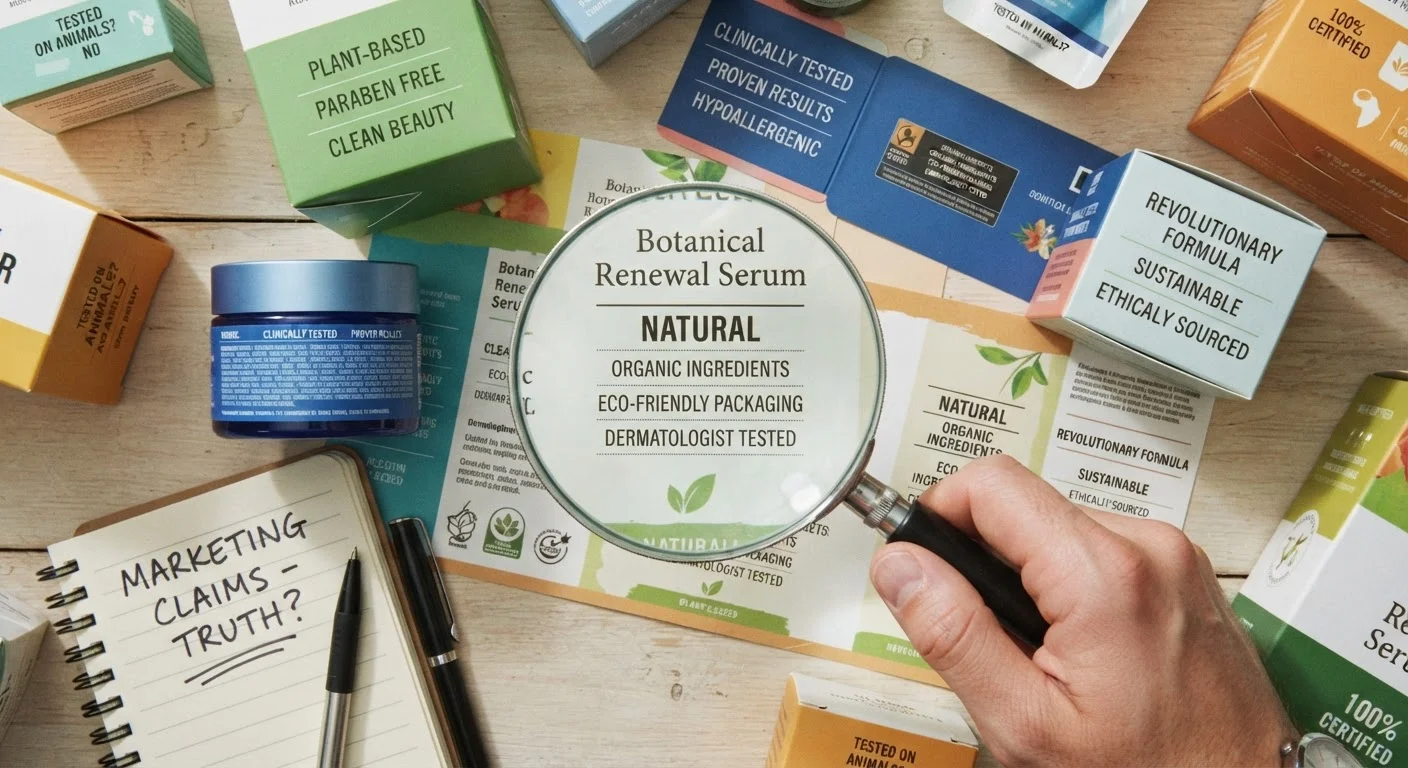
Unregulated label claims are marketing terms printed on product packaging that have no standardized legal definition enforced by a government body. This means a manufacturer can use words like 'natural,' 'eco-friendly,' or 'gentle' without meeting any specific criteria or third-party verification. Unlike terms such as 'USDA Organic' or 'FDA Approved,' these phrases are essentially self-declared.
The Federal Trade Commission (FTC) issues Green Guides that provide guidance on environmental marketing claims, but violations are addressed after the fact — not through pre-approval. The FDA regulates some labeling language on food and drugs but leaves many terms undefined.
Why Vague Label Terms Exist
Product packaging is prime marketing real estate, and manufacturers know that certain words — natural, clean, eco, gentle — trigger positive associations in shoppers. Because many of these terms are not legally defined, companies face little regulatory friction when using them. The result is a labeling landscape where language that sounds like a guarantee often functions as decoration.
This isn't a new problem. For decades, consumer advocates and regulators have flagged the gap between what shoppers assume these terms mean and what manufacturers are actually required to prove. Understanding that gap is the first line of defense for any household trying to spend wisely.
Regulated Terms Do Exist — Know Them
Some label terms are legally defined and enforced. 'USDA Organic' requires certification to documented federal standards. 'FDA Approved' (for drugs and some devices) means the agency reviewed evidence before market entry. 'Non-GMO Project Verified' involves third-party testing. When you see these specific phrases alongside recognized logos, the claim has teeth — unlike self-declared adjectives.
For a related example of how food packaging language can mislead families, see our look at sneaky nutrition pitfalls in kids' foods.
Breaking Down the Most Common Vague Terms
Natural
The FDA has not formally defined 'natural' for most consumer products. For packaged food, the agency has offered informal guidance suggesting the term means no artificial or synthetic ingredients were intentionally added — but this is not a binding rule. It also says nothing about how ingredients were grown, processed, or whether pesticides were used. A product can contain high-fructose corn syrup and still carry the word 'natural.'
Eco / Eco-Friendly / Green / Sustainable
These environmental terms are almost entirely unregulated when used on their own. The FTC's Green Guides discourage vague, unqualified environmental claims, but action is taken after the fact. A claim like 'eco-friendly packaging' with no supporting context — what percentage recycled content? certified by whom? — is essentially unverifiable by a consumer at the shelf.
Clinically Tested / Clinically Proven
'Clinically tested' is one of the most misunderstood label terms. It communicates only that a test involving people was run at some point. It does not specify the study size, whether the study was independent, what was being measured, or whether results were statistically significant. 'Clinically proven' is a stronger claim, but manufacturers can apply it liberally. Without a published, peer-reviewed study to reference, neither phrase guarantees efficacy.
Dermatologist Tested / Pediatrician Approved
Professional endorsement language sounds authoritative but is often minimally substantiated. 'Dermatologist tested' may mean one dermatologist reviewed the ingredient list. 'Pediatrician recommended' may reflect a sponsored survey of a small group. These claims are not meaningless, but they are far less rigorous than they appear.
42%
Of EU green claims found unverifiable or false
A 2021 European Commission screening of websites found that 42% of green claims were exaggerated, false, or deceptive — a pattern consumer researchers note is not unique to Europe.
0
Federal legal definitions for 'natural' on most labels
The FDA has not issued a formal regulatory definition of 'natural' for most consumer product categories, meaning the term is effectively self-policed by manufacturers.
1 in 3
Shoppers who assume 'natural' means no synthetic chemicals
Consumer surveys have consistently found a significant share of shoppers attribute stronger guarantees to the word 'natural' than any regulation requires.
What Actually Carries Weight: Third-Party Certifications
Not all label claims are equally hollow. The meaningful distinction is between self-declared claims — where a manufacturer writes its own language — and third-party certifications, where an independent organization verifies compliance with published criteria.
Certifications worth recognizing include USDA Organic (defined and enforced federal standards), ENERGY STAR (EPA-administered efficiency benchmarks), NSF International certifications (for water filtration and dietary supplements), and Forest Stewardship Council (FSC) for wood and paper products. These require documented processes and periodic auditing.
When shopping, look for a certification logo rather than just a marketing adjective. If you're unsure whether a certification is legitimate, you can usually search the certifying organization's website to verify whether a specific product is listed.
How to Quickly Verify a Certification
Most legitimate third-party certification organizations maintain searchable product databases on their websites. If a product displays a certification logo you don't recognize, search the certifier's name and confirm the product appears in their registry. This takes under a minute and immediately separates verified claims from imitation logos.
A Practical Framework for Label Skepticism
Developing a habit of label skepticism doesn't require expertise — it requires a short checklist you apply automatically.
- Front of pack vs. ingredients list: Front-of-pack language is marketing. The ingredients list is regulated and must accurately reflect what is inside. Start there.
- Specific vs. vague: 'Contains 30% post-consumer recycled materials, verified by XYZ' is specific. 'Eco-friendly' alone is not. Prefer claims that can be verified.
- Who funded the test? A study run by the product manufacturer and not independently replicated tells you far less than independent research. Ask whether published data is available.
- Certification logo present? A recognized third-party certification logo is the fastest signal that a claim was verified by someone other than the seller.
This framework applies across product categories — from cleaning supplies and personal care to pet food and packaged snacks. For more on how these same dynamics play out with online ratings, see our article on fake reviews and inflated star ratings.
Label literacy is one component of broader smart spending habits — knowing when packaging language is substance versus style keeps your household from paying a premium for nothing more than the word printed on the box.