

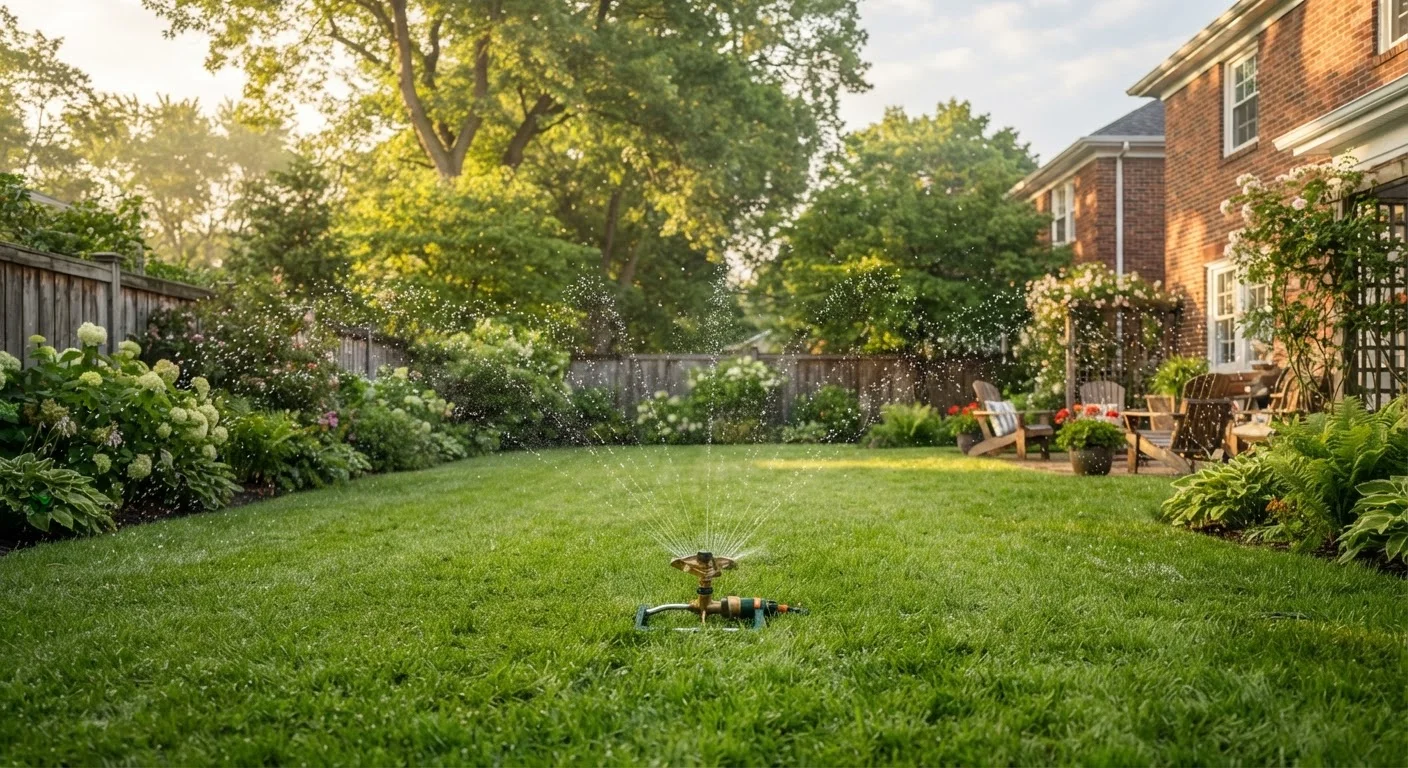
Why Seasonal Watering Adjustments Matter
Most lawn watering problems — brown patches, shallow roots, fungal disease, and wasted water — trace back to one misstep: using the same schedule year-round. Grass doesn't need the same amount of water in March as it does in July. Soil moisture, evaporation rates, daylight hours, and the grass's own growth cycle all shift with the seasons, and your irrigation routine needs to follow.
Whether you have a programmable sprinkler system or you're dragging a hose across the yard, adjusting your approach four times a year pays off in lower water bills and visibly healthier turf. The type of grass you have also matters — cool-season and warm-season varieties have opposite peak growth windows. See our guide on choosing the right grass type for your region for more on that.
Season-by-Season Watering Guide
Spring
As soil temperatures rise and grass breaks dormancy, moisture needs increase gradually. Most lawns benefit from about 1 inch of water per week, combining rainfall and irrigation. Water deeply 1–2 times per week rather than lightly every day — this encourages roots to grow downward instead of staying shallow near the surface. In early spring, natural rainfall often covers the full need; check before running your system.
Summer
Peak heat means peak demand. In hot, dry climates, lawns may need up to 1.5 inches per week. Water in the early morning — between 4 a.m. and 9 a.m. — to reduce evaporation and minimize the risk of fungal issues that develop when grass stays wet overnight. Avoid midday watering; most water evaporates before it reaches roots. If your lawn goes dormant during extreme heat, light watering every two to three weeks can keep roots alive without forcing unnatural growth. Brown patches during this period don't always mean thirst — see what different brown patch patterns actually mean before increasing water.
Fall
Cooler temperatures reduce evaporation, and many cool-season grasses enter their strongest growth phase. Taper watering frequency — once or twice per week is typically sufficient — but maintain depth. Fall is also an ideal time for aeration and overseeding, which pair well with consistent moisture. As soil cools and rainfall increases, gradually reduce irrigation. Stop watering roughly two weeks before your first expected frost. For a complete fall lawn checklist, refer to our fall yard prep guide.
Winter
In most northern climates, lawn irrigation stops entirely once grass goes dormant and ground freezes. In southern and transitional zones where winters are mild and some grass remains green, light watering every three to four weeks may be needed during dry spells. Shut off and drain irrigation systems before a hard freeze to prevent pipe damage — a task that often requires a licensed irrigation professional in colder regions.
Deep watering
Applying water slowly and for long enough that moisture penetrates 6 or more inches into the soil. This encourages grass roots to grow deeper, making the lawn more drought-resistant.
Dormancy
A natural survival state in which grass slows or stops growth to conserve energy during extreme heat or cold. Dormant grass often turns brown but is not necessarily dead.
Evapotranspiration (ET)
The combined loss of water from soil evaporation and plant transpiration. Irrigation systems and smart controllers use ET rates to estimate how much water a lawn needs on a given day.
Run-off
Water that flows off the lawn surface without being absorbed, often caused by watering too fast, on sloped ground, or on compacted soil. Run-off wastes water and can carry pollutants into storm drains.
Soil compaction
A condition in which soil particles are pressed too tightly together, reducing the pore space that allows water and air to reach grass roots. Compacted soil absorbs water poorly and often leads to run-off.
Practical Tips to Make Any Schedule Work
A schedule is only as good as the execution. A few habits make a meaningful difference:
- Use a rain gauge. A simple, inexpensive tool that tells you exactly how much water your lawn received from rainfall, so you can adjust accordingly.
- Apply the tuna-can test. Place empty cans around your yard during a watering cycle. When they collect about 1 inch, you've hit the target.
- Account for soil type. Sandy soils drain quickly and may need more frequent, lighter watering. Clay soils hold moisture longer but can become compacted and waterlogged.
- Upgrade to a smart controller. Wi-Fi-connected irrigation timers can automatically skip cycles after rain and adjust for local weather conditions — a practical way to avoid overwatering without constant manual oversight.
Watering efficiency also works hand-in-hand with overall lawn health. Compacted or thinning turf absorbs water poorly. Learn how aeration and overseeding restore water absorption, and check whether your irrigation system type is the right fit for your yard's layout. Getting the watering right is also part of a broader low-maintenance yard strategy — see our complete backyard landscaping guide for an end-to-end approach.
50%
Of residential irrigation water wasted
The U.S. Environmental Protection Agency estimates that about half of all residential irrigation water is lost to overwatering, evaporation, or run-off.
~9 billion gallons
Water used daily on U.S. landscapes
According to the EPA's WaterSense program, this daily total highlights the scale of potential conservation through smarter watering habits.
1 inch
Weekly water need for most lawns
Most turfgrass extension guidelines cite 1 inch per week — from rain and irrigation combined — as the general baseline for healthy cool- and warm-season grasses.