

Key Takeaways
Option A
Drip Irrigation
The targeted, water-efficient choice for garden beds and trees.
Best for: Vegetable gardens, raised beds, shrubs, and any planting area where precise root-zone watering matters.
Option B
Sprinkler Systems
The broad-coverage solution for lawns and open landscape areas.
Best for: Grass lawns, large ground-cover plantings, and landscapes where wide, even distribution is needed.
If you grow vegetables, herbs, or ornamental beds
Drip Irrigation
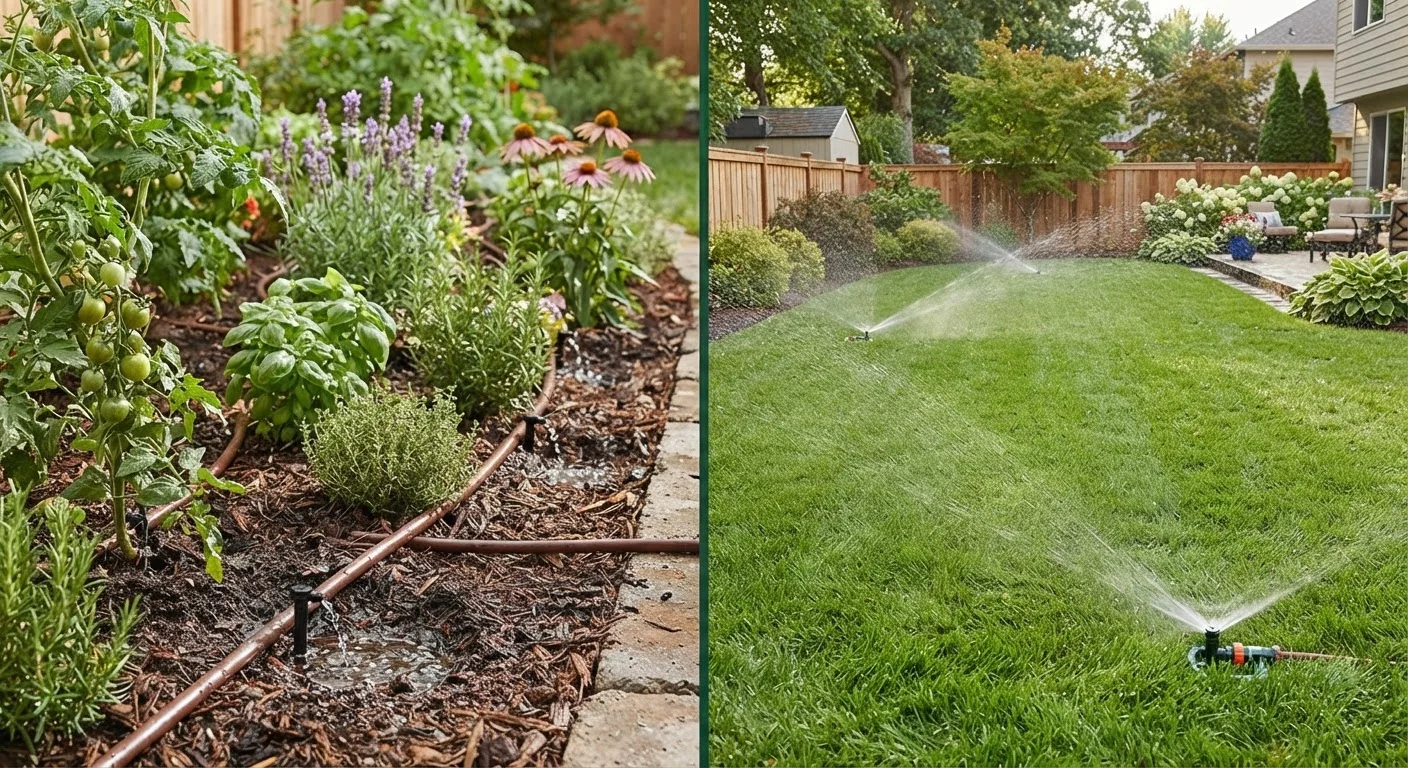
Drip emitters deliver water precisely where plants need it most, keeping foliage dry and reducing fungal disease risk in garden beds.
If you have a large grass lawn to maintain
Sprinkler Systems
Sprinklers distribute water evenly across wide turf areas in a fraction of the time — drip systems are not designed for lawn coverage.
If water conservation is a top priority
Drip Irrigation
Drip systems apply water slowly at the root zone, which can significantly cut water use compared to overhead spraying, especially in hot or windy conditions.
If you want minimal hands-on installation complexity
Sprinkler Systems
Pop-up sprinkler zones on a timer are a familiar, well-supported technology that many homeowners and irrigation professionals can install and service.
If your yard includes both lawn and planting beds
Drip Irrigation
A hybrid approach using drip for beds and sprinklers for turf is generally more efficient than running overhead spray across the entire yard.
How Each System Works
Understanding the mechanics of each approach helps you match the right system to your yard's actual needs.
Drip irrigation uses a network of flexible tubing and small emitters placed at or near soil level. Water seeps out slowly — typically at 0.5 to 2 gallons per hour per emitter — directly into the root zone of individual plants. Because water never touches leaves or open soil between plants, less is lost to evaporation and splash.
Sprinkler systems push water through pressurized pipes to rotating or fixed heads that broadcast water overhead in arcs or circles. They're designed to cover large, relatively uniform areas. Pop-up rotary heads are common in residential lawns; oscillating and impact sprinklers are simpler versions used with garden hoses.
The core difference is delivery: drip is a slow, targeted soak, while sprinklers provide a broad, aerial application. Your plant types, bed layout, and lawn size largely determine which suits you better. For broader yard planning context, see our complete backyard landscaping guide.
| Criterion | Drip Irrigation | Sprinkler Systems |
|---|---|---|
| Water delivery method | Slow drip at root level | Overhead spray or rotation |
| Best application | Garden beds, shrubs, trees | Lawns and large open areas |
| Water efficiency | High — minimal evaporation | Moderate — wind and heat losses |
| Typical DIY complexity | Low to moderate | Moderate to high |
| Upfront cost (small garden) | Lower | Higher for full-yard systems |
| Maintenance requirements | Emitter cleaning, tubing checks | Head leveling, winterization |
| Foliage wetness risk | Minimal | Higher with overhead spray |
| Weed suppression effect | Moderate — dry soil between plants | Low — broad wetting encourages weeds |
Cost, Installation, and Upkeep
Both systems range from simple DIY setups to complex professional installs, and costs vary accordingly.
Drip irrigation starter kits for a small garden bed are relatively inexpensive and widely available. Expanding a drip system is modular — you add tubing, emitters, and splitters as your garden grows. The trade-off is that small emitters can clog, especially with hard water, and tubing exposed to sunlight degrades over time. Flushing emitters seasonally and replacing UV-damaged tubing every few years is part of the maintenance picture.
Sprinkler systems for a full yard require trenching, a backflow preventer (required by code in most US municipalities), zone valves, and often a professional install. Labor and materials for a whole-yard system can run several thousand dollars depending on yard size and local labor rates. Once in place, though, a well-designed system is durable. Heads occasionally need leveling or replacement, and winterization — blowing out lines before a hard freeze — is essential in cold climates.
30–50%
Potential water savings with drip vs. overhead
The US Environmental Protection Agency has noted that drip irrigation can use significantly less water than conventional sprinkler watering when properly designed and managed.
~50%
Outdoor water use from irrigation in US homes
According to the EPA's WaterSense program, roughly half of residential outdoor water use goes to landscape irrigation, much of which is applied inefficiently.
If you're also thinking about how mulch can extend the efficiency gains from drip irrigation, our guide to mulch types explains how to layer the two strategies for best results.
Efficiency, Coverage, and Plant Suitability
Neither system is universally superior — they excel in different scenarios.
Drip irrigation is well-suited to rows or clusters of individual plants: vegetable gardens, shrub borders, fruit trees, and raised beds and in-ground plots. Because water goes directly to roots, weeds between plants receive less moisture, which can reduce germination of weed seeds. Drip also works well in sloped areas where runoff is a concern, since water is applied slowly enough for the soil to absorb it.
Sprinklers shine on lawns and large plantings of ground cover or similar-height plants. They can refresh a large turf area in 20–30 minutes — something a drip system simply isn't configured to do. The downside: overhead watering leaves foliage wet, which can promote fungal diseases in some plants, and timing matters. Watering in the evening extends leaf wetness overnight; early morning watering is generally preferable.
Regardless of which system you choose, scheduling is one of the most impactful variables. Our seasonal lawn watering schedule guide outlines how to adjust run times across spring, summer, fall, and winter so you're not overwatering or leaving plants short.
Check Local Water Restrictions First
Many US municipalities impose seasonal watering restrictions — specific days, time windows, or total duration limits — that apply regardless of which system you use. Before investing in either setup, check with your local water utility or municipal website for current rules. Permitted watering hours (often early morning) also align well with best irrigation practices, so restrictions and good habits tend to reinforce each other.