

Key Takeaways
Room Zoning
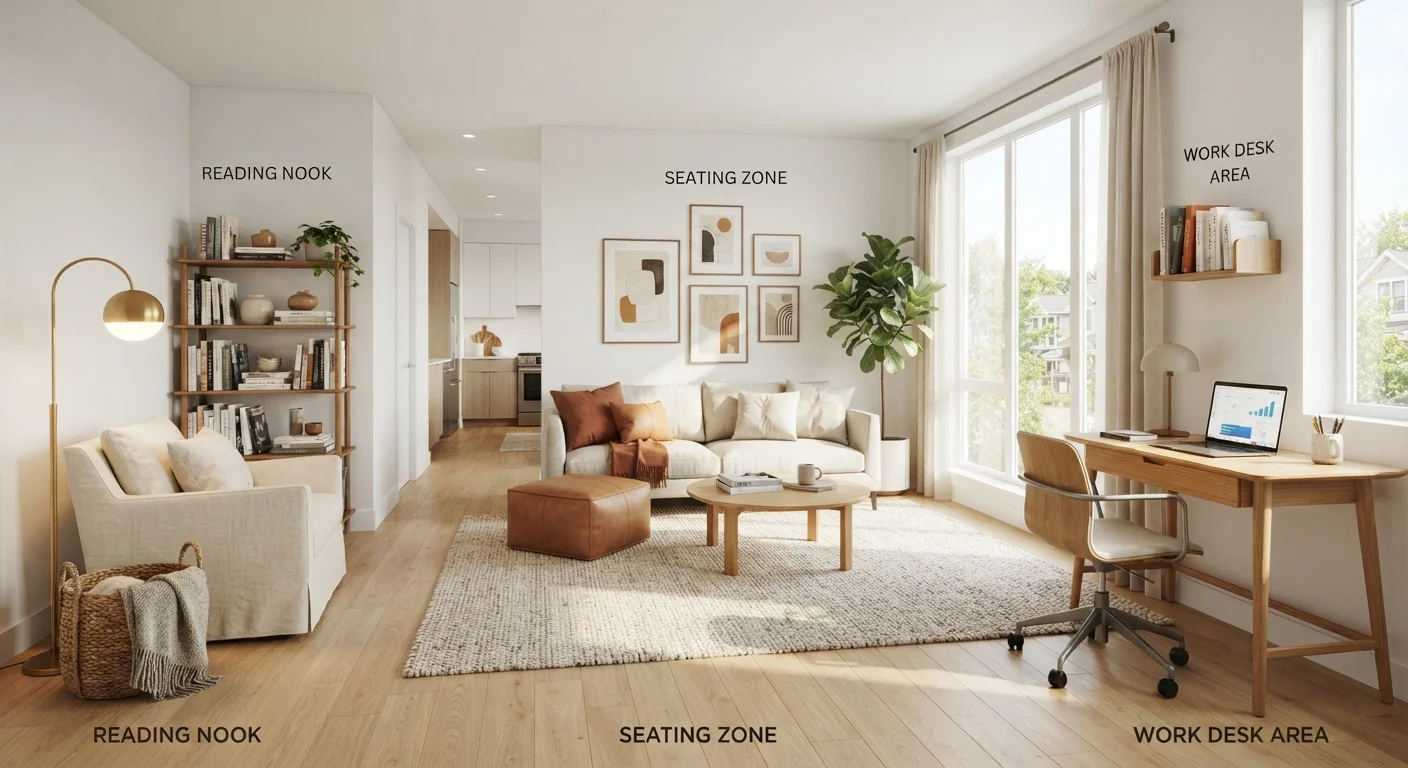
Room zoning means deliberately dividing a room into smaller areas, each assigned a specific purpose or activity. Instead of treating a room as one open space where everything happens everywhere, zoning creates clear boundaries — physical or visual — that tell you and your family where each task belongs. The result is a room that's easier to keep organized because everything has a designated home.
In interior design, zones are often defined through furniture arrangement, area rugs, lighting, and color rather than walls, making the concept applicable to open-plan layouts as well as traditionally divided rooms.
Why Zoning Solves Problems That Tidying Alone Cannot
Most household clutter isn't caused by owning too much — it's caused by things having no clear home. When a room serves multiple purposes without defined areas, items drift wherever they land: homework spreads across the dining table, toys migrate to the living room, and charging cables colonize the kitchen counter. Tidying feels endless because nothing has a permanent place to return to.
Zoning breaks this cycle by giving every activity its own space. Once a zone exists, the question shifts from "where should I put this?" to "which zone does this belong in?" That's a much easier question for every member of a household to answer consistently.
This is also why zoning is a foundational step in any whole-home organization approach. Our complete guide to organizing a family home treats zoning as a first principle before recommending any storage product or furniture solution.
1 in 4
US households with a two-car garage that can't fit a car
The U.S. Department of Energy has noted that garage storage overflow is widespread, with a significant share of garages used primarily for storage rather than vehicles.
~40%
Of time spent looking for misplaced items at home
Research on household productivity consistently finds that searching for misplaced objects is among the most common daily time drains for families.
How to Define Zones Without Demolishing Anything
You don't need to move walls to create meaningful room zones. Four tools do most of the work:
- Furniture placement: The back of a sofa facing a certain direction effectively creates a boundary. Bookshelves positioned perpendicular to a wall divide a room without closing it off.
- Area rugs: A rug anchors a seating group or a play area visually, signaling that this patch of floor is designated for a specific activity.
- Lighting: A pendant lamp over a reading chair, or a task lamp on a desk, communicates purpose. Different light levels across a room naturally separate zones.
- Color and texture: Painting one wall a different shade, or hanging a curtain, marks the beginning and end of a zone without construction.
If your home has an open floor plan, defining zones becomes especially important — and particularly achievable with these methods. Our article on opening up a floor plan covers how open layouts change the way rooms function, which pairs directly with zoning strategy.
Start With How the Room Is Actually Used
Before moving any furniture, spend a few days observing where activities naturally happen in the room. If kids always do puzzles in one corner, that's where your play zone probably belongs. Zones work best when they align with existing behavior rather than fight against it.
Room-by-Room Zoning Ideas for Families
Zoning looks different depending on who uses the room and how. Here are practical starting points:
Kitchen
Define a prep zone near the cutting board and knives, a cooking zone at the stove, and a landing zone near the sink for dishes coming off the table. Keep countertops clear of anything that doesn't belong to those three zones.
Living Room
Separate a media or entertainment zone from a conversation area, and if space allows, carve out a reading nook with a single chair and a small side table. Families with young children often add a contained play zone anchored by a rug and a toy bin.
Kids' Bedroom or Playroom
Distinguish a sleep area, a creative or art zone, and a building or active play zone. Clear zones help children understand where toys belong and make cleanup more concrete: "put the art supplies back in the art zone."
Home Office
Even a desk in a bedroom benefits from a defined work zone that stops at the edge of the desk mat. Keeping work materials physically contained helps mentally separate work time from rest time.
Our room-by-room organization checklist walks through each space in more detail, including often-overlooked areas like entryways and garages.
Making Zones Stick for the Whole Household
A zone only works if everyone uses it. The most common reason zoning fails is that it's set up by one person and not communicated to the rest of the household. A few practices help zones become habits:
- Label generously at first. A simple label on a basket or shelf removes ambiguity. Labels can come down once the habit forms.
- Start with one room. Attempting to zone an entire house at once is overwhelming. Pick the room causing the most daily friction and establish zones there first.
- Adjust without guilt. If a zone isn't working — if items keep ending up somewhere else — that's information. The zone's location or size may need to change.
- Involve everyone. When family members help decide what goes where, they're more invested in maintaining it. This is especially true for children and for households where people have different organizational instincts — a dynamic explored in our article on organizing shared spaces when family members disagree.
Zones are not permanent fixtures. As children grow, as work situations change, and as hobbies evolve, the purpose of a room shifts. Revisit your zones once or twice a year and adjust them to reflect how your family actually lives now — not how you lived two years ago.