

Key Takeaways
Start with a Home Audit
Before purchasing a single bin or shelf, walk through every room with a notepad and document what's working and what isn't. This audit reveals where clutter actually accumulates — often different from where you assume it does. Note the number of people using each space, what items need daily access, and what can reasonably be stored out of reach.
Group your findings into three categories: keep and organize, relocate, and donate or discard. Tackling excess before organizing prevents you from building elaborate systems around things you don't need. Families who skip this step frequently find they've reorganized clutter rather than eliminated it.
Pair this audit with a realistic budget. Thoughtful smart spending on home organization means investing in durable, flexible solutions rather than trendy products that won't suit your family's actual habits. For broader household financial planning, see The Complete Household Budgeting Guide for US Families.
Audit Before You Shop
Resist the urge to browse storage products before completing your audit. Shopping without a specific problem to solve leads to bins and baskets that don't fit your spaces or needs. Write down exact dimensions and use cases before purchasing anything.
Entryways and Mudrooms
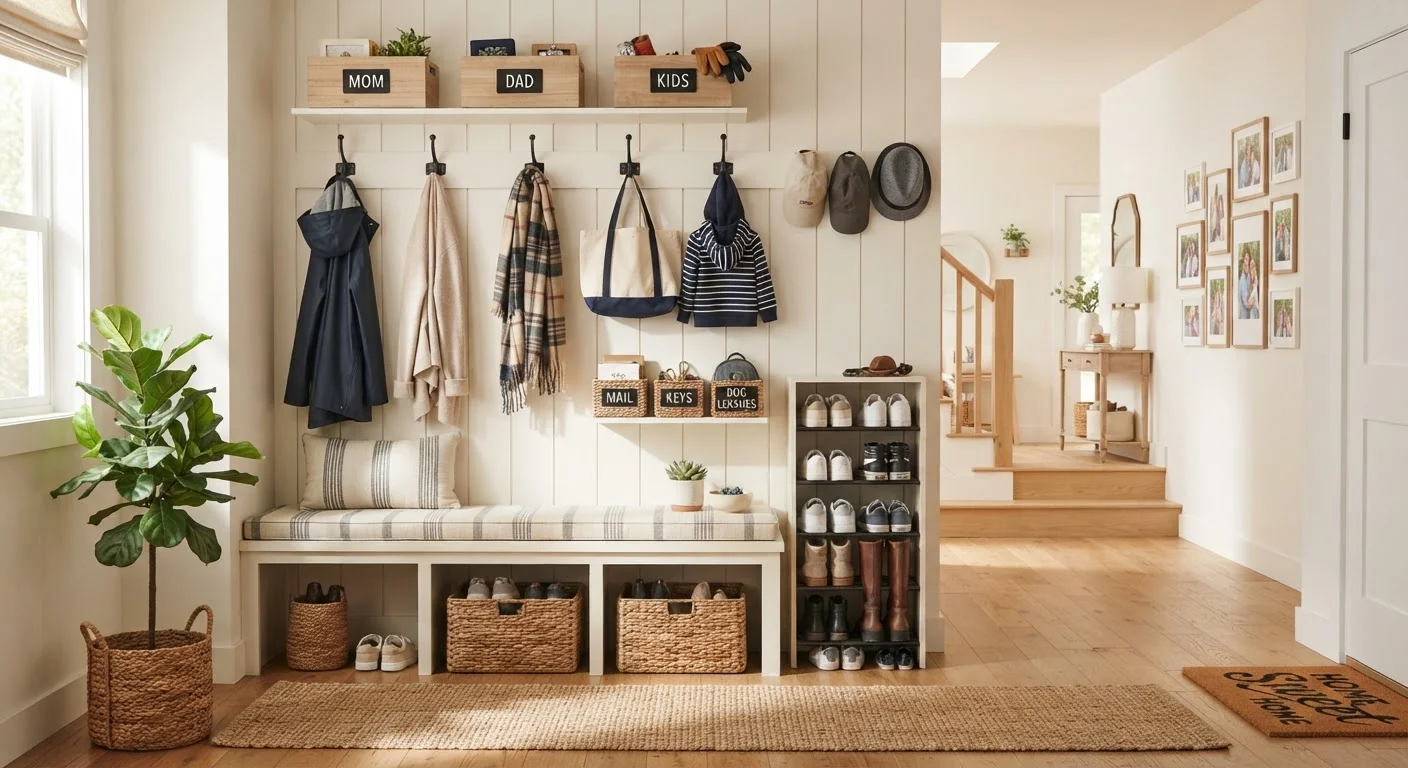
The entryway is the first point of contact between the outside world and your home's interior — and the most common drop zone for bags, shoes, mail, and jackets. A functional entryway system prevents this chaos from spreading.
Install hooks at two heights: adult level and child level. This small adjustment dramatically increases the chance that every family member will actually hang up their own gear. Add a bench with under-seat storage for shoes, and a small basket or tray specifically for mail and keys. If your space allows a mudroom, divide it into individual cubbies — one per family member — with a labeled hook, shelf, and basket for each person.
Install a small wall-mounted charging station near the entryway to prevent phones and tablets from migrating to counters, tables, and sofas throughout the house.
Devices left in random locations are a leading source of household clutter and contribute to the habit of leaving other items wherever feels convenient. A fixed charging spot creates a behavioral anchor.
Use the back of closet and cabinet doors for additional storage — over-door organizers, hooks, and mounted racks turn unused vertical space into functional storage without taking up any floor or shelf space.
The back of a standard door offers several square feet of usable space that most households never utilize, making it one of the highest-return organizational moves in any room.
For homes without a dedicated mudroom, a narrow console table with baskets underneath and hooks above does the same job in a hallway. The goal is to intercept clutter before it travels deeper into the home.
Kitchen and Pantry Organization
Kitchens serve triple duty as meal prep spaces, homework hubs, and family gathering spots. Start with the pantry: group food by category (grains, canned goods, snacks, baking supplies) and store the most frequently used items at eye level. Clear, stackable containers for dry goods such as pasta, rice, and cereal allow you to see quantities at a glance and reduce duplicate purchases.
Inside cabinets, use drawer dividers for utensils, turntables (lazy Susans) for deep shelves, and vertical dividers for baking sheets and cutting boards. Reserve one low drawer or shelf for kids' dishes and snacks so children can help themselves independently — this reduces parental interruptions during busy mornings.
80%
Of household clutter is disorganized, not excess
Professional organizers commonly report that most household clutter stems from a lack of designated homes for items rather than having too many possessions outright.
30 min
Average time families spend searching for lost items weekly
Research from household productivity studies suggests families lose meaningful time each week locating misplaced everyday objects such as keys, schoolwork, and remote controls.
Countertop space is premium real estate. Keep only what you use daily on the counter; everything else earns a cabinet spot. Reducing visual clutter in the kitchen has a measurable effect on mealtime stress, according to environmental psychology research.
Kids' Rooms and Playspaces
Children's spaces require organization systems that kids can actually maintain themselves. The most common mistake parents make is placing storage too high or making it too complex. Low, open shelving; labeled bins with pictures alongside words for pre-readers; and toy rotation systems all reduce overwhelm for both children and adults.
Apply the one-in, one-out rule consistently: when a new toy or book enters the room, one leaves. Involve children in this process rather than purging without them — it builds decision-making skills and reduces resistance. Divide the room into activity zones (reading corner, building area, art station) so each type of play has a natural home.
For shared rooms, vertical storage is your best ally. Loft beds with shelving underneath, stackable bins, and wall-mounted organizers maximize floor space for play while keeping belongings separated by child.
Avoid Overloading Wall-Mounted Shelves
In children's rooms, wall-mounted shelves must be anchored into studs — not just drywall — to safely hold the weight of books or bins. Always verify stud locations with a stud finder before installation, and follow the weight limits specified by the manufacturer. If you're unsure, consult a handyman or contractor.
Attics, Basements, and Garages
These utility spaces tend to become the household's default dumping ground. The key to keeping them functional is a clear categorical system: seasonal items, sports equipment, holiday décor, tools, and long-term keepsakes each deserve a dedicated zone with labeled shelving.
Temperature and humidity matter enormously in these spaces. Avoid storing photographs, documents, wood furniture, or electronics in unconditioned attics or damp basements. Use sealed plastic bins rather than cardboard for anything stored long-term in a garage or basement, and elevate items off a concrete floor to prevent moisture damage.
For garages specifically, wall-mounted pegboards and ceiling-hung storage racks for bicycles and seasonal gear keep floor space clear. Mark a clear boundary between the car's parking area and the storage zone — this prevents gradual encroachment that eventually leaves no room for the vehicle. Speaking of vehicles, an organized garage pairs well with a proactive approach to car care; see The Complete Family Car Maintenance Playbook for a full maintenance framework.
Building Habits That Stick
Systems only work if they're used consistently. The most elegantly organized home will revert to chaos within weeks without supportive daily habits. Focus on three routines: a 10-minute evening reset where the whole family returns items to their designated spots; a weekly 20-minute tidy targeting hotspot areas; and a seasonal purge every three to four months.
Assign age-appropriate tasks to each child and rotate them so no one feels stuck with the least favorite jobs. Visual checklists posted inside cabinet doors or on the refrigerator help younger children remember their responsibilities without adult prompting.
Organization also extends to planning. Families who maintain tidy, well-stocked homes often find trip preparation — from packing to locating gear — far less stressful. For families ready to put that efficiency to work, The Complete Guide to Planning a Family Vacation offers a practical framework for stress-free travel prep. Likewise, an organized outdoor space complements indoor order; explore backyard landscaping guidance for ideas on extending your organized home to the yard.
Organizing Is an Ongoing Process
Family needs change constantly — new hobbies, school supplies, seasonal gear, and growth spurts all shift storage requirements. Plan to revisit and adjust your systems at least once a year rather than expecting a single setup to work indefinitely. Flexibility is a feature, not a failure.