

| Common residential statutory limit | 25 mph (varies by state) |
| Minimum following distance (dry conditions) | 3 seconds (NHTSA general guidance) |
| Recommended following distance (wet/icy roads) | 4-6+ seconds |
| School zone penalties | Fines often doubled; vary by state |
| Move-over law coverage | All 50 US states |
| Pedestrian right-of-way | Required at all marked and most unmarked crosswalks (Most US state vehicle codes) |
Speed Limits: What the Numbers Actually Mean
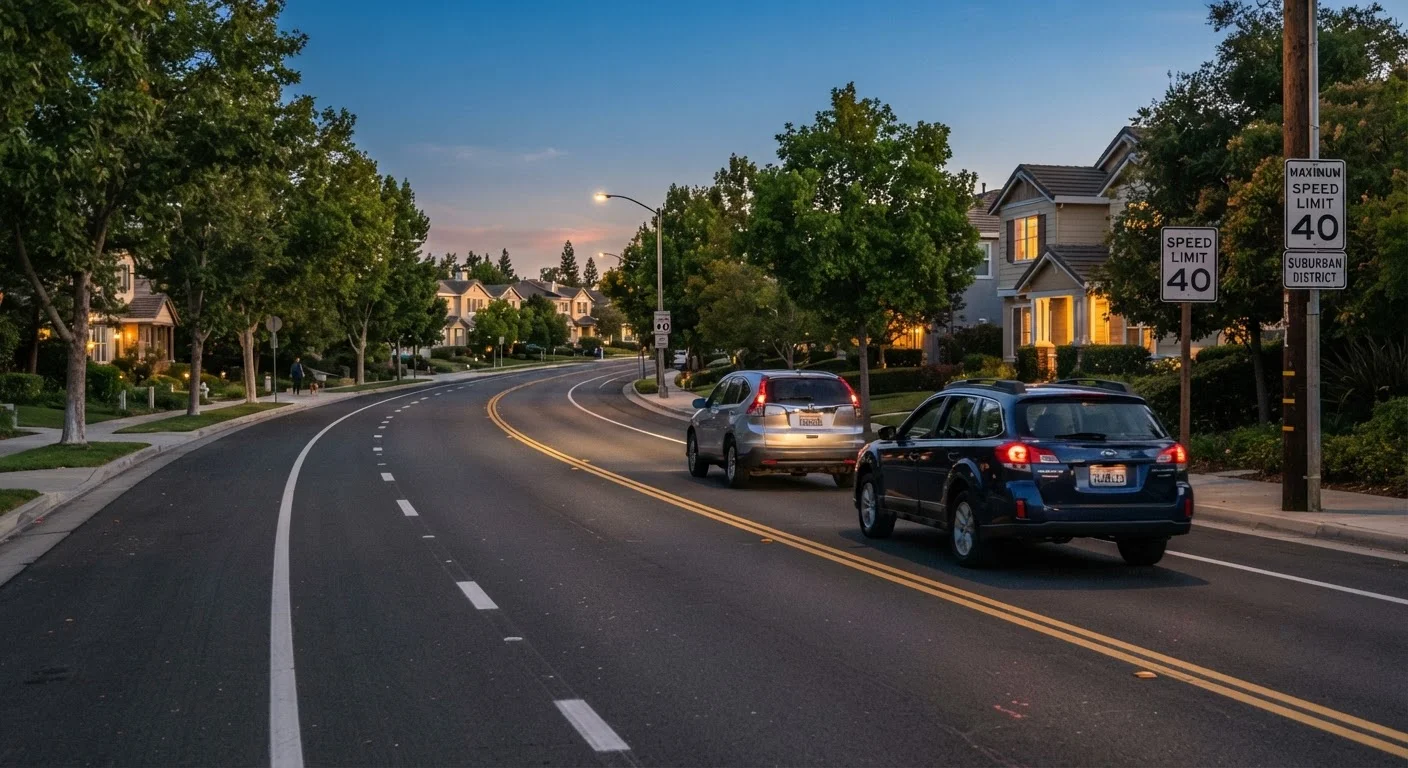
Speed limits are legal maximums - not targets. A posted limit of 35 mph means you must not exceed that speed, but driving conditions may require you to travel well below it. Rain, snow, heavy traffic, reduced visibility, and road construction all call for speeds lower than the posted limit. Driving too fast for conditions is a separate violation from speeding in many states, even when you're within the posted number.
There are three main categories of speed limits families encounter:
- Statutory limits: Set by state law for road types when no sign is posted (e.g., 25 mph in residential areas, 65-70 mph on rural interstates - these vary by state).
- Posted limits: The signed maximums specific to a stretch of road, established based on traffic studies and road design.
- Advisory speeds: Yellow signs indicating a recommended safe speed for a curve or ramp - not a legal limit, but a meaningful safety caution.
School zones and construction zones typically carry reduced limits with increased penalties for violations. Always watch for temporary signage, as these limits take effect even when workers are not present in some states.
| Common residential statutory limit | 25 mph (varies by state) |
| Minimum following distance (dry conditions) | 3 seconds (NHTSA general guidance) |
| Recommended following distance (wet/icy roads) | 4-6+ seconds |
| School zone penalties | Fines often doubled; vary by state |
| Move-over law coverage | All 50 US states |
| Pedestrian right-of-way | Required at all marked and most unmarked crosswalks (Most US state vehicle codes) |
Following Distance: The Three-Second Rule and When to Extend It
Following distance is the space between your vehicle and the one ahead. Too little space leaves no room to react. The widely taught three-second rule gives you a practical baseline: when the vehicle ahead passes a fixed object (a sign, a shadow line), count three full seconds. If you pass the same point before you finish counting, you're following too closely.
Three seconds is a minimum under ideal conditions. Several situations require you to extend that buffer:
- Wet or icy roads: Braking distances increase significantly. Four to six seconds - or more - is appropriate on slick surfaces. See our guide to stopping distances for the physics behind this.
- Large vehicles: Trucks and SUVs take longer to stop. Add at least one second when following them, and increase your space if you're driving a heavier vehicle yourself.
- Night driving or low visibility: Your reaction time and the distance you can see ahead are both reduced. Increase following distance accordingly.
- Distracted or fatigued driving: If you or your passengers are creating demands on your attention, more space creates more forgiveness.
Tailgating is a leading contributor to rear-end collisions - one of the most common crash types on US roads. For families driving with young children, in-car distractions make disciplined following distance even more important.
Statutory speed limit
A default speed limit set by state law that applies when no sign is posted. Values differ by road type and state - for example, 25 mph is common in residential areas.
Advisory speed
A recommended (not legally required) speed shown on yellow signs, typically for curves, ramps, or hazardous areas. Ignoring them substantially increases crash risk.
Following distance
The gap between your vehicle and the vehicle ahead. Measured in time (seconds) rather than car lengths, because time accounts for both speed and reaction delay.
Right-of-way
The legal priority granted to one driver, cyclist, or pedestrian to proceed before others in a given situation. It is granted by law, not claimed by force.
Move-over law
State laws requiring drivers to change lanes or reduce speed when passing stopped emergency, law enforcement, or roadside assistance vehicles. All 50 US states have some version of this law.
Reaction distance
The distance your vehicle travels between the moment you perceive a hazard and the moment you actually begin to brake. At higher speeds, this distance increases substantially.
Right-of-Way: Who Goes First and Why It Matters
Right-of-way rules establish who has the legal priority to proceed at intersections, merges, and other conflict points. Critically, having the right of way does not mean the other driver will yield - defensive driving means being prepared to yield even when you're technically entitled to go.
Key right-of-way situations
- Four-way stops
- The first vehicle to stop is the first to go. When two vehicles arrive simultaneously, the driver on the left yields to the driver on the right. Our companion piece on four-way stops and roundabouts walks through the full logic.
- Uncontrolled intersections
- Yield to vehicles already in the intersection, then to any vehicle on your right.
- Highway on-ramps
- Merging traffic must yield to vehicles already on the highway - the through lane has right of way. However, courteous and safe highway driving often involves highway drivers adjusting speed to assist merging. See our guide to highway merging for practical technique.
- Emergency vehicles
- Pull to the right and stop when any emergency vehicle approaches with lights or sirens active, regardless of direction. Move-over laws also require drivers to change lanes or slow down near stopped emergency vehicles - rules vary by state.
- Pedestrians and cyclists
- Pedestrians have right of way in marked crosswalks and, in most states, unmarked crosswalks at intersections. Cyclists have rights equivalent to vehicles on most roads.
Teaching these rules to teen drivers - not just for the test, but as daily habits - significantly reduces crash risk. Our resource on teaching a teen to drive covers how to build these instincts through deliberate practice.
~29%
Of traffic fatalities linked to speeding
According to NHTSA data, speeding is consistently implicated in roughly 29% of annual traffic deaths in the United States.
1 in 3
Crashes involve rear-end collisions
Rear-end crashes are among the most frequent collision types on US roads, with insufficient following distance as a primary contributing factor.