

Key Takeaways
Right-of-Way
Right-of-way is the legal and practical priority one driver, cyclist, or pedestrian has to proceed through a given point before others. It is not an absolute personal right - it's a shared agreement that keeps traffic moving safely. Traffic control devices like stop signs, yield signs, and roundabout markings communicate who holds right-of-way at any given moment.
Right-of-way rules are established by state vehicle codes; while the core principles are consistent across the US, minor variations exist between states. Always defer to posted signage and local law.
Why Intersection Rules Trip Up Even Experienced Drivers
Most drivers passed a written test covering intersection rules years or even decades ago. Day-to-day driving reinforces some habits and quietly erodes others. The result is that roundabouts, four-way stops, and yield signs - three of the most common intersection controls on American roads - are regularly misread, even by drivers with clean records.
The consequences range from awkward hesitation to serious collisions. Understanding the logic behind each control, not just memorizing the rule, helps drivers respond correctly even in unfamiliar situations. If you're teaching a new teen driver, these distinctions deserve deliberate practice before they become habit.
40%
Of all US traffic crashes occur at intersections
According to the Federal Highway Administration, roughly 40 percent of all crashes in the United States involve intersections, making them the most common crash location.
~50%
Reduction in injury crashes at roundabout conversions
The Insurance Institute for Highway Safety has found that converting traditional intersections to roundabouts reduces injury crashes by approximately 50 percent on average.
Four-Way Stops: The Order of Operations
An all-way stop - where every approach has a stop sign - works on a simple queue system with a tiebreaker rule built in.
- First to arrive, first to go. The vehicle that reaches the intersection and comes to a complete stop first has the right-of-way. Each subsequent vehicle goes in the order it stopped.
- Simultaneous arrival: yield to the right. When two vehicles stop at the same time, the one on the left yields to the one on the right.
- Facing each other with different intentions. If two vehicles arrive at the same time from opposite directions, the driver turning left yields to the driver going straight or turning right.
The most common error at four-way stops is rolling slowly through without actually stopping - which resets your place in the queue and creates unpredictability for other drivers. A full stop, wheels stationary, is required by law. For a broader look at everyday rules that drivers frequently misapply, see this family driver's reference on speed limits, following distance, and right-of-way.
Count to Two After Stopping
At any stop sign - all-way or not - a common technique is to count silently to two after your wheels stop moving before scanning and proceeding. This brief pause ensures you've genuinely stopped (not just slowed), gives you time to assess the intersection, and signals your intent clearly to other drivers.
Roundabouts: Yield Before You Enter, Then Flow
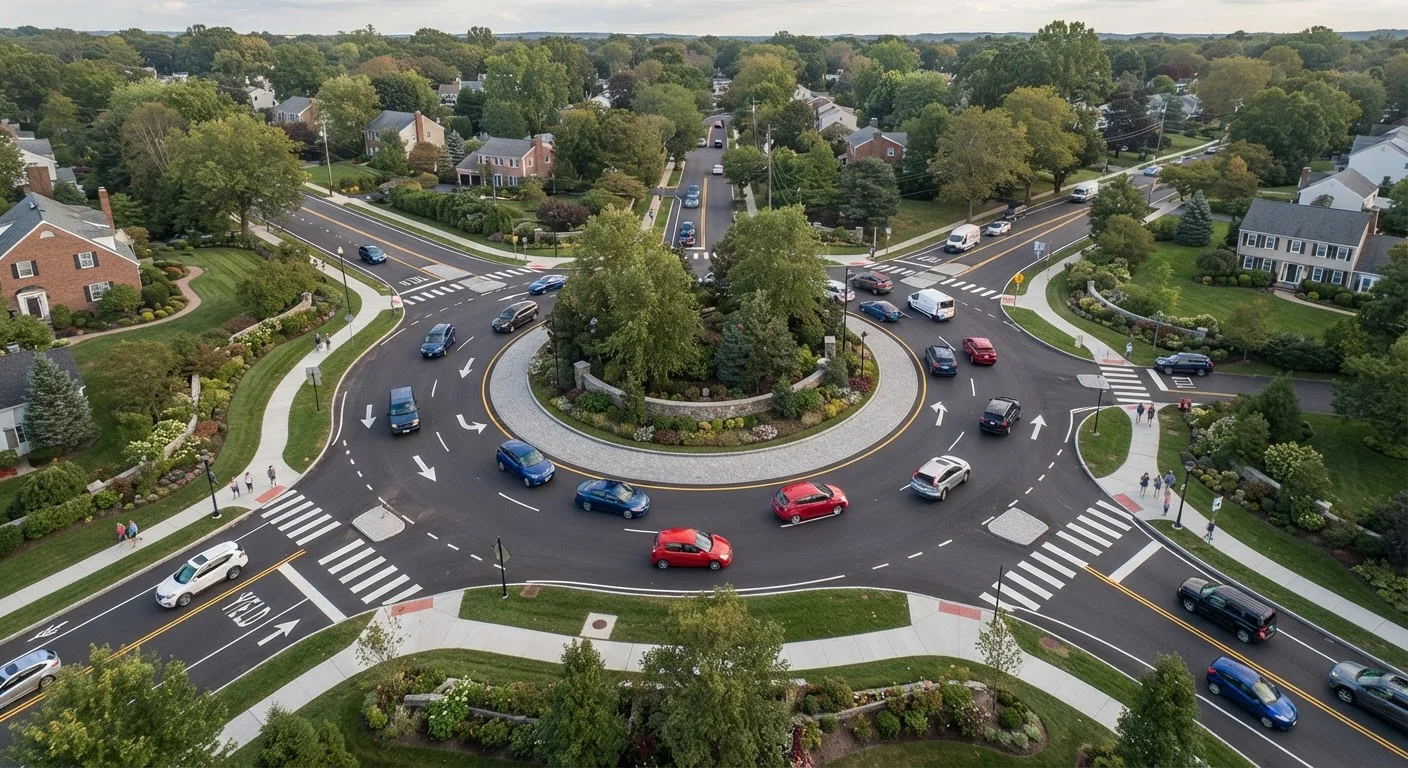
Roundabouts eliminate the most dangerous type of intersection conflict - high-speed perpendicular collisions - by routing all traffic in the same direction around a central island. The single governing rule is straightforward: vehicles already circulating inside the roundabout have the right-of-way. Entering drivers must yield.
Practical steps for navigating a roundabout correctly:
- Slow as you approach and watch for the yield line at the entry.
- Check for vehicles in the circle to your left. If any are present, wait for a safe gap.
- Enter when the flow is clear, select your lane based on your intended exit (in multi-lane roundabouts, right lane for the first or second exit, left lane for exits further around).
- Signal your exit and yield to pedestrians in the crosswalk on the exit leg.
Roundabouts can feel counterintuitive at first because they remove the familiar stop-and-go rhythm of traffic lights. The learning curve is short, and the safety record is strong - but only when drivers resist the urge to enter without yielding. Roundabout skills also tie into the broader discipline of merging confidently into moving traffic.
Yield Signs: A Conditional Pause, Not a Suggestion
A yield sign is often misread as optional - it is not. It is a legal instruction to give right-of-way to any conflicting vehicle or pedestrian before you proceed. The distinction from a stop sign is that a full stop is only required if traffic is present and a gap does not exist. If the road is clear, you may continue at reduced speed.
Yield situations arise in several common places beyond the standard triangular sign:
- Freeway on-ramps: Merging drivers must match speed and find a gap in highway traffic - the highway has priority. See how to merge correctly on the highway for a deeper explanation.
- Uncontrolled T-intersections: The driver on the terminating road typically yields to cross traffic.
- Left turns across oncoming traffic: Even without a yield sign posted, a driver completing a left turn must yield to any oncoming vehicle or pedestrian.
Yield vs. Merge: An Important Distinction
Yielding and merging are related but distinct actions. Yielding means giving right-of-way to conflicting traffic before you enter a shared space. Merging refers to blending into a lane of moving traffic, typically on a highway. On most US on-ramps, you are legally required to yield - meaning the merging vehicle does not have priority over the through lane.
The key mindset shift with yield signs is to treat them as a scanning requirement rather than a formality. Approach with speed reduced, eyes scanning the conflict zone, and be genuinely prepared to stop - not just slow down.
Building Better Intersection Habits for the Whole Family
Correct right-of-way behavior is as much about communication as it is about rules. Clear signals - turn indicators used early, controlled braking, and eye contact at ambiguous stops - reduce the guesswork that leads to conflict. Avoid the twin traps of being overly aggressive (pushing through before it's your turn) and overly passive (waving others through when you have clear priority, creating confusion).
For families with newer drivers in the household, intersection scenarios are worth rehearsing in low-traffic conditions before tackling busy roads. Parents often underestimate how much deliberate practice teen drivers need in exactly these situations. Reinforcing the logic - not just the rule - builds judgment that holds up under pressure.
Consistent intersection habits also complement attention to other road skills. Staying alert at night, for example, is covered in our guide on night driving hazards for family drivers.