

Key Takeaways
Why Supervised Hours Don't Always Equal Readiness
Most states require 40 to 50 hours of supervised driving before a teen can test for an independent license. Parents often treat this as a checkbox - accumulate the hours, pass the test, done. But research from the National Safety Council and highway safety organizations consistently shows that crash risk for 16- and 17-year-olds is disproportionately high, not because teens lack hours, but because those hours tend to cluster in low-demand conditions: daylight, familiar roads, dry weather, low traffic.
The gap isn't time - it's deliberate exposure. A teen who has driven 45 hours mostly on the same neighborhood streets and school route may be less prepared than one who has logged 25 hours across genuinely varied scenarios. This distinction matters, because crashes don't happen on familiar roads in perfect conditions. They happen at night, in rain, on highways, in moments of unexpected complexity.
3x
Teen crash risk vs. experienced drivers per mile driven
According to the Insurance Institute for Highway Safety, the crash rate per mile driven for 16-19-year-olds is roughly three times that of drivers aged 20 and older.
52%
Teen fatal crashes occurring at night or in low-light
The National Highway Traffic Safety Administration has documented that a disproportionate share of teen driver fatalities occur during nighttime hours, despite teens driving less after dark overall.
High-Risk Scenarios Parents Most Often Skip
The following conditions account for a disproportionate share of teen crashes, yet they're routinely skipped during parent-supervised practice:
- Night driving: Visibility is reduced, hazard detection is slower, and fatigue becomes a genuine factor. Many parents are understandably reluctant to practice at night, but if the teen will drive after dark - and they will - it must be part of training. See our guide to night driving hazards for what to watch for.
- Highway merging and lane changes: These require simultaneous mirror checks, blind-spot checks, speed matching, and decision-making under time pressure. Practicing only on surface streets leaves this entire skill domain untouched.
- Adverse weather: Rain, fog, and winter conditions each demand different adjustments. The differences between driving in rain, ice, and fog are significant enough that each deserves deliberate practice - not just a first encounter alone.
- Following distance under real traffic conditions: Many teens mimic the insufficient gaps they observe from experienced drivers. Our article on why tailgating is more dangerous than most drivers realize makes this risk concrete.
Build Complexity Gradually, Not Randomly
Rather than picking practice routes arbitrarily, think in tiers: start with empty parking lots for basic vehicle control, move to quiet residential streets, then moderate surface roads, then busy arterials, then highways. Adding night driving or weather conditions should happen after competence is established at the prior tier - not as a surprise. This sequencing lets the teen consolidate one skill set before layering new demands.
How Parents Teach - Not Just What They Teach
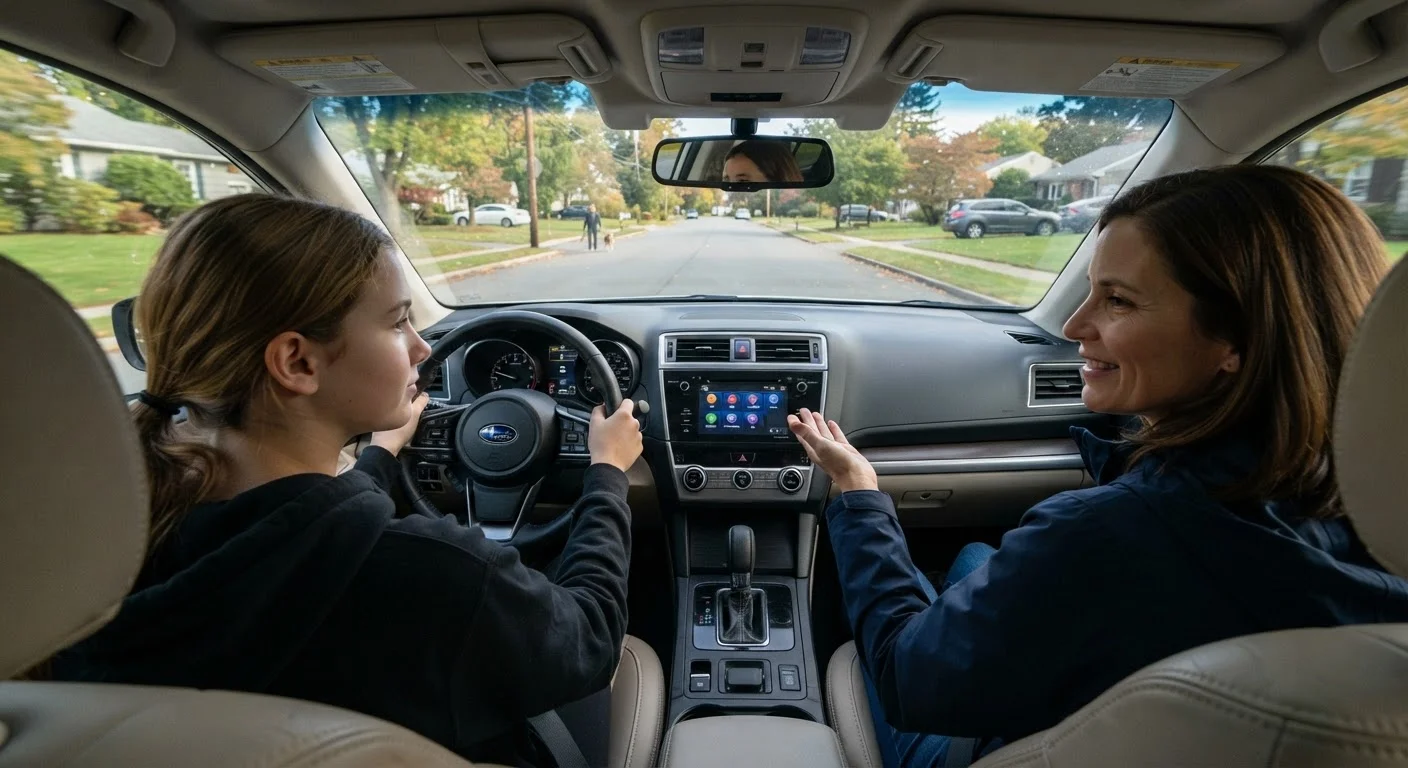
The dynamic inside the car during practice sessions is itself a variable that most parents don't consciously manage. Yelling, grabbing the dash, or issuing rapid-fire corrections creates anxiety - and anxious drivers fixate, freeze, or overcorrect. Calm, specific, advance communication is consistently more effective.
“The quality of the adult's coaching during supervised practice matters as much as the hours themselves. A tense or unpredictable co-pilot can undermine the learning that the miles are supposed to deliver.”
— AAA Foundation for Traffic Safety, Research organization focused on traffic safety and driver education
Effective coaching means narrating decisions before they need to happen: "We're going to merge in about 400 feet - start checking your mirror now" rather than "Why didn't you check your mirror?" This gives the brain time to practice the actual perceptual sequence, not just react to criticism.
It also helps to debrief after each session rather than during every moment. A five-minute post-drive conversation - "What felt hard today? What did you handle well?" - builds self-awareness and metacognition, which are the foundations of defensive driving that lasts beyond the learner period.
The Rules Parents Often Haven't Re-Read Themselves
Right-of-way at four-way stops, when a yield sign means stop, proper following distance formulas - these are rules many parents learned decades ago and haven't thought about since. Teaching them confidently requires refreshing your own knowledge. Our family driver's reference on speed limits, following distance, and right-of-way is a practical place to start.
GDL Laws Are a Floor, Not a Ceiling
Graduated Driver Licensing laws set legal minimums - they don't define readiness. Some teens will reach the legal milestone for an unrestricted license before they've had meaningful practice in all the conditions described here. Parents have the authority to extend supervised practice beyond what the law requires, and doing so is a reasonable choice if specific skill gaps remain.
Graduated Driver Licensing (GDL) laws also vary significantly by state - passenger restrictions, nighttime curfews, phone bans, and mandatory holding periods differ. Verify your state's specific requirements through your state DMV before your teen transitions to an independent license, and treat those restrictions as safety tools, not inconveniences.