

Key Takeaways
Why Following Distance Is a Life-Safety Issue
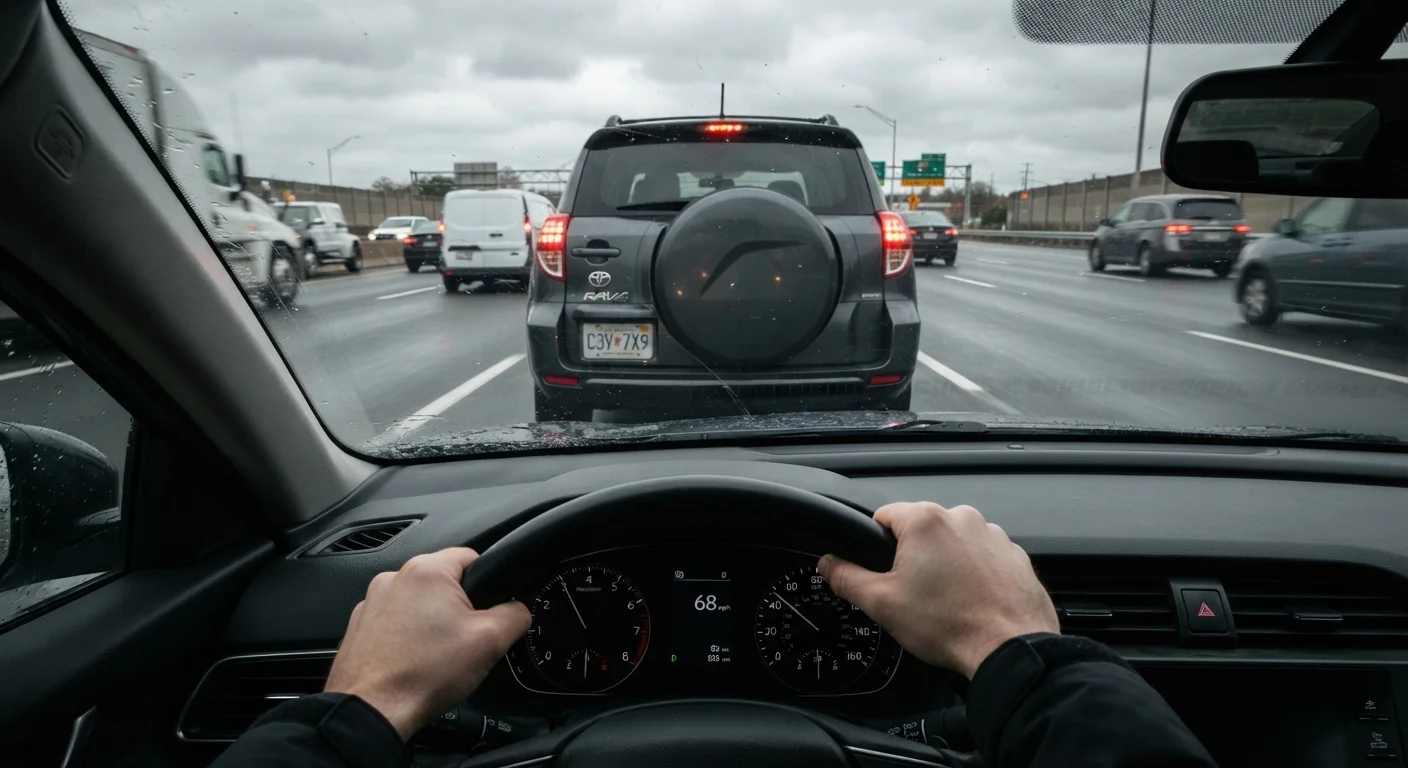
Most drivers acknowledge, in the abstract, that tailgating is bad. Yet following too closely remains one of the most common behaviors observed on American roads - and one of the most consequential. Rear-end crashes represent approximately one-third of all reported traffic collisions in the US, according to federal road safety data, and inadequate following distance is a primary contributing factor.
The danger is not simply about reaction time, though that matters enormously. It is about the compounding effect of speed, vehicle weight, road conditions, and cognitive load - all of which conspire to make the gap between cars vanish far faster than most drivers instinctively appreciate. Understanding the physics and the psychology behind tailgating is the first step toward changing the habit.
For families transporting children, the stakes are even higher. A rear-end collision at highway speeds is not a minor inconvenience; it can produce serious injuries even in vehicles with modern safety systems. The principles of defensive driving begin with creating and maintaining space - and that starts with following distance.
~33%
Share of US crashes that are rear-end collisions
Federal Highway Administration and NHTSA crash data consistently identify rear-end crashes as one of the most frequent collision types on American roads.
1.5-2.5 sec
Typical driver reaction time before braking begins
Research on human response times in driving scenarios shows most drivers cannot initiate braking faster than 1.5 seconds even when alert and attentive.
300+ ft
Total stopping distance at 60 mph on dry pavement
This figure combines reaction distance and braking distance for a typical passenger vehicle and underscores how much road is consumed before a stop is complete.
Common Myths About Tailgating - Corrected
Several persistent misconceptions lead drivers to underestimate the risk they create when following too closely. The myth-and-fact breakdowns below address the most widespread errors in judgment.
Myth
I have good reflexes, so I can stop quickly enough even when I'm close behind another car.
Fact
Human reaction time - even for attentive drivers - typically ranges from 1.5 to 2.5 seconds before braking begins. At 60 mph, that's 130-220 feet traveled before your foot touches the brake.
Reaction time is the delay between perceiving a hazard and initiating a physical response. Even a sharp, experienced driver cannot compress this below roughly 1.5 seconds. At highway speeds, that delay translates to significant distance covered before any braking force is applied. Add the vehicle's actual stopping distance after braking begins, and the total stopping distance at 60 mph in a typical passenger vehicle can exceed 300 feet. A two-car-length gap - which many drivers consider adequate - is roughly 30 to 40 feet. The math is unambiguous.
Myth
Tailgating only really matters at high speeds - at lower urban speeds it isn't that risky.
Fact
Low-speed rear-end collisions still cause significant whiplash injuries, and urban environments introduce more unpredictable hazards - pedestrians, cyclists, and sudden stops - that demand more reaction time, not less.
Injury data consistently show that rear-end crashes at speeds as low as 15-25 mph produce whiplash and soft-tissue injuries that can cause lasting pain and disability. Urban driving also involves a higher density of hazards: a pedestrian stepping off a curb, a delivery vehicle double-parked ahead, or a cyclist braking unexpectedly. These events demand faster decision-making, and a tight following gap leaves almost no margin. The cognitive cost of distraction makes this even more acute in city environments.
Myth
Leaving a large gap is pointless because other drivers just fill it in.
Fact
When another vehicle merges into your gap, a brief adjustment restores the buffer. The safety value of following distance is not permanently negated by a single merge.
This rationalization is understandable but flawed. When a vehicle merges ahead of you, you simply ease off the accelerator for a moment to re-establish your three-second gap. The total trip time impact is negligible - typically under a few seconds. What drivers lose by abandoning following distance is the ability to respond to whatever that newly merged vehicle does next. Maintaining space is about controlling your own risk exposure, not about preventing every other driver from occupying that space.
Myth
Rear-end collisions are always the following driver's fault, so as long as I'm in front, tailgating doesn't affect me.
Fact
Being the lead vehicle in a rear-end crash does not insulate you from injury. Occupants of struck vehicles frequently experience serious neck and spine injuries, regardless of fault.
Fault in a legal or insurance sense is a separate matter from physical injury. Being rear-ended - particularly at speed - subjects the vehicle and its occupants to sudden, violent acceleration. Children, older passengers, and those with pre-existing conditions may be especially vulnerable. Practicing adequate following distance protects you from striking others, but the broader point is that maintaining safe spacing throughout traffic reduces the likelihood of multi-vehicle pileups where you can be struck from behind precisely because traffic ahead stopped suddenly.
Myth
Wet roads only require a slightly larger following distance - maybe one extra car length.
Fact
In wet conditions, braking distances can increase by 50% or more compared to dry pavement; doubling your following distance is a reasonable minimum adjustment.
Water reduces tire-to-road friction significantly. At highway speeds on wet roads, braking distances that are already substantial under dry conditions extend considerably - and the increase is not linear. Hydroplaning - where a layer of water prevents the tires from maintaining contact with the road surface - can occur at speeds as low as 35 mph on standing water. Drivers who simply add one extra car length in rain are applying a dry-road mental model to a fundamentally different physical situation. For families, particularly when driving unfamiliar roads in wet weather, the heightened risks of low-visibility conditions reinforce why larger buffers are essential.
How to Maintain Proper Following Distance in Practice
The three-second rule is the most widely taught baseline: pick a fixed object on the road, and when the vehicle ahead passes it, count three full seconds before you reach the same point. If you arrive before three seconds have elapsed, you are following too closely. Under adverse conditions - rain, fog, heavy traffic, nighttime driving - safety experts recommend extending that gap to four or five seconds minimum.
On the highway, this translates to a following distance that may feel uncomfortably large. That discomfort is largely cultural: many drivers equate a large gap with an invitation for others to merge in. In reality, a brief merge by another vehicle does not meaningfully reduce your safety margin - simply ease off slightly and re-establish your gap. What does create risk is the habit of closing that gap to discourage merging.
Never Brake-Check a Tailgating Driver
If someone is following you too closely, sudden braking is not a deterrent - it is a collision trigger. At the distances most tailgaters maintain, there is simply no room to stop. Your safest response is to maintain a steady speed, signal clearly, and create an opportunity for the other driver to pass. If the behavior continues and you feel unsafe, consider pulling off the road when it is safe to do so.
Being tailgated is its own hazard. If a driver is following you too closely, resist the urge to brake-check - a sudden stop at close range is a near-certain collision. Instead, signal early, maintain steady speed, and where safely possible, change lanes or allow the vehicle to pass. More guidance on managing these moments appears in our reference on speed limits, following distance, and right-of-way.
Teaching these habits matters at every stage of driving life. Parents working through the supervised driving phase with teens should specifically practice following-distance calibration - it is a skill that degrades under pressure without deliberate reinforcement. See our guide on what parents often overlook when teaching a teen to drive for a structured approach.