

Key Takeaways
Stopping Distance
Stopping distance is the total distance a vehicle travels from the moment a driver perceives a hazard to the moment the vehicle comes to a complete stop. It has two components: reaction distance (how far the car moves while the driver responds) and braking distance (how far it travels once the brakes are applied). Together, these determine how much road you need to avoid a collision.
Braking distance increases with the square of speed - doubling your speed quadruples the braking distance required, not merely doubles it. This non-linear relationship is why speed changes are so consequential.
Two Components That Make Up Every Stop
Every time you brake, your vehicle is actually going through two distinct phases before it halts. Understanding both helps explain why stopping takes far more road than most drivers intuitively expect.
Reaction distance is the distance covered between the moment you perceive a hazard and the moment your foot actually engages the brake. At a typical reaction time of 1.5 seconds - considered an average for an alert, unimpaired driver - a vehicle traveling at 60 mph covers roughly 132 feet before braking even starts. Fatigue, distraction, or impairment stretches this significantly.
Braking distance is what happens next: the physics of friction between your tires and the road surface slowing the vehicle to a stop. Add these two together and you have your total stopping distance - a figure that can easily exceed the length of a basketball court under ordinary highway conditions.
Reaction Time Starts Earlier Than You Think
Many drivers assume their reaction time begins the moment they see a hazard. In practice, your brain must first register the hazard as a threat before commanding a response. Distraction, fatigue, or unfamiliar surroundings can add fractions of a second that translate to dozens of additional feet at highway speeds. Staying mentally engaged and scanning the road ahead is the simplest way to keep reaction distance as short as possible.
Why Speed Is More Dangerous Than It Looks
The most important - and most misunderstood - fact about stopping distance is that braking distance does not increase in proportion to speed. It increases with the square of speed. That's the key physics principle at work here.
Consider this: a car braking from 30 mph might need approximately 45 feet to stop on dry pavement. The same car at 60 mph - twice the speed - needs not 90 feet, but closer to 180 feet. At 90 mph, braking distance balloons to roughly 400 feet or more. Speed doesn't just add risk; it multiplies it.
This is why even modest speed reductions in school zones, neighborhoods, or adverse weather are not arbitrary - they reflect the real mathematics of momentum and kinetic energy. Kinetic energy, the energy a moving object must shed to stop, also scales with the square of velocity.
~180 ft
Braking distance from 60 mph on dry pavement
This figure, cited in driver education resources, reflects average stopping performance under ideal conditions and does not include reaction distance.
50%+
Increase in stopping distance on wet roads
Reduced tire-road friction on wet surfaces is a well-documented factor in traffic safety research and is reflected in wet-weather speed guidance.
132 ft
Distance traveled during average reaction time at 60 mph
At a 1.5-second average reaction time, a vehicle traveling 60 mph covers approximately 132 feet before the driver's foot reaches the brake pedal.
How Road Conditions and Vehicle Weight Alter the Math
Friction between tire and road surface is what makes braking possible. Change that surface, and you change the entire stopping equation.
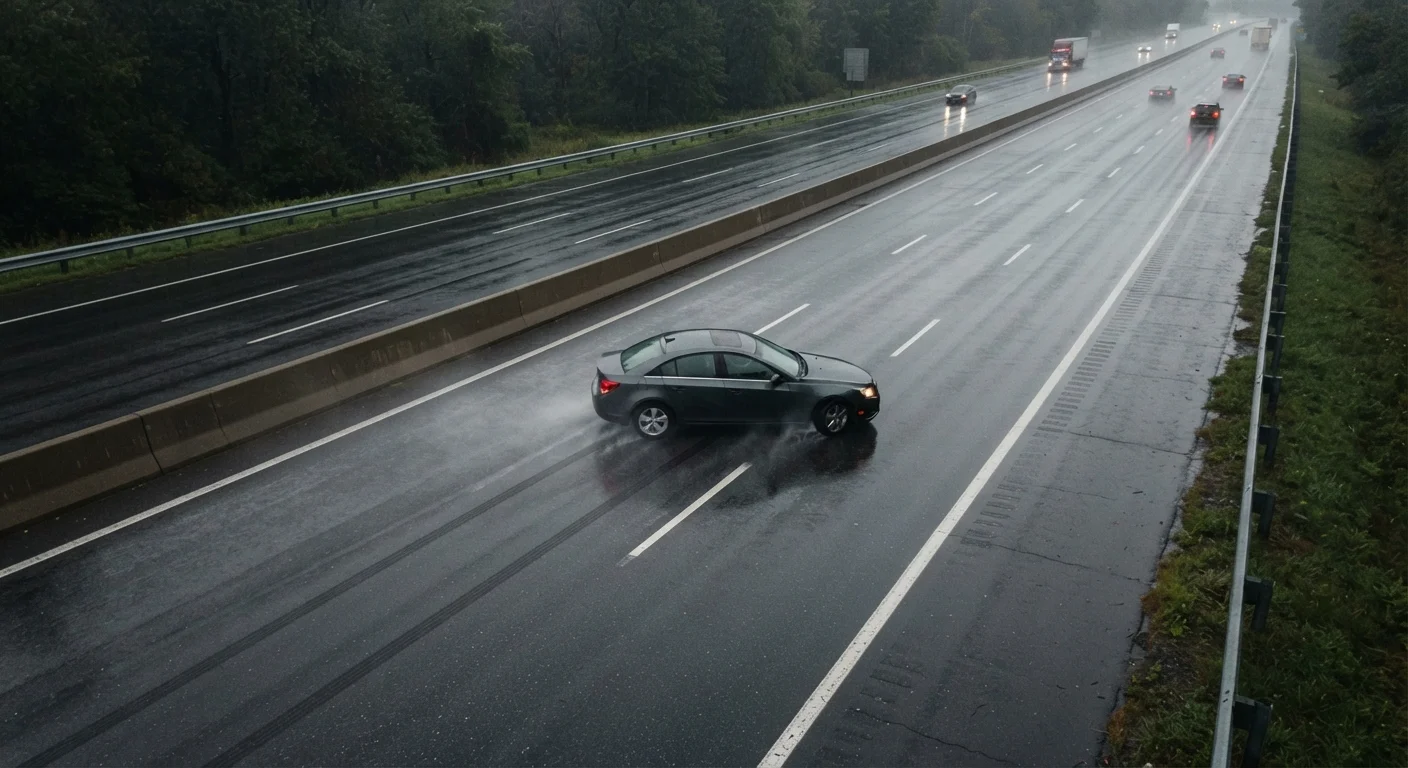
On wet pavement, friction coefficients drop substantially. Stopping distances commonly increase by 50% or more, and the risk of hydroplaning adds an additional layer of danger when tire tread is worn. On ice or packed snow, stopping distances can be five to ten times longer than on dry asphalt - a figure that should inform how much space you leave between vehicles in winter.
Vehicle weight is an equally important variable. Greater mass means greater momentum, and momentum is what your brakes must overcome. A fully loaded SUV or minivan will need more road to stop than the same vehicle running light, even with identical brakes. The condition of your braking system - pad thickness, rotor health, and fluid integrity - also directly affects how effectively that momentum is shed.
Tire Condition Is a Hidden Variable
Worn tire tread reduces the rubber's ability to channel water and grip the road surface, worsening stopping performance significantly - particularly in wet conditions. The relationship between tire tread depth and braking distance is direct: shallower tread means less friction available. Regular tire inspections are a practical way to ensure your stopping distance stays within the ranges these guidelines describe. See our family driver's reference on following distance and speed limits for additional context on how tire condition fits into broader road safety.
Putting the Science to Work on Every Drive
Understanding stopping distance is only useful if it shapes driver behavior. The most immediate application is following distance. Tailgating is dangerous not because it looks aggressive, but because it eliminates the physical buffer that stopping distance requires. Our related article on why tailgating is more dangerous than most drivers realize explores this in detail.
The three-second rule - counting the gap between when the car ahead passes a fixed point and when you reach it - provides a simple, adaptable baseline. In rain, fog, or when carrying extra passengers and cargo, extending that gap to four or six seconds reflects the actual physics of your situation.
Speed choices before conditions change matter as much as reactions during an emergency. Slowing down before a curve, an intersection, or a patch of wet road means your reaction distance and braking distance are both shorter when it counts. Pairing this understanding with core defensive driving principles gives families a practical framework for managing risk on every journey.
Visibility conditions add another layer of complexity - particularly at night, when hazards appear later in your field of view, effectively compressing the time available to react. Our guide to night driving hazards covers how reduced visibility intersects with stopping distance in ways many drivers underestimate.