

Key Takeaways
How Artificial Urgency Gets Built Into the Shopping Experience
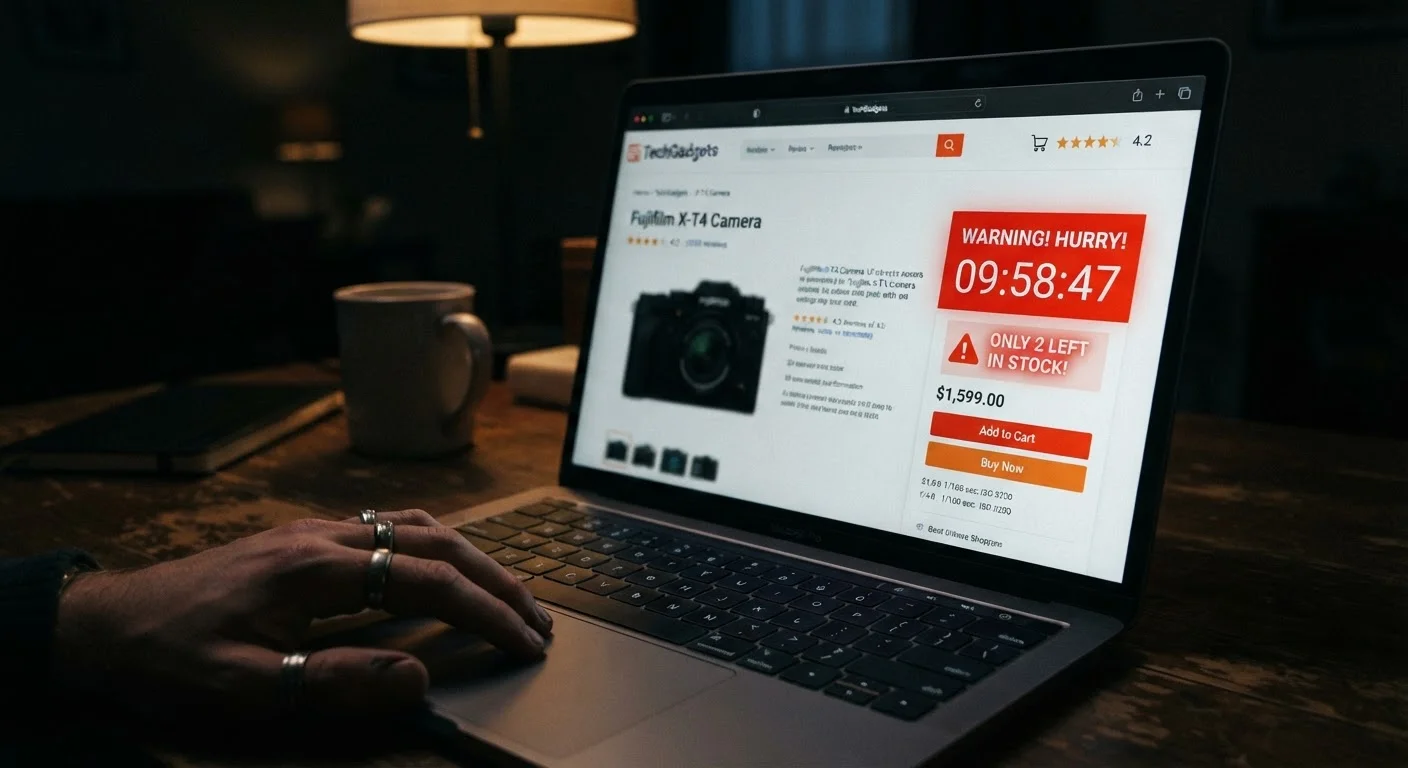
Online retailers have spent years studying the psychology of hesitation. The conclusion they've acted on: the longer a shopper thinks, the less likely they are to buy. Countdown timers, low-stock badges, and phrases like "Only 3 left!" exist specifically to compress that deliberation window. These are not neutral informational features — they are persuasion tools with a documented effect on purchasing behavior.
The mechanism is well understood in behavioral economics. Scarcity and time pressure activate a sense of potential loss, and people generally work harder to avoid a loss than to secure a gain. Retailers exploit this by making ordinary transactions feel like rare opportunities. Understanding that these signals are often engineered rather than organic is the foundation of smarter shopping.
This connects directly to how one-click checkout and frictionless payment systems work — the entire funnel is designed to move you from interest to transaction before your deliberate thinking kicks in. See our guide to impulse buying in the age of one-click checkout for a broader look at how the digital retail environment is structured against slow decision-making.
Myth
If a countdown timer is ticking, the deal really does expire when it hits zero.
Fact
Many countdown timers are set to reset automatically for every visitor or upon expiration, making the deadline fictional.
A countdown clock creates the impression of a hard deadline, but in practice many are implemented as session-based or cookie-based scripts that simply restart when the browser is refreshed or a new visitor arrives. Consumer advocacy investigations and browser-based testing have repeatedly shown timers returning to their original count after reaching zero. The deadline exists in presentation only — the price and availability remain unchanged.
Myth
"Only 2 left in stock" means the warehouse is nearly empty.
Fact
Low-stock labels are often triggered by algorithms at arbitrary thresholds, not real-time inventory data.
Some retailers set their systems to display a low-stock warning whenever inventory dips below a defined number — say, 50 or 100 units — not because the product is rare, but because the warning increases conversion rates. Others display the message regardless of actual stock levels as a standing feature. Unless a retailer explicitly publishes its methodology, there is no reliable way for a consumer to verify what "only a few left" actually means in warehouse terms.
Myth
Flash sales with countdown timers represent genuinely unusual prices you won't see again.
Fact
Many "flash sale" prices are recurring or can be found through basic comparison shopping at any time.
Price-tracking tools and browser extensions that log historical pricing data have shown that a significant share of products presented as flash sale deals are offered at similar or identical prices on a regular basis. The "sale" price is sometimes set against an inflated reference price that was never the standard market rate. Before treating any timed sale as a genuine exception, it's worth checking historical price data or simply searching the same product across multiple retailers.
Myth
Feeling a sense of urgency while shopping means the opportunity is real and worth acting on quickly.
Fact
A feeling of urgency is the intended outcome of these design choices, not evidence that the opportunity is genuine.
Behavioral research consistently shows that time pressure degrades decision quality — people make faster choices that they are more likely to regret. The urgency you feel when looking at a ticking clock or a low-stock warning is a predictable psychological response to a deliberately engineered stimulus. That feeling is data about the retailer's design choices, not about the product's actual value or scarcity. Treating the emotion as a signal to pause rather than proceed is one of the most reliable ways to avoid purchases you'll later question. For a deeper look at the psychological gap between impulse and considered purchasing, see our article on impulse versus considered purchasing.
Myth
If you miss a deal because you waited, you've made a financial mistake.
Fact
Most consumer goods see repeated promotions; the cost of an impulsive mistake typically exceeds the cost of a missed deal.
Genuine once-in-a-lifetime deals are vanishingly rare in everyday retail. Most promotions recur — seasonally, during platform-wide sales events, or simply as part of a retailer's standard rotation. The financial risk of buying something impulsively that turns out to be the wrong product, the wrong size, or simply unwanted is usually greater than the marginal savings lost by waiting. Checking return policies before purchasing is one safeguard, but restrictions on returns can leave you absorbing the full cost of a rushed decision. Our article on return policy realities covers what to look for before you commit.
What to Actually Do When You Feel Rushed
Recognizing artificial urgency is useful only if you have a practical response. The single most effective countermeasure is introducing deliberate friction into your own process. Close the tab. Add the item to a wishlist rather than a cart. Come back in 24 to 48 hours.
Screenshot Before You Leave — Then Come Back
Before closing a product page that's displaying urgency signals, take a screenshot of the timer, price, and stock message with a timestamp. Return after 24–48 hours and compare. If the timer has reset or the stock warning is unchanged, you have direct evidence that the urgency was artificial. This simple habit converts emotional pressure into verifiable data.
If the countdown timer has reset, the price is unchanged, or the "limited stock" message is identical, you've confirmed the urgency was manufactured. If the item genuinely sold out, that's useful information too — real scarcity does exist, and a brief wait helps you distinguish it from theater.
It's also worth checking whether the same product is available through other channels at a comparable or lower price. Artificial urgency depends on the assumption that you won't look elsewhere. Our article on why a 48-hour pause changes purchasing decisions walks through how to build this habit for any purchase over $50.
Finally, remember that urgency tactics often travel alongside other forms of misleading presentation. Vague claims, inflated "original" prices, and pressure messaging frequently appear together. If you're already seeing one, look for others — and consider checking our guide to misleading labels and marketing language before finalizing any purchase.
~60%
Shoppers who report urgency tactics influence their decisions
Research in consumer psychology suggests a majority of online shoppers acknowledge that scarcity and time-pressure cues affect their purchasing behavior, even when they suspect the cues may not be accurate.
2–3×
Conversion rate lift from scarcity messaging
E-commerce industry analyses have documented that low-stock and countdown displays can multiply product page conversion rates several times over compared to pages without such cues.