

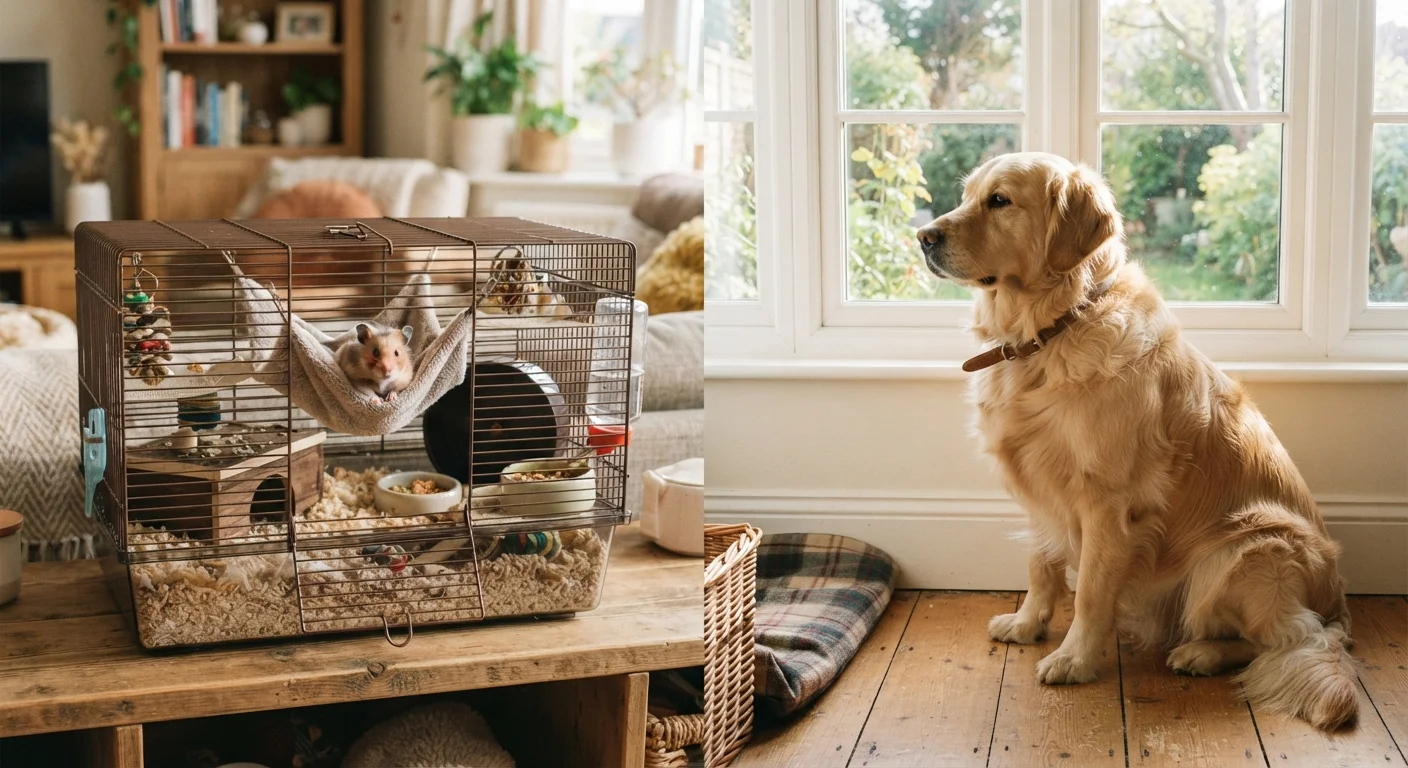
Key Takeaways
Option A
Small Pets
The compact, lower-footprint companion option.
Best for: Families in smaller homes or apartments, households with limited time for active care, and first-time pet owners building confidence.
Option B
Large Pets
The high-engagement, high-reward companion choice.
Best for: Active families with outdoor space, households that can commit consistent daily time, and those seeking a deeply interactive animal bond.
If your household has limited square footage or rents an apartment
Small Pets
Small pets like guinea pigs, fish, or rats thrive in compact spaces without needing outdoor access. See our guide to apartment pet expectations for species-specific detail.
If your family is highly active and has consistent daily availability
Large Pets
Large dogs in particular match well with families who can provide structured exercise, outdoor time, and regular engagement every day without exception.
If you have young children under age six
Small Pets
Many small pets are easier to introduce safely, though supervision is still essential. Very young children may unintentionally harm fragile small animals, so temperament and species matter greatly.
If emotional bonding and interactive companionship are top priorities
Large Pets
Large animals — particularly dogs — form complex social bonds and respond to family members in ways that many small pets cannot replicate behaviorally.
If budget predictability is a significant household concern
Small Pets
Routine costs for food, bedding, and basic vet care tend to be lower for most small pets, though exotic species can carry higher care costs than expected.
Why Pet Size Is a Household-Fit Question
Choosing between a small or large pet is rarely just about how much floor space an animal occupies. Size determines feeding volume, veterinary costs, exercise requirements, noise levels, and the emotional demands placed on every family member. Before selecting a species or breed, it helps to map these variables honestly against your household's real rhythms.
What 'pet-friendly' really means for your household goes beyond the obvious — allergies and square footage — to uncover how daily schedules, travel frequency, and family temperament all factor in. Size amplifies or softens each of those considerations significantly.
Use this framework as a structured starting point. For a deeper self-assessment before committing, see questions to ask yourself before committing to a pet.
| Criterion | Small Pets | Large Pets |
|---|---|---|
| Space requirement | Enclosure or habitat; minimal floor space | Significant indoor and often outdoor space |
| Daily time commitment | 30–60 minutes typical | 1–3+ hours for exercise and interaction |
| Annual food cost (general range) | Low to moderate | Moderate to high |
| Routine vet cost | Low to moderate; exotic species can be higher | Moderate to high |
| Typical lifespan | 2–10 years depending on species | 10–15+ years (dogs); varies by species |
| Social bonding depth | Variable; some species bond closely | Generally deep and expressive |
| Noise level | Generally low; some birds are loud | Can be significant (barking, etc.) |
| Suitability for apartments | Usually well-suited | Depends on breed; often challenging |
Care Demands: Time, Training, and Daily Commitment
Large pets — dogs in particular — typically require structured daily exercise, behavioral training, and consistent social interaction. The American Veterinary Medical Association notes that inadequate stimulation is a leading cause of behavioral problems in dogs. For a family with unpredictable schedules, this is a real planning challenge, not a minor inconvenience.
Small pets such as hamsters, guinea pigs, gerbils, and rabbits need daily feeding, habitat cleaning, and handling for socialization, but their care blocks are generally shorter and more flexible. That said, rabbits and guinea pigs are highly social and require more enrichment than many families anticipate — they are not hands-off pets.
63%
US households owning at least one pet
According to the American Pet Products Association's National Pet Owners Survey, nearly two-thirds of American households include at least one pet.
~2 hrs
Daily care time for large dogs on average
Veterinary behaviorists generally recommend at least one to two hours of combined exercise, training, and interactive play daily for medium-to-large dog breeds.
4–5 yrs
Average lifespan of a pet hamster
Most domestic hamsters live between two and five years, making them a shorter-term commitment compared to dogs or cats.
Feeding structure also differs meaningfully by size. Larger animals often benefit from scheduled mealtimes both for portion control and behavioral predictability. Our comparison of free-feeding vs. scheduled meals covers how each approach affects weight and digestion across pet types.
Cost, Lifespan, and Long-Term Planning
Upfront acquisition costs vary widely within both categories, but ongoing expenses tend to scale with size. Larger animals eat more, require larger enclosures or more outdoor infrastructure, and often have higher routine veterinary costs. Emergency veterinary care for a large dog can run into thousands of dollars — a factor worth considering before adoption.
Lifespan introduces a different kind of planning dimension. Many small pets — hamsters, mice, some birds — live two to five years, meaning families, especially those with children, should discuss what loss looks like before bringing the animal home. Large dogs live roughly ten to fifteen years on average, while some large parrots can outlive their owners. Neither is inherently better; they're simply different commitments.
Exotic Small Pets and Veterinary Access
Some small animals — rabbits, guinea pigs, ferrets, reptiles, and birds — require care from an exotic animal veterinarian, who may not be available in every area. Before adopting an exotic small pet, confirm that qualified veterinary care is accessible in your region. This is a commonly overlooked factor that affects both routine wellness visits and emergency situations.
For a broader look at how species maps to lifestyle, see dogs, cats, and everything in between.
Social Needs, Children, and Household Dynamics
The social profile of a pet — how much interaction it needs and gives — often matters more to family satisfaction than physical size alone. Large dogs are pack-oriented animals and integrate into family social life naturally, but that also means they suffer when left alone for long periods. Separation anxiety is a documented and treatable condition, but it requires awareness and planning.
Small pets vary considerably. Rats are highly social and intelligent; they benefit from being kept in pairs and enjoy human interaction. Guinea pigs are gentle and communicative. Hamsters, by contrast, are largely solitary and often nocturnal — which can disappoint younger children expecting a playful daytime companion.
When family members have differing opinions about which pet to choose, a structured approach helps everyone feel heard. Our guide on choosing a pet when the whole family disagrees offers a practical framework for navigating that conversation. Matching the pet's social temperament to your household's rhythm — not just its size — is where most successful placements begin.