

Key Takeaways
Soil Health
Soil health refers to the ongoing capacity of soil to support plant growth, manage water, and sustain the living organisms within it. Three core properties — pH, texture, and organic matter content — largely determine whether your soil is working for or against your plants. Improving soil health is one of the highest-return investments a home gardener can make.
Soil scientists often define soil health using the USDA framework, which emphasizes biological, chemical, and physical properties working together as a dynamic system rather than static conditions.
Why Soil Is More Than Just Dirt
Most plant failures in home gardens aren't caused by bad seeds or insufficient watering — they stem from soil that can't support root function. Soil is a living system containing minerals, water, air, and billions of microorganisms. Its physical and chemical properties determine whether nutrients reach your plants, whether water drains or pools, and whether roots can penetrate deeply enough to anchor and feed a plant.
Understanding three fundamental properties — pH, texture, and organic matter — gives you the diagnostic framework to stop guessing and start making targeted improvements. These properties interact with each other and with local climate, so addressing one often benefits the others. For a broader perspective on how soil fits into overall yard planning, see the complete backyard landscaping guide for US homeowners.
Soil pH: The Master Switch for Nutrient Availability
Soil pH is measured on a scale from 0 to 14, where 7 is neutral, values below 7 are acidic, and values above 7 are alkaline. For home gardens, this number controls which nutrients are chemically available for plant uptake — even if those nutrients are physically present in the soil.
Nitrogen, phosphorus, and potassium — the three primary plant nutrients — are most accessible in the 6.0–7.0 range. Outside that window, nutrients can become chemically "locked up," causing deficiency symptoms even in well-fertilized soil. This is why applying more fertilizer to a pH-imbalanced garden often produces little improvement. Understanding pH helps explain common fertilization myths that lead homeowners to overfeed their soil with little result.
6.0–7.0
Optimal pH range for most vegetables
According to USDA soil health guidance, this range maximizes nutrient availability for the majority of common garden crops.
1–5%
Typical organic matter content in garden soil
University extension research indicates that even modest increases in organic matter percentage produce measurable improvements in soil structure and plant performance.
3 types
Particle types that define soil texture
Sand, silt, and clay combine in varying ratios to create every soil type, from free-draining sandy loam to dense, compaction-prone clay.
To adjust pH, gardeners typically add ground limestone to raise it (make more alkaline) or elemental sulfur to lower it (make more acidic). Adjustments are gradual — retest after several months rather than immediately. Your local cooperative extension service can provide region-specific guidance and low-cost testing.
Soil Texture: How Sand, Silt, and Clay Shape Your Garden
Soil texture describes the proportion of three particle sizes — sand (largest), silt (medium), and clay (smallest). That ratio directly controls drainage, water retention, aeration, and how easily roots can move through the soil.
- Sandy soil drains quickly, warms fast in spring, and is easy to work — but holds little water or nutrients.
- Clay soil retains moisture and nutrients well but drains slowly, compacts easily, and becomes hard when dry.
- Silt falls between the two but can crust over and resist water infiltration when compacted.
The ideal is loam — a balanced mix of all three that drains well while holding adequate moisture and nutrients. Most native soils lean toward one extreme. A simple at-home jar test (mixing soil with water and letting it settle by particle weight) gives a rough sense of your texture profile. This matters especially if you're weighing in-ground plots versus raised beds, since raised beds let you build ideal texture from the start.
Quick Texture Test You Can Do Today
Take a small handful of moist soil and squeeze it firmly. Sandy soil crumbles apart immediately; clay soil holds its shape and feels sticky; loam holds shape briefly then crumbles when poked. This simple squeeze test takes seconds and gives you a working sense of your soil's texture profile before you invest in amendments.
Organic Matter: The Engine of a Living Soil
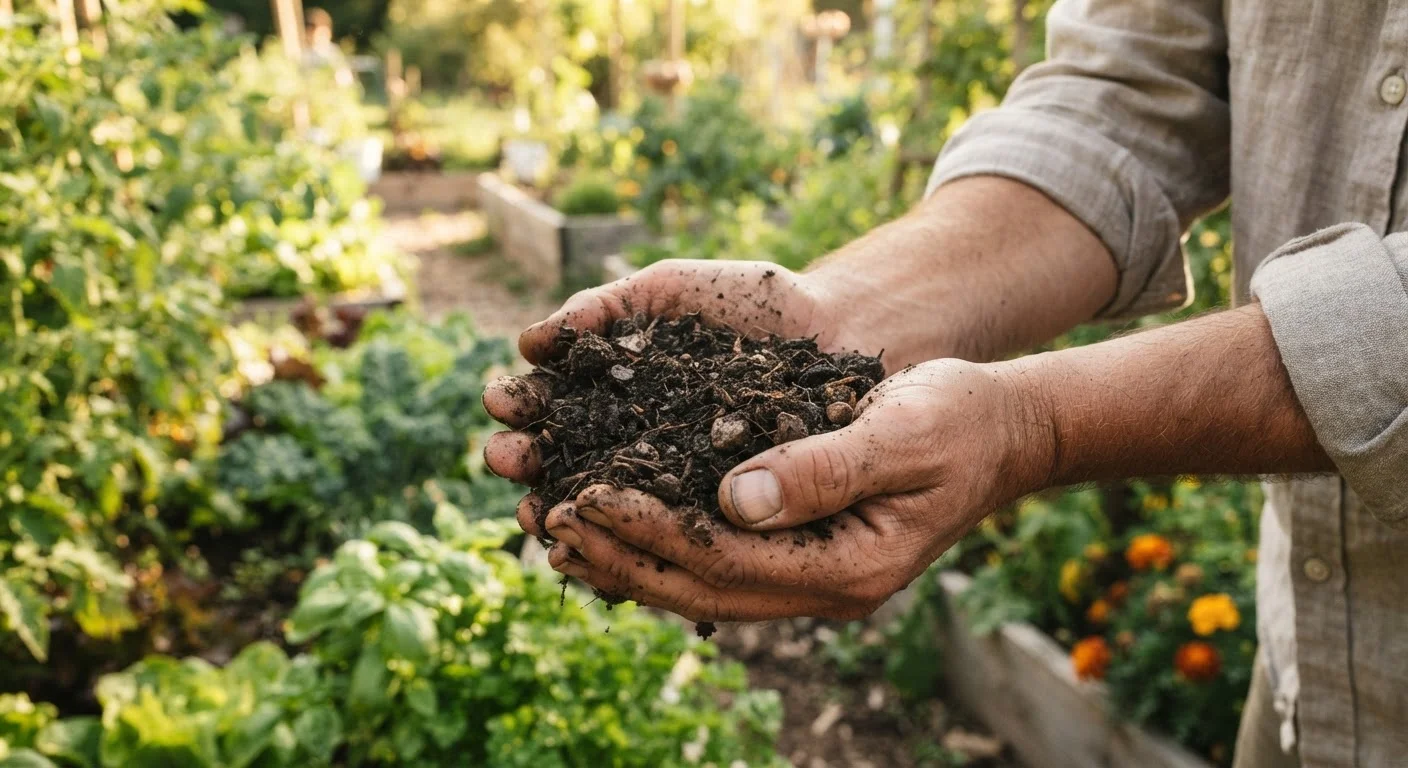
Organic matter is decomposed plant and animal material — the dark, spongy component that gives healthy garden soil its rich appearance and earthy smell. It typically makes up only 1–5% of soil by weight, but its impact is outsized.
Organic matter improves nearly every soil property simultaneously: it loosens clay, improves water retention in sand, feeds microbial communities that convert nutrients into plant-available forms, and buffers against pH swings. It also improves aeration and encourages earthworm activity, which further improves structure.
The most practical way to increase organic matter is consistent compost additions. Even a one-inch layer of finished compost worked into the top six inches of soil each season measurably improves structure over time. Learn how to produce your own supply with our guide on composting kitchen and yard waste at home.
Testing and Improving Your Soil: Where to Start
The most efficient starting point is a soil test. Cooperative extension services in most US states offer laboratory testing for a modest fee — typically returning results that cover pH, major nutrients, and improvement recommendations tailored to your region. Basic home test kits provide quick pH readings and are useful for monitoring changes between full tests.
Once you have data, address pH first, since it affects how all other improvements perform. Then build organic matter steadily through compost and mulch. Texture is the hardest property to change dramatically, but organic matter additions improve both sandy and clay soils over time without requiring full replacement.
For lawn areas specifically, compaction is often the hidden texture problem — soil becomes so dense that water, air, and roots can't penetrate. Aeration and overseeding address this directly and work best when soil conditions are understood first.
Soil Improvement Is a Multi-Season Process
Significant soil health improvements rarely happen in a single growing season. pH adjustments, organic matter buildup, and texture changes accumulate over years of consistent practice. Track your progress with annual or biannual soil tests rather than expecting immediate transformation. Small, consistent inputs consistently outperform large one-time fixes.