

Key Takeaways
Option A
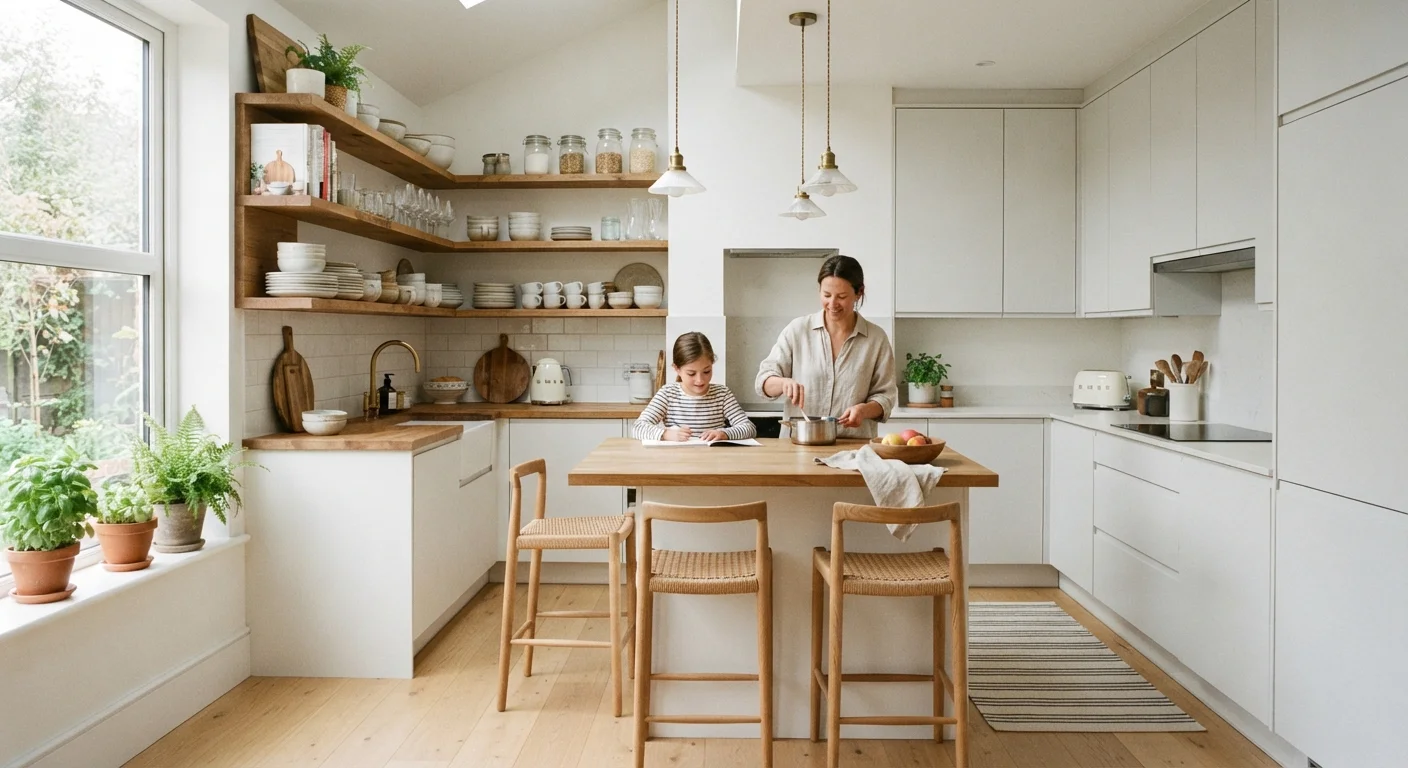
Open Shelving
The airy, accessible, display-friendly option.
Best for: Households with curated, consistent dishware who want fast visual access to everyday items.
Option B
Closed Cabinets
The practical, clutter-concealing workhorse of family kitchens.
Best for: Busy families who prioritize easy cleanup, dust control, and flexible hidden storage.
If your household has young children or heavy daily cooking
Closed Cabinets
Cabinets protect dishes from grease splatter, spills, and curious hands, reducing cleanup time and breakage risk.
If you want to make a small kitchen feel more open without structural changes
Open Shelving
Removing upper cabinet doors or installing floating shelves visually expands the space and improves sightlines.
If multiple adults share kitchen duties and have varied tidiness standards
Closed Cabinets
Cabinets provide a one-step solution to visual clutter regardless of how items are stored inside.
If you have a curated set of dishware and enjoy a styled, intentional kitchen aesthetic
Open Shelving
Uniform, attractive items displayed on open shelves can function as both storage and decor without extra effort.
If you want maximum flexibility on a modest renovation budget
Open Shelving
Floating shelves are less expensive to install than full cabinet runs, and their configuration can be changed more easily over time.
Why This Decision Matters More Than It Looks
Kitchen storage shapes how your family cooks, cleans, and moves through the space every day. Open shelving has dominated design inspiration boards for years, while closed cabinets remain the practical standard in most American homes — and for good reason. The right choice depends far less on aesthetics than on how your household actually functions.
Before committing to either approach, it helps to consider daily routines: how often you cook from scratch, how many people access the kitchen regularly, whether young children are in the mix, and how much time you're realistically willing to spend maintaining the space. For a broader look at how competing household preferences affect shared spaces, see organizing a home when family members disagree.
| Criterion | Open Shelving | Closed Cabinets |
|---|---|---|
| Visual impact | Airy, spacious feel | Solid, structured look |
| Dust & grease exposure | High — items exposed daily | Low — doors protect contents |
| Clutter visibility | Everything on display | Hidden behind doors |
| Accessibility | Instant, no doors to open | Requires opening doors |
| Maintenance effort | Frequent wiping required | Periodic interior cleaning |
| Child safety | Items within reach at lower heights | Childproof latches easily added |
| Installation cost | Generally lower | Generally higher |
| Storage flexibility | Limited by what looks tidy | Flexible — varied items hide well |
The Real Trade-Offs of Open Shelving
Open shelving has genuine advantages. It eliminates the visual weight of overhead cabinets, makes items immediately visible and reachable, and can make a compact kitchen feel less enclosed. For households with a consistent set of dishware, it also removes the friction of opening and closing doors dozens of times a day.
The maintenance burden, however, is real. Grease particles from cooking settle on open surfaces, meaning dishes and shelves need wiping down more frequently than closed cabinet interiors. Clutter is permanently on display, so mismatched mugs, excess packaging, and rarely used items can make the kitchen look chaotic quickly. Families with toddlers may find that accessible shelving means accessible breakables.
~30%
Kitchens now featuring open shelving
Design industry surveys consistently show open shelving appearing in roughly a quarter to a third of newly renovated kitchen designs in recent years.
2–3×
More frequent cleaning needed for open shelves
Interior designers and professional organizers commonly advise that open kitchen shelves near cooking areas need wiping two to three times more often than closed cabinet interiors.
Open shelving also works against households that accumulate a wide variety of items over time — the kind of collection that looks fine behind a door but distracting in plain sight. If pure minimalism doesn't suit your lifestyle, read the trade-offs of going fully minimalist at home for an honest assessment before committing to an open aesthetic.
What Closed Cabinets Actually Offer Families
Closed cabinets provide something underappreciated in busy homes: instant visual calm. One cabinet door closed and the kitchen reads tidy, regardless of what's stacked inside. That forgiving quality is significant when multiple family members are putting things away with varying degrees of care.
Cabinets also protect stored items from dust, grease, and moisture — particularly relevant near the stove and sink. Dishware stored behind doors stays cleaner between uses, which matters for families who pull out serving pieces only occasionally.
The trade-off is accessibility. Deep cabinets can swallow items that then get forgotten, and corner cabinets are notoriously inefficient without interior organizers. Closed storage also requires thoughtful labeling or consistent habits so everyone in the household knows where things belong. For a detailed look at maximizing every type of storage space, the complete guide to organizing every corner of a family home covers interior cabinet systems in depth.
Cabinet Depth and Interior Organizers
Standard base cabinets run 24 inches deep, which can make items at the back genuinely hard to reach. Pull-out shelves, lazy Susans, and drawer inserts can substantially improve usability without altering the cabinet structure itself. If you're renovating, asking a cabinet installer about interior organizer options upfront is far easier than retrofitting them later.
Making a Hybrid Approach Work
Most family kitchens function best with a combination of both. A practical starting point: use closed lower cabinets (where clutter accumulates most and children can reach) and consider open shelving or glass-front doors for upper storage where you keep everyday glassware or a curated selection of items. This preserves the visual openness that makes open shelving appealing while keeping the chaos contained.
When evaluating how much open versus closed storage to incorporate, also think vertically. Wall space above standard cabinet height is often unused — floating shelves there add storage without replacing existing cabinets. Our guide on vertical vs. horizontal storage explains how to layer these strategies effectively in compact kitchens.
If you're considering more structural changes — such as removing upper cabinets entirely to open up a floor plan — be aware that this may intersect with wall modifications that require permits or professional assessment. Opening up a floor plan is a useful reference before any demolition decisions are made.