

Key Takeaways
Significant savings on routine labor costs
Labor charges at independent shops and dealerships can account for 50-70% of a service bill. Handling straightforward maintenance yourself eliminates that markup on tasks within your skill level.
Builds deeper familiarity with your vehicle
Hands-on maintenance helps owners notice early signs of wear, leaks, or deterioration that might be missed between scheduled appointments.
Flexible scheduling on your own timeline
You're not waiting for an appointment slot or shop availability - a Saturday morning oil change happens when it suits your family's schedule.
Greater control over parts quality
When you source your own parts, you can choose the grade and brand that fits your vehicle's needs rather than accepting whatever a shop has in stock.
Safety risk from improperly completed repairs
Mistakes on brakes, suspension, or wheel fasteners can have immediate and serious consequences on the road. Safety-critical systems demand the right tools, torque specs, and verified technique.
Upfront tool investment can be substantial
A quality floor jack, jack stands, torque wrench, and basic socket set represent a real cost. Specialized tools for specific jobs add further expense that can outweigh labor savings on a single repair.
Misdiagnosis wastes money and time
Without proper diagnostic equipment, it's easy to replace the wrong component. Shops with professional scan tools can isolate faults faster and with greater accuracy.
Some repairs may affect warranty coverage
On newer vehicles, certain DIY repairs or non-OEM parts may complicate warranty claims. Reviewing your warranty terms before starting work is an important step many owners skip.
Liability for errors falls entirely on you
A licensed shop carries professional liability and typically guarantees their work. A DIY mistake that causes further damage or a safety incident is entirely the owner's responsibility.
Our Verdict
DIY car maintenance is a smart, cost-conscious habit for straightforward tasks that don't touch safety-critical systems. The line to respect is where a mistake could endanger you, your passengers, or other drivers - or where specialized tools and diagnostic equipment are genuinely required. Getting that line right saves money and keeps your vehicle reliable.
Owners who are comfortable with basic mechanical tasks, have access to the right tools, and are willing to research their specific vehicle's procedures before starting any job.
Why the DIY Question Matters
Every car owner eventually faces the moment: the check-engine light is on, a belt is squealing, or the oil-change interval has arrived. Do you book a shop appointment, or do you handle it yourself?
The honest answer isn't the same for every task - or every owner. Maintenance decisions involve your mechanical skill level, available tools, the specific vehicle, and, critically, the safety consequences if something goes wrong. Understanding that spectrum is the foundation of smart ownership. For a broader look at which services fall due and when, see our guide to your car's maintenance schedule.
The goal here is a clear framework for sorting jobs into the right bucket - not to push you toward a wrench or a waiting room.
The Case for DIY: Real Advantages
Significant savings on routine labor costs
Labor charges at independent shops and dealerships can account for 50-70% of a service bill. Handling straightforward maintenance yourself eliminates that markup on tasks within your skill level.
Builds deeper familiarity with your vehicle
Hands-on maintenance helps owners notice early signs of wear, leaks, or deterioration that might be missed between scheduled appointments.
Flexible scheduling on your own timeline
You're not waiting for an appointment slot or shop availability - a Saturday morning oil change happens when it suits your family's schedule.
Greater control over parts quality
When you source your own parts, you can choose the grade and brand that fits your vehicle's needs rather than accepting whatever a shop has in stock.
The savings on labor are genuine. A shop oil change might run $60-$100 once you factor in the service-center markup on parts, while doing it yourself often costs a fraction of that - assuming you already own a drain pan and a filter wrench. Multiply that across several services per year and the cumulative saving is meaningful for a family budget.
Beyond cost, DIY builds familiarity with your vehicle. Owners who do their own maintenance tend to catch unusual wear, leaks, or component deterioration early - before they become expensive. That familiarity directly relates to what we cover in why skipping small maintenance tasks leads to big repair bills.
The Case for the Shop: Real Limitations
Safety risk from improperly completed repairs
Mistakes on brakes, suspension, or wheel fasteners can have immediate and serious consequences on the road. Safety-critical systems demand the right tools, torque specs, and verified technique.
Upfront tool investment can be substantial
A quality floor jack, jack stands, torque wrench, and basic socket set represent a real cost. Specialized tools for specific jobs add further expense that can outweigh labor savings on a single repair.
Misdiagnosis wastes money and time
Without proper diagnostic equipment, it's easy to replace the wrong component. Shops with professional scan tools can isolate faults faster and with greater accuracy.
Some repairs may affect warranty coverage
On newer vehicles, certain DIY repairs or non-OEM parts may complicate warranty claims. Reviewing your warranty terms before starting work is an important step many owners skip.
Liability for errors falls entirely on you
A licensed shop carries professional liability and typically guarantees their work. A DIY mistake that causes further damage or a safety incident is entirely the owner's responsibility.
DIY has a ceiling, and crossing it carries genuine risk. Brake jobs done incorrectly can result in brake fade or failure. Suspension work done without a proper alignment afterward causes accelerated tire wear and unpredictable handling. These aren't hypothetical concerns - they're the reason certain systems are treated as shop-only by most experienced home mechanics.
There's also a tool investment threshold. Specialized items like a scan tool capable of reading proprietary codes, a torque wrench calibrated for cylinder-head bolts, or a spring compressor for strut work represent significant upfront cost. If a tool is only needed once, renting often makes more financial sense - a principle explored further in our guide to renting vs. buying household items.
Check Your Owner's Manual First
Before starting any maintenance task, your vehicle's owner's manual is the authoritative source for fluid specs, torque values, and service intervals specific to your make and model. Generic online guides are a useful starting point, but they can't account for vehicle-specific requirements. Some modern vehicles also require a scan tool reset after battery replacement or oil changes - steps that are easy to miss if you rely on general instructions.
A Practical Sorting Framework
Rather than a rigid list, use these three filters to evaluate any task:
- Safety criticality: Does this system affect braking, steering, or structural integrity? If yes, default to a professional unless you have verifiable training and the correct tools.
- Reversibility: If you make a mistake, can it be easily corrected before the vehicle is driven? An incorrectly installed cabin air filter causes no immediate harm. An over-torqued wheel lug nut can cause a wheel to separate at highway speed.
- Diagnostic complexity: Does the repair require accurate diagnosis first? A rough idle might be a $12 spark plug or a failing mass airflow sensor. Replacing parts without proper diagnosis wastes money and can leave the root cause unresolved.
~$100
Average shop labor rate per hour in the US
According to AAA data, labor rates at dealerships and independent shops vary significantly by region, with many markets exceeding $100 per hour for diagnostic and repair work.
35%
Share of vehicle owners who perform some DIY maintenance
Consumer research surveys consistently show a significant portion of US vehicle owners handle at least some routine maintenance tasks themselves, most commonly oil changes and filter replacements.
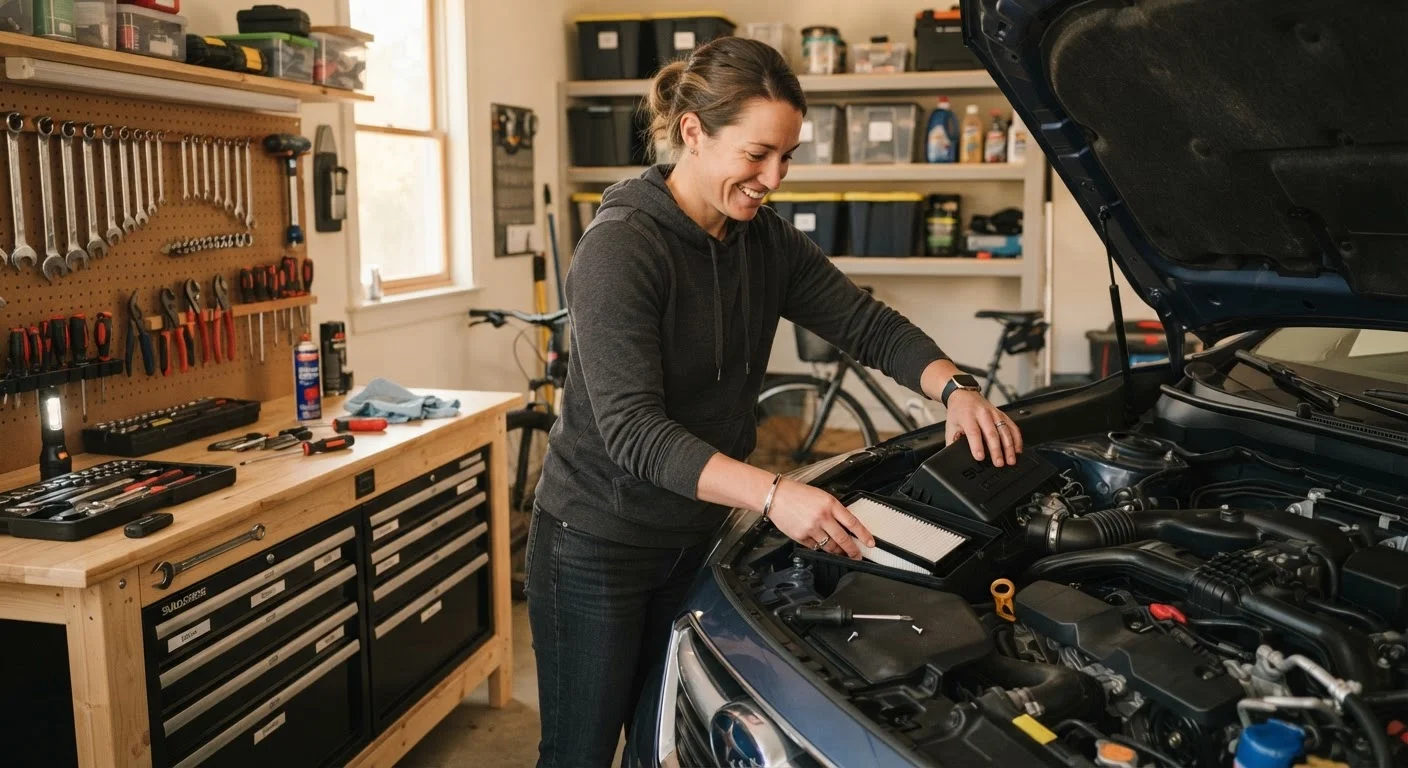
Jobs that typically pass all three filters for a careful, informed DIYer include: engine and cabin air filter replacement, windshield wiper blades, battery replacement (with attention to reset procedures for some vehicles), and tire rotation using proper jack stands and torque specs.
When to Walk Into the Shop Without Hesitation
Certain categories belong in professional hands regardless of your skill level:
- Brake hydraulics and pad/rotor replacement on unfamiliar vehicles - the margin for error is zero when stopping distance is involved.
- Airbag system service - accidental deployment can cause serious injury; this work requires specialized tools and training.
- Transmission internal repairs - tolerances are extremely tight and require factory-level tooling to meet.
- Fuel system repairs beyond filter replacement - fire risk is real and regulations in many states require licensed work on certain components.
- Any repair that would void a warranty or fail an emissions inspection - confirm what your warranty covers before touching related components.
The broader lesson about respecting your limits - and the cost of overstepping them - applies whether you're working on a car or a home. Our look at situations where DIY can do more harm than good covers the same principle in a different context.
This article provides general educational information about vehicle maintenance. It is not a substitute for guidance from a qualified, licensed mechanic familiar with your specific vehicle. Always consult your owner's manual and a certified professional before performing any repair that involves safety-critical systems.