

Key Takeaways
Option A
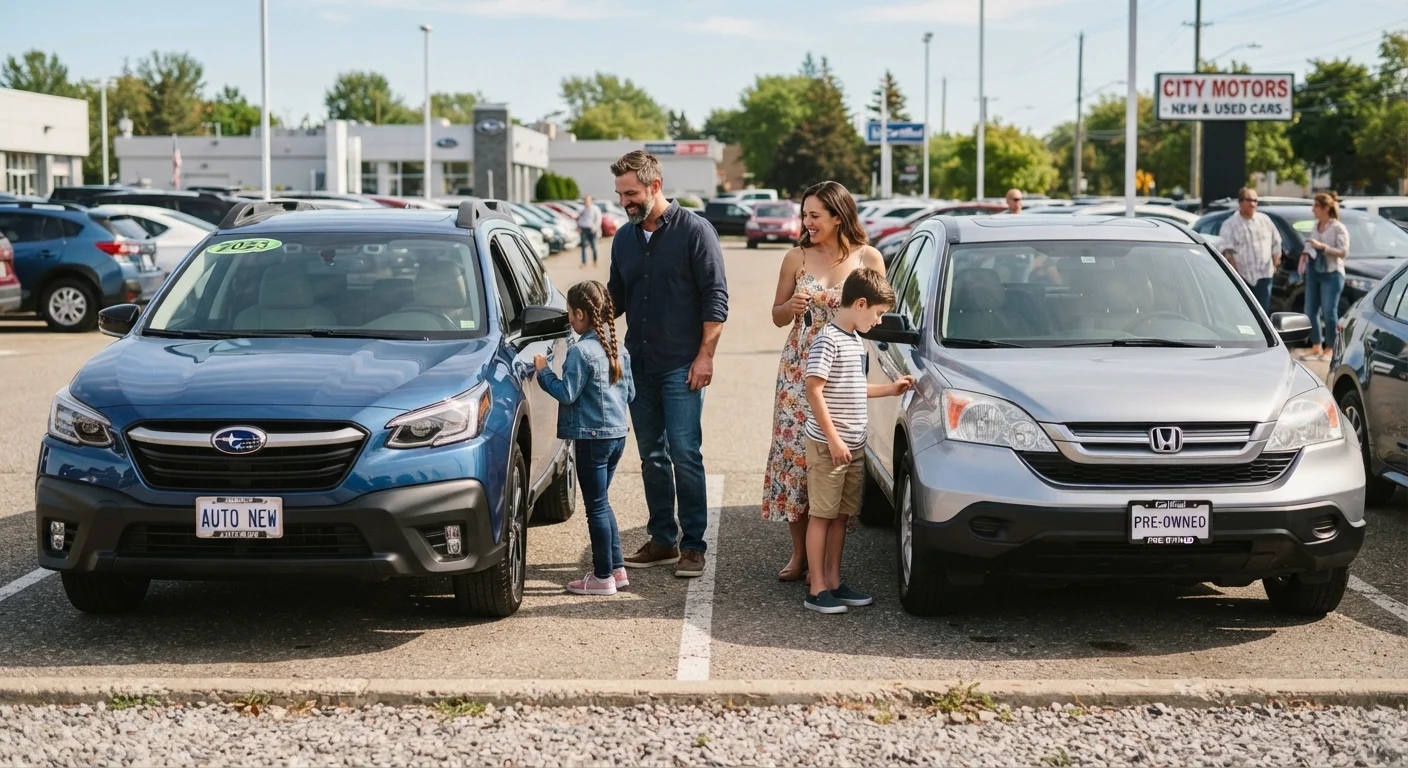
New Car
The full-warranty, latest-features option.
Best for: Families who prioritize predictable maintenance costs, current safety technology, and long-term ownership peace of mind.
Option B
Used Car
The lower-cost, depreciation-smart alternative.
Best for: Families focused on minimizing upfront cost and letting the first owner absorb the steepest depreciation hit.
If your family needs absolute reliability and peace of mind
New Car
A full manufacturer warranty and no unknown ownership history reduce the risk of surprise repair bills in the first several years.
If keeping monthly costs and total outlay as low as possible is the priority
Used Car
A well-chosen used vehicle lets you avoid the sharpest depreciation curve while still meeting your family's practical needs.
If you want some used-car savings without sacrificing reliability assurance
Used Car
A certified pre-owned vehicle from a franchised dealer can offer extended warranty coverage and inspection standards closer to a new-car experience at a lower price.
If advanced driver-assistance and crash-avoidance technology is a top priority
New Car
Current-model-year vehicles are most likely to include the latest active safety systems as standard equipment, which can be meaningful for families with young children.
The Core Financial Picture
The sticker price is only the beginning of the new-vs.-used cost comparison. New vehicles carry higher purchase prices and, in most cases, higher insurance premiums. However, they typically qualify for lower financing rates through manufacturer programs, which can partially offset the price gap for buyers who finance.
The most significant financial factor is depreciation. New vehicles can lose a substantial portion of their value in the first few years of ownership - meaning a family that buys used is, in effect, letting a prior owner absorb that loss. This principle is central to understanding when buying used makes sense across major household purchases.
Used vehicles generally carry lower registration fees in states that tie annual fees to vehicle value. On the other hand, older vehicles may require more maintenance spending over time, and those costs are less predictable. Families should budget for both possibilities rather than assuming a used car will always be cheaper to own overall.
| Criterion | New Car | Used Car |
|---|---|---|
| Purchase Price | Higher | Lower |
| Depreciation Impact | Absorbed by buyer | Prior owner absorbed steepest drop |
| Warranty Coverage | Full manufacturer warranty | Limited or none (CPO adds some) |
| Financing Rates | Often lower (promo rates available) | Typically higher |
| Safety Technology | Latest systems standard | Varies by year and trim |
| Insurance Cost | Generally higher | Generally lower |
| Ownership History | None - clean slate | Unknown unless documented |
| Maintenance Predictability | High (early years covered) | Lower - varies with vehicle condition |
Safety, Reliability, and Technology
Modern vehicle safety technology has advanced rapidly. Features such as automatic emergency braking, lane-keeping assist, and blind-spot monitoring - once reserved for premium trims - are increasingly standard on new models. A used vehicle from even a few model years back may lack these systems entirely, or offer them only on higher trim levels.
That said, reliability is not simply a function of age. Many well-maintained used vehicles have long, dependable service lives, and independent vehicle reliability surveys consistently show that some older model years outperform newer ones from the same manufacturer. Safe driving habits and vehicle condition both contribute to family safety - the car itself is one factor among several.
For families considering used vehicles, a certified pre-owned (CPO) program offered through franchised dealerships provides multi-point inspections and manufacturer-backed extended warranties. CPO vehicles are not without limitations - they are typically priced higher than comparable non-certified used cars - but they narrow the reliability gap meaningfully.
~20%
Typical first-year new car depreciation
Industry data consistently shows new vehicles can shed roughly 15-20% of their value within the first year, with further drops in years two and three.
3-5 yrs
Typical new car bumper-to-bumper warranty
Most mainstream manufacturers offer a 3-year/36,000-mile bumper-to-bumper and a 5-year/60,000-mile powertrain warranty as standard coverage.
~$3,000+
Average used car price savings vs. new
The price gap between comparable new and certified pre-owned vehicles varies by segment, but used vehicles are consistently priced below their new equivalents.
Hidden Costs and Practical Considerations
Several costs are easy to overlook. New car buyers may pay destination charges, dealer fees, and optional add-ons that inflate the out-the-door price well beyond the advertised figure. Used car buyers should budget for a pre-purchase inspection by an independent mechanic - a modest expense that can surface significant issues before a commitment is made.
Financing terms differ as well. Lenders and manufacturers often offer promotional rates on new vehicles that are unavailable on older used cars, and some lenders restrict financing on high-mileage or older vehicles entirely. Families should compare the total interest paid over the loan term, not just the monthly payment, as part of their decision.
Trade-in value is another factor worth understanding upfront. A new car purchased today becomes a used car the moment it leaves the lot, affecting what you can expect when you eventually sell or trade. The trade-in process involves trade-offs that are worth understanding before you commit to either path.
Don't Skip the Vehicle History Report
For any used vehicle purchase, obtaining a vehicle history report using the car's VIN (Vehicle Identification Number) is a basic but critical step. These reports can surface prior accidents, title issues, odometer discrepancies, and service records. A report alone does not replace a professional inspection, but it is an important first filter before investing further time or money.
Making the Right Call for Your Family
There is no universal right answer. The better choice depends on your household's cash flow, how long you plan to keep the vehicle, how many miles you drive annually, and how much uncertainty you are comfortable absorbing. A family planning to keep a vehicle for ten or more years may find that the new-car premium spreads out to a manageable per-year figure. A family replacing a vehicle every four to five years may find used ownership considerably more cost-efficient.
If you are navigating the broader buying process - from budgeting and financing to negotiation - the complete family car buying guide covers each stage in detail. And once you have decided on used, the question of private seller versus dealership introduces its own set of meaningful trade-offs worth examining carefully.
Whatever path you choose, approach the decision with a clear total-cost-of-ownership framework - purchase price, financing, insurance, maintenance, and expected resale value - rather than focusing on any single number.