

Key Takeaways
Why Good Intentions Aren't Enough
Most families don't lack motivation — they lack systems that account for how real life actually unfolds. A Sunday afternoon overhaul can produce a beautifully organized pantry or closet, only to see it return to chaos within two weeks. The problem usually isn't the people; it's the design of the system itself.
Understanding why clutter feels so overwhelming is a useful starting point, but the practical fix lies in diagnosing where your system's structure breaks down. The mistakes below represent the most common structural failures — and each one has a straightforward correction.
Designing the system for who you wish you were, not who you actually are.
Why it happens: Organizing inspiration — from social media or home tours — often showcases aspirational lifestyles that don't match real household rhythms, so people copy the aesthetic without accounting for their actual habits.
Building a system that takes too many steps to maintain.
Why it happens: When setting up an organization system, people are motivated and patient — so multi-step sorting processes feel manageable. That patience evaporates during a busy Tuesday evening.
Skipping buy-in from other household members.
Why it happens: One motivated person often overhauls a shared space without consulting everyone who uses it, assuming others will adapt once they see the new setup.
Treating the initial setup as the finish line.
Why it happens: Getting organized feels like completing a project, so people don't plan for the ongoing maintenance that keeps it functional. Life changes — new purchases, seasonal shifts, kids' ages — and systems need to adapt.
Trying to organize volume instead of reducing it.
Why it happens: Decluttering is emotionally harder than rearranging, so many people reach for containers and labels before asking whether they need everything they own. The result is a neatly packaged excess.
Ignoring how paper and digital clutter undermine physical systems.
Why it happens: Most organization overhauls focus on physical objects and overlook the steady stream of mail, school forms, and paperwork that accumulates on every flat surface.
Building a System That Actually Holds
Sustainable organization isn't about perfection — it's about friction. The lower the friction involved in putting something away correctly, the more consistently everyone in the household will do it. When a system gets bypassed repeatedly, that's diagnostic information: the system is asking too much of the people using it.
The System Must Fit Real Life
An organization system that works only when conditions are perfect will collapse under the pressure of a normal week. Before redesigning any space, observe how your household actually moves through it for several days. Build the system around those real patterns, not an idealized version of them.
If you're starting from scratch or moving into a new space, a complete introduction to home organization can help you establish core principles before habits calcify. For households already mid-struggle, the most effective intervention is usually to pick the single highest-friction area and redesign that one system before touching anything else.
Buying More Storage Is Often the Wrong First Step
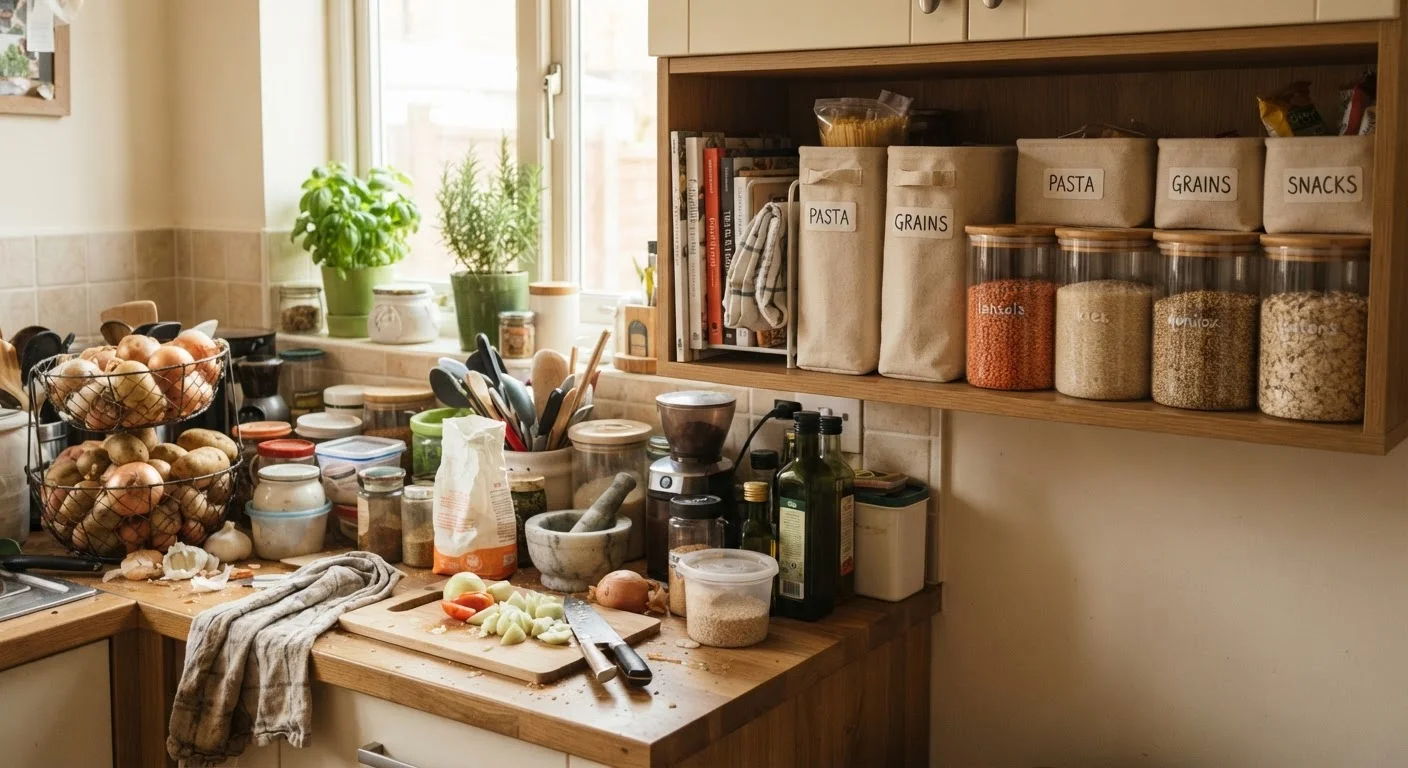
Purchasing bins, baskets, and shelving before decluttering typically makes the problem worse, not better. You end up organizing clutter rather than eliminating it, and the new containers add visual noise without solving the underlying volume problem. Reduce first, then contain.
Small, consistent improvements compound. A system that gets used imperfectly every day will always outperform one that gets used perfectly once a month.
25%
Of garage space used for actual cars
Research from the U.S. Department of Energy suggests roughly one in four Americans with a garage can no longer fit a vehicle inside — a common indicator that volume, not system design, is the primary obstacle.
40%
Of housework attributed to clutter
The National Soap and Detergent Association has cited estimates suggesting that eliminating clutter could reduce the average household's cleaning time significantly, as excess belongings create the majority of mess.