

Key Takeaways
Our Verdict
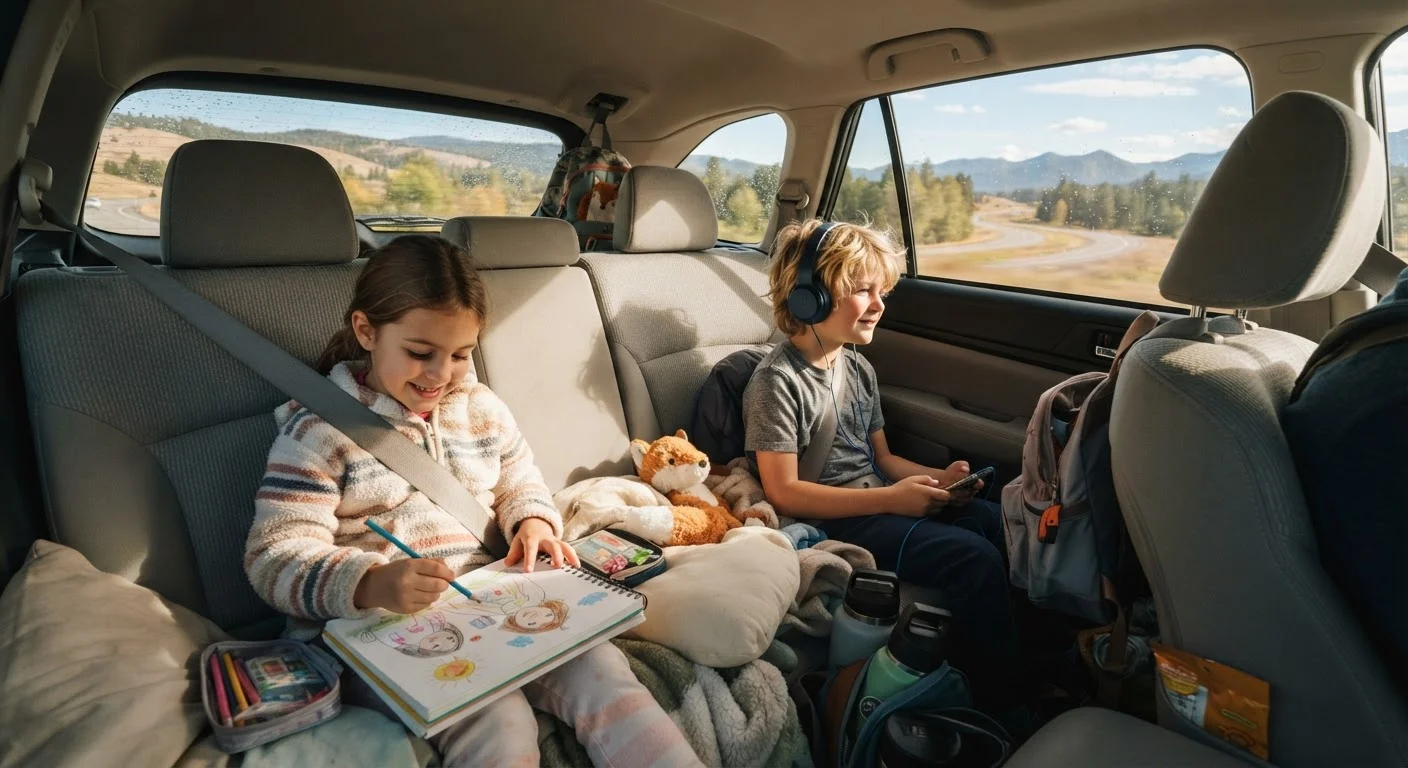
Each approach has a genuine role to play on a long family journey. Screens provide reliable, low-effort distraction for stretches when parents need a break; audiobooks create shared family moments without anyone staring at a device; and activity kits give hands-on kids something tactile to focus on. The families who report the smoothest road trips tend to rotate between all three rather than relying on one.
| Best for | Recommended |
|---|---|
| Parents who need reliable, low-maintenance distraction | Screen Time |
| Families who want a shared, screen-free experience | Audiobooks & Podcasts |
| Hands-on kids who get restless quickly | Activity Kits |
| Mixed-age groups with varied interests | A Rotating Combination |
Why No Single Approach Covers the Whole Trip
Ask ten parents how they survive a six-hour drive with kids, and you'll get ten different answers — and all of them are probably right. The honest truth is that long travel days are dynamic: energy levels rise and fall, younger kids nap while older ones don't, and what was captivating at hour one is agony by hour four. If you're planning a big family journey, our road trip vs. flying comparison can help you think through the bigger picture before you pack a single bag.
The three most common in-transit entertainment strategies — screen time, audiobooks, and activity kits — each have genuine strengths and real limitations. Understanding both helps you stack them strategically rather than scrambling when one stops working.
| Screen Time | Audiobooks & Podcasts | Activity Kits | |
|---|---|---|---|
| Setup effort required | Low — download content ahead | Low to moderate — curate playlist | High — assemble and pack items |
| Works without Wi-Fi | Yes, if pre-downloaded | Yes, if pre-downloaded | Yes, fully offline |
| Shared family experience | Limited — usually solo viewing | High — everyone can listen | Moderate — often individual |
| Best age range | Toddler through teen | Ages 5 and up | Ages 3 through 12 |
| Typical engagement duration | 2–4+ hours | 1–3 hours | 30 min – 2 hours |
| Physical engagement level | Passive | Passive | Active / hands-on |
| Reusability across trips | High — same device, new content | High — new titles each trip | Low to moderate — consumable items |
Screen Time: The Reliable Workhorse
Tablets and smartphones are the most widely used travel entertainment tool for a reason: they work quickly, hold attention reliably, and require almost no parental energy to deploy. Downloaded movies, kid-friendly streaming apps, and educational games can cover enormous stretches of highway with minimal friction.
That said, extended passive screen use has trade-offs worth knowing. Research on screen time and children's health is nuanced — the content type, context, and co-viewing all matter. On a travel day, most families find that screens work best in defined blocks rather than as an all-day background presence. A two-hour movie followed by a non-screen activity tends to land better than five hours of continuous viewing.
Download Before You Go
Cellular dead zones and spotty highway coverage can cut off streaming at the worst moments. Download movies, episodes, and audiobooks to the device before departure — not the morning of, but the night before so you have time to troubleshoot any storage or account issues. A fully loaded tablet is your most dependable travel companion.
For toddlers and preschoolers especially, interactive apps beat passive video for keeping engagement going. Older kids often do well with episodic content — something with a story they want to follow — because it gives them a natural reason to keep watching.
Audiobooks and Podcasts: The Underrated Family Experience
Audiobooks and kid-focused podcasts are genuinely underused by most traveling families, and that's a shame — they're one of the only entertainment formats everyone in the car can experience simultaneously. A well-chosen story can hook a seven-year-old and their parents in equal measure, turning what would have been a quiet slog into something the family talks about at dinner.
The key is age-appropriate selection. Chapter books with strong narrators work well for kids roughly six and up. Younger children tend to do better with shorter, more episodic content. Many public libraries offer free audiobook lending through apps, which keeps costs down considerably.
One practical note: audiobooks tend to work better on road trips than on planes, where cabin noise can make following a narrator difficult without high-quality headphones. For tips on matching entertainment to your child's stage of development, the age-by-age travel guide is worth a read before you build your playlist.
Activity Kits: High Effort Up Front, High Reward in Transit
A well-assembled activity kit — think a zip pouch filled with a small sketchpad, colored pencils, stickers, a travel-sized game, and a simple puzzle — requires planning before departure but pays off significantly once you're moving. Unlike screens, activity kits keep kids physically engaged in a way that can reduce the restless, cooped-up energy that leads to backseat meltdowns.
The most effective kits are assembled with the specific child in mind. A six-year-old might love a dot-to-dot book and foam stickers. A ten-year-old might prefer a travel journal or a Sudoku pad. Wrapping each item individually adds a small element of surprise that extends the novelty further than you'd expect.
Watch Out for Motion Sickness
Some children are more prone to car sickness when looking down at activity books or screens than when looking out the window. If your child has any history of motion sickness, introduce activity kits and screens gradually and watch for early warning signs like unusual quietness or pallor. When in doubt, audiobooks are the safest format since they don't require looking at anything. Consult your child's pediatrician if motion sickness is a consistent issue on car trips.
Activity kits do have a ceiling — most kids exhaust their interest in physical activities faster than they would a screen. Think of them as a one-to-two hour bridge between screen blocks, or as a way to kick off the journey before reaching for the tablet. For broader strategies on managing long travel days, see our guide on keeping kids engaged on long travel days.
Building a Smart Entertainment Rotation
The families who tend to have the least turbulent long travel days are the ones who plan their entertainment in intentional blocks rather than defaulting to one format. A rough structure that many parents find effective: start with an activity kit to burn off pre-trip excitement, transition into an audiobook or family podcast for an hour, then introduce screen time for the long middle stretch, followed by another short offline break before arrival.
Matching the rotation to your kids' ages matters too — the mixed-age family planning guide covers this well if you're traveling with children at very different developmental stages. When siblings have a three- or four-year age gap, their entertainment needs diverge sharply, and building in individual headphone time alongside shared audiobook time can prevent a lot of negotiation.
The goal isn't to eliminate boredom entirely — a little staring out the window is fine, and even healthy. The goal is to avoid the kind of escalating frustration that turns a great trip into an ordeal before you've even arrived.
6 hrs
Average duration of a long family road trip
Travel industry surveys consistently find that six to eight hours is among the most common road trip lengths for US families, making sustained entertainment planning essential.
~40%
Parents citing boredom as top travel challenge
Multiple family travel surveys have found that managing children's boredom and restlessness ranks among the most frequently cited challenges of traveling with kids under 12.