

Key Takeaways
Anchoring & Decoy Pricing
Anchoring is a psychological effect where the first price you see heavily influences how you judge every price after it. Decoy pricing is a related tactic where a third, less attractive option is added to a lineup specifically to make another option look like the obvious choice. Together, these techniques shape spending decisions without shoppers being aware of it.
Both tactics exploit cognitive shortcuts described in behavioral economics - anchoring relies on the anchoring-and-adjustment heuristic, while decoy pricing leverages the asymmetric dominance effect identified by researchers Joel Huber, John Payne, and Christopher Puto in the early 1980s.
How a Single Number Can Control Your Spending
Before you compare two prices, your brain needs a starting point. Retailers know this - and they provide one, carefully chosen to work in their favor. That starting point is an anchor: a reference number that shapes every judgment that follows, even when it's arbitrary or inflated.
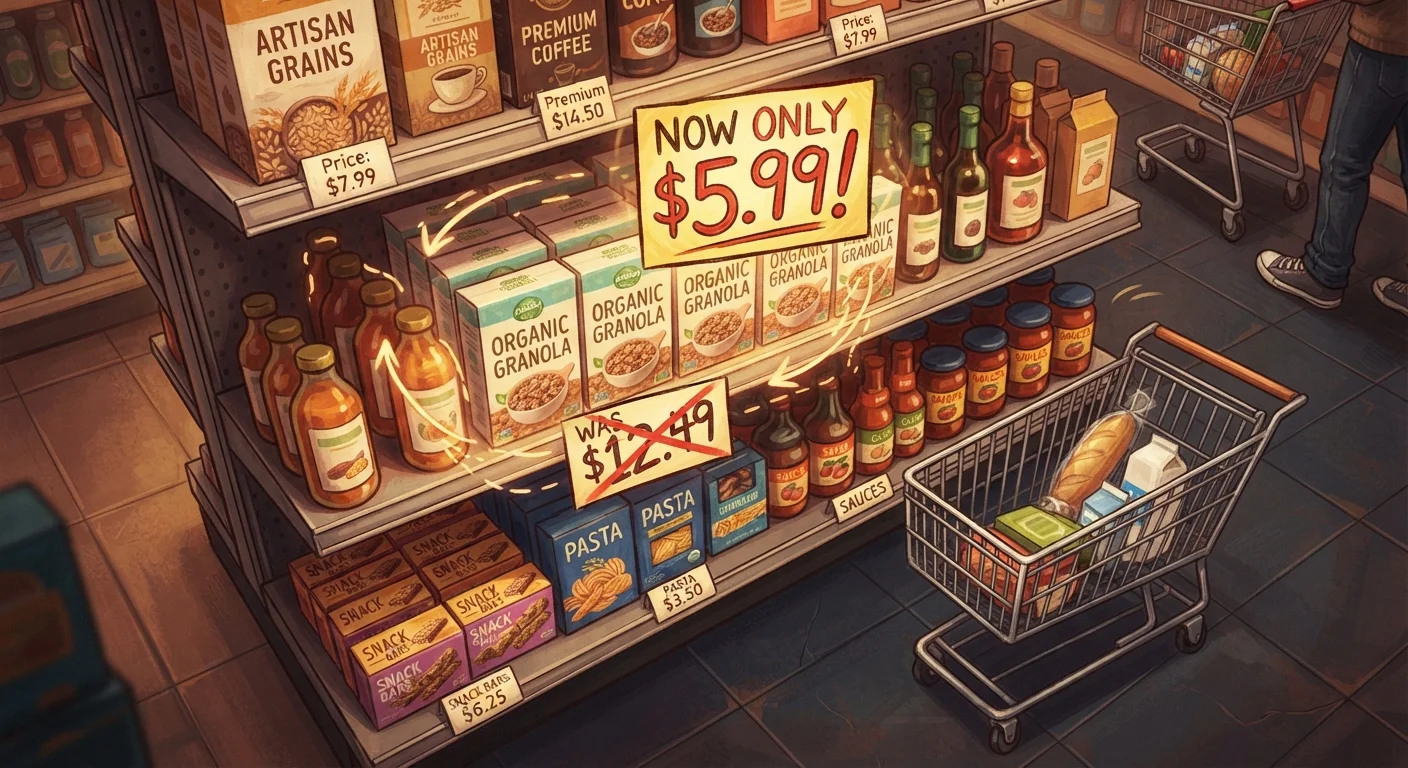
A crossed-out "was $149" sitting above a "now $99" price tag isn't just information - it's a frame. Your brain automatically evaluates the $99 relative to $149, not relative to what the item is actually worth or what competitors charge. The perceived saving feels concrete even if the original price was never the real market price. Anchor pricing and the illusion of a deal breaks this down further if you want to go deeper.
Anchoring isn't a sign of weak decision-making. It's a predictable feature of how human cognition handles numerical comparisons - which is exactly why it's so widely used.
~60%
Shoppers influenced by anchor prices
Behavioral economics research broadly supports that a majority of consumers adjust their price expectations significantly based on an initial reference price, even when told it may be arbitrary.
3x
Likelihood of choosing the 'target' option with a decoy present
Studies on the asymmetric dominance effect show that adding a decoy can triple the likelihood that consumers select the option the decoy is designed to highlight.
$1,000+
Estimated annual grocery overspend per family
Consumer research suggests that pricing psychology in grocery retail - including charm pricing and placement cues - can add hundreds to over a thousand dollars annually to a typical family's food bill.
The Decoy: An Option Designed to Lose
Imagine you're choosing a streaming subscription. There's a basic plan for $7/month, a premium plan for $18/month, and a middle plan for $14/month that offers almost everything the premium does. The middle plan suddenly looks like the obvious choice - but the comparison only works because the premium plan was priced to make it look that way.
That's the decoy effect. Retailers and service providers introduce a third option not because customers want it, but because it recalibrates the whole comparison. The decoy is typically designed to be asymmetrically dominated: clearly worse than one specific option, which makes that option look dominant by contrast.
This pattern shows up in software tiers, meal kit plans, appliance bundles, and even gym memberships. Once you know what a decoy looks like - an option that seems to exist mainly to make another look reasonable - you can step back and ask what you actually need, independent of the lineup in front of you.
Charm Pricing and the One-Cent Illusion
A price of $19.99 and a price of $20.00 differ by a single penny - yet research consistently shows that consumers perceive .99-ending prices as meaningfully lower. This works because people process numbers left to right: the "19" registers before the ".99," anchoring perception in the $10s rather than the $20s.
Charm pricing is ubiquitous in grocery stores, fast food, and online retail. Across a week of family grocery shopping, dozens of these micro-effects accumulate. A $4.99 item added to the cart because it felt "basically $4" is $5.00. Repeated across a full basket, the gap between perceived and actual spending can be meaningful.
Round Up to Reset Your Perception
When you see a .99 or .95 price, mentally round it to the next whole dollar before deciding. This one habit counteracts the left-digit anchoring that makes $19.99 feel far cheaper than $20. Applied consistently during a grocery run or online cart review, it brings your perceived total much closer to the actual total.
One simple counter: when evaluating prices, round up rather than down. Train yourself to read $49.99 as $50. It sounds trivial, but the habit recalibrates your perception to match reality.
For a broader look at how store layouts and pricing cues affect grocery bills, see grocery spending patterns that quietly inflate your bill.
Practical Steps Families Can Take
Knowing these tactics exist is genuinely protective - but a few habits make that knowledge actionable at the moment of purchase.
- Set your price range before you shop. Decide what you're willing to spend before seeing any retailer's pricing. Your number, not theirs, becomes the anchor.
- Ignore crossed-out reference prices. Look up comparable prices independently before accepting any "was/now" frame as meaningful. Avoiding common shopping pitfalls covers more tactics worth knowing.
- Name the decoy. When comparing three options, ask: which one seems like it's there to make another look better? If one option is clearly inferior to just one of the others, it may be the decoy.
- Round prices up. Mentally convert .99 pricing to whole numbers to get an accurate sense of real cost.
- Separate needs from comparisons. Before evaluating a lineup, write down the features you actually need. Evaluate options against your list, not against each other.
These steps are especially valuable for big-ticket decisions. Household purchase decisions can also go more smoothly when both partners understand the pricing environment they're navigating together.
This article is for general informational and educational purposes only and does not constitute financial or purchasing advice tailored to your individual circumstances.