

Key Takeaways
Option A
Drowsy Driving
The silent, underestimated impairment.
Best for: Understanding how sleep deprivation degrades reaction time, judgment, and situational awareness behind the wheel.
Option B
Drunk Driving
The well-documented, legally defined danger.
Best for: Understanding a measurable, legally recognized form of impairment with established thresholds and enforcement systems.
If you're driving home after a late-night event or shift
Drowsy Driving Awareness
Fatigue accumulates quickly after extended wakefulness. Knowing the warning signs - yawning, lane drifting, inability to recall recent miles - can prompt you to stop before a microsleep occurs.
If you want to understand the legal and enforcement landscape
Drunk Driving Awareness
Alcohol impairment has defined legal limits and standardized testing. Understanding BAC thresholds and consequences helps drivers grasp why those standards exist.
If you're a parent educating a new teen driver
Drowsy Driving Awareness
Teen drivers are among the highest-risk groups for fatigue-related crashes. Since they may underestimate drowsiness, early education about its dangers is especially valuable.
If you're evaluating overall crash risk on a long road trip
Drowsy Driving Awareness
On extended drives, fatigue builds gradually and is easily rationalized. Planning scheduled rest stops reduces crash risk more effectively than relying on self-assessed alertness.
Two Forms of Impairment, One Dangerous Outcome
Most drivers recognize drunk driving as a serious road hazard - it's illegal, measurable, and carries significant legal consequences. Drowsy driving, by contrast, rarely commands the same level of concern, even though research consistently shows it can produce similar impairments to driving ability.
A widely cited body of research, including studies from the AAA Foundation for Traffic Safety, indicates that going without sleep for approximately 18 to 20 hours can impair driving performance to a degree comparable to a blood alcohol concentration (BAC) of 0.08% - the legal limit in all US states. At 24 hours without sleep, that equivalency may approach a BAC of 0.10% or higher, according to some research findings. These are general comparisons based on performance metrics, not a direct biological equivalence.
For families sharing the road, this comparison matters. Both forms of impairment compromise the same core driving skills: reaction time, hazard detection, lane-keeping, and sound judgment. Understanding how they compare - and where they differ - can change how seriously drivers take fatigue before getting behind the wheel.
How Each Type of Impairment Affects Driving
Alcohol affects the central nervous system by slowing neural communication. Even at moderate BAC levels, drivers experience reduced coordination, diminished peripheral vision, and overconfidence that leads them to take risks they'd otherwise avoid. These effects are dose-dependent and broadly predictable.
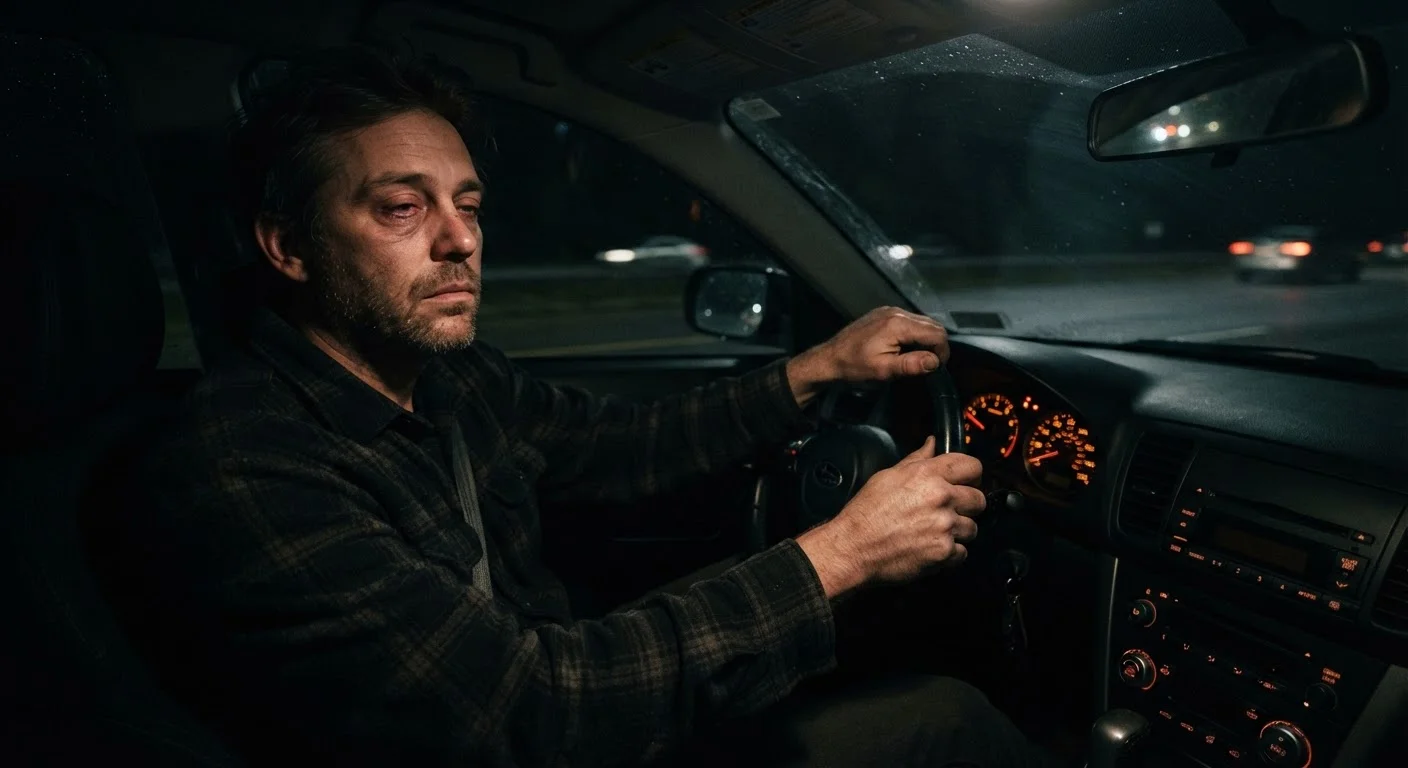
Fatigue impairs driving through a different but overlapping set of mechanisms. Sleep-deprived drivers experience slower reaction times, reduced ability to sustain attention, and degraded decision-making - effects that closely mirror alcohol's impact. What makes drowsy driving uniquely dangerous is the phenomenon of microsleeps: brief, involuntary sleep episodes lasting between one and ten seconds. At 60 mph, a two-second microsleep means traveling roughly 176 feet with no driver awareness whatsoever.
Unlike alcohol, fatigue also tends to be underestimated by those experiencing it. People who are acutely sleep-deprived often believe they are performing adequately, even when objective tests show significant impairment. This self-assessment gap creates a particular hazard on long drives. For context on how fatigue compounds with other nighttime challenges, see our guide to night driving hazards.
| Criterion | Drowsy Driving | Drunk Driving |
|---|---|---|
| Reaction time | Significantly slowed | Significantly slowed |
| Lane control | Degraded; drifting common | Degraded; weaving common |
| Judgment and risk assessment | Impaired; underestimation of fatigue | Impaired; overconfidence typical |
| Unique danger | Microsleeps (1-10 seconds of unconsciousness) | Reduced inhibition; increased risk-taking |
| Roadside detection | No standardized test available | Breathalyzer and blood tests available |
| Legal threshold | None defined in law | 0.08% BAC for adults (all US states) |
| Self-awareness of impairment | Often underestimated by driver | Variable; often underestimated |
| Crash reporting accuracy | Widely believed to be underreported | Better documented due to testing |
Detection, Measurement, and Legal Accountability
One of the most significant practical differences between these two forms of impairment is measurability. Alcohol impairment can be assessed at the roadside using a breathalyzer and confirmed with a blood test. There are established legal thresholds (0.08% BAC for adults in the US), and law enforcement has standardized protocols for identifying and prosecuting impaired drivers.
Drowsy driving has no equivalent tool. There is no roadside breathalyzer for fatigue, no accepted biological marker law enforcement can test in the field, and no legal BAC-style threshold for sleep deprivation. This absence makes drowsy driving crashes far harder to attribute officially - researchers believe drowsy driving is significantly underreported in crash statistics as a result.
Drowsy Driving Is Chronically Underreported
Traffic safety researchers widely acknowledge that official crash statistics undercount drowsy driving as a contributing factor. Without a reliable roadside test for fatigue, investigators often cannot determine that sleepiness caused or contributed to a crash. Some estimates suggest the true number of drowsy driving crashes is several times higher than official figures indicate. This data gap makes it harder to allocate public safety resources and raise awareness proportionate to the actual risk.
The legal asymmetry matters for families: a drunk driving crash creates a clear paper trail of impairment and accountability. A drowsy driving crash may be filed simply as a single-vehicle or inattention crash, without capturing the underlying cause. This gap in data may contribute to public underestimation of drowsy driving's true toll on road safety.
Recognizing the Warning Signs and Reducing Your Risk
Because fatigue lacks an external enforcement mechanism, the responsibility falls on individual drivers to recognize their own impairment early. Key warning signs include: frequent yawning, heavy eyelids, difficulty maintaining speed or lane position, missing exits, and an inability to remember the last few miles driven.
If any of these signs appear, the safest response is to exit the road, find a safe location, and rest. A short nap of 20 minutes can restore alertness temporarily. Caffeine can provide modest short-term benefit but is not a substitute for sleep, and its effects wear off. Driving with the windows down or turning up the radio are not reliable countermeasures.
~18-20 hrs
Wakefulness equivalent to 0.08% BAC
Research cited by the AAA Foundation for Traffic Safety and other institutions suggests this approximate equivalence in driving performance degradation.
1 in 25
Adult drivers report falling asleep at the wheel in the past 30 days
According to the Centers for Disease Control and Prevention (CDC), self-reported drowsy driving is more common than many drivers assume.
176 feet
Distance traveled in a 2-second microsleep at 60 mph
A vehicle traveling at highway speed covers this distance with no driver input during even a brief involuntary sleep episode.
For long family road trips, planning scheduled rest stops every two hours or 100 miles is a practical strategy recommended by safety organizations. Traveling during your normal waking hours and sharing driving duties where possible also reduces cumulative fatigue risk.
Cognitive distractions compound the problem - a fatigued brain is even less equipped to handle divided attention. Our article on distracted driving explores how cognitive load affects reaction time even in alert drivers.
This article is for general educational purposes only and does not constitute legal or safety advice. Always follow the laws and regulations applicable in your state, and consult relevant authorities or safety professionals for guidance specific to your situation.