

Key Takeaways
Why Seasonal Maintenance Is Different from Regular Service
Most families are familiar with the idea of regular oil changes and tire rotations, but seasonal maintenance addresses something different: the specific stresses each time of year places on your vehicle's systems. Temperature swings, road salt, summer heat, and spring potholes don't follow a mileage-based schedule - they follow the calendar.
Think of your complete car maintenance routine as having two layers: the manufacturer's mileage-based service intervals, and a seasonal overlay that catches weather-driven wear before it becomes a breakdown. This article focuses on that second layer - the checks and adjustments that make a real difference at each transition.
Check Your Owner's Manual First
Every vehicle has manufacturer-specified service intervals that may differ from general seasonal guidance. Your owner's manual is the authoritative source for fluid types, filter replacement schedules, and inspection intervals. When in doubt, it overrides generic advice. For a deeper look at interpreting those intervals, see Your Car's Maintenance Schedule, Explained.
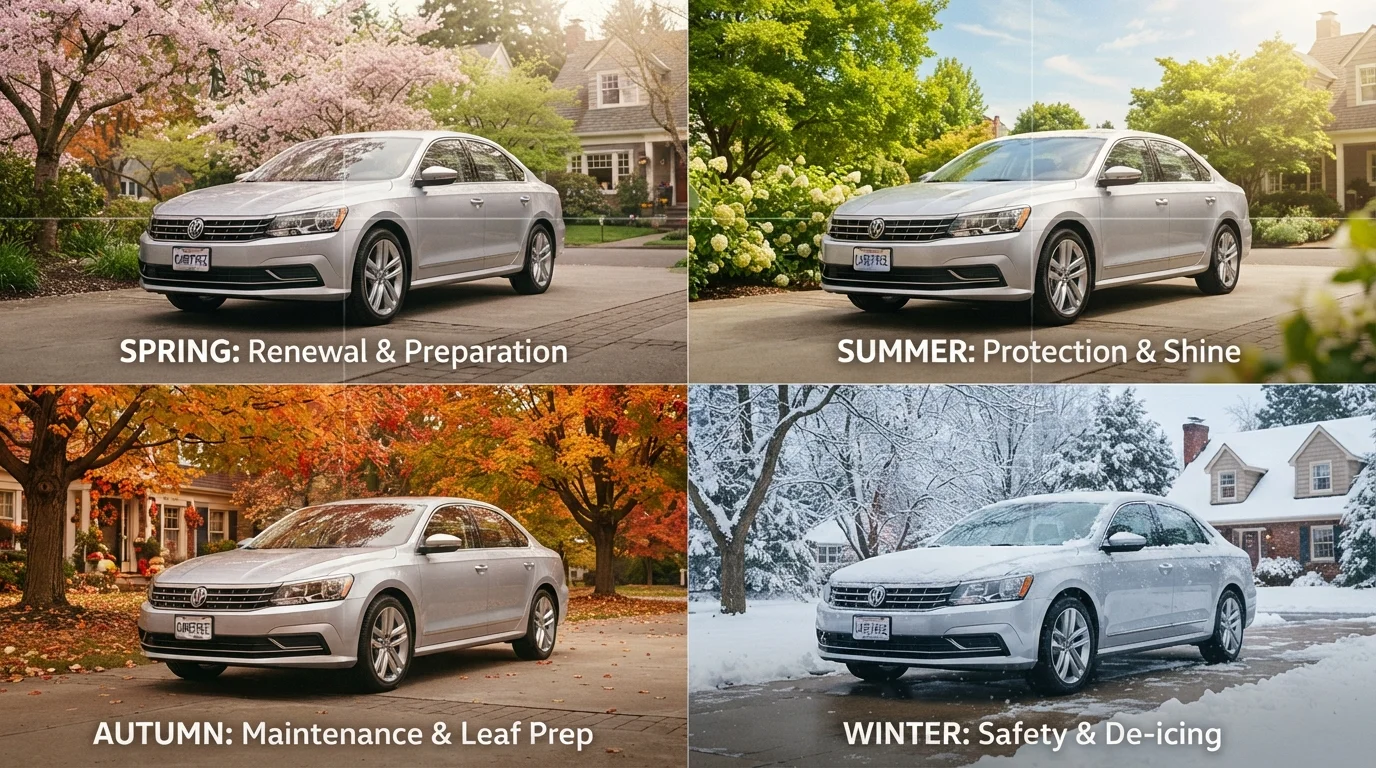
Spring: Undo Winter's Damage
Winter is hard on vehicles. Road salt accelerates corrosion on brake lines and undercarriage components, cold temperatures stress the battery and tires, and frozen-road impacts can knock wheels out of alignment. Spring is your window to assess and address that accumulated wear.
- Wash the undercarriage thoroughly to remove salt before it continues corroding metal components.
- Check alignment and suspension if the vehicle pulls to one side or the steering wheel vibrates - winter potholes are a common culprit.
- Inspect brake pads and rotors while winter grime is being cleaned off anyway.
- Swap to all-season or summer tires if you ran dedicated winter tires - and check pressure after the swap, as warmer air expands tire pressure slightly.
Spring is also an ideal time to review your pre-road-trip safety checklist before summer vacation season begins.
Summer and Fall: The High-Stakes Transitions
Summer brings its own hazards: overheating engines, UV-damaged rubber belts and hoses, and air conditioning systems pressed into daily service. Fall, meanwhile, is arguably the most critical seasonal transition - it's your last reasonable window to prepare for winter before conditions become dangerous.
Inspect and inflate tires at every seasonal transition.
Tire pressure drops roughly one PSI for every 10°F decrease in temperature, meaning winter-ready pressure is critically different from summer levels. Under-inflated tires increase stopping distances, reduce fuel economy, and wear unevenly. Catching this at the season change - rather than mid-winter - keeps handling predictable. For a full checklist, see Tire Pressure, Tread Depth, and Rotation.
Test your battery before summer heat and winter cold arrive.
Extreme temperatures are a battery's primary enemy - heat degrades internal chemistry while cold reduces cranking power. A battery weakened by one season may fail entirely in the next. A load test, available at most auto parts stores, reveals remaining capacity before it leaves you stranded.
Flush and refill coolant according to your vehicle's service schedule.
Coolant (antifreeze) degrades over time, losing its ability to regulate engine temperature in both summer heat and winter freeze conditions. Old coolant becomes acidic and can corrode cooling system components. Addressing this at spring or fall service intervals keeps the system effective year-round.
Replace wiper blades before the season that demands them most.
Spring rain and winter snow both require wipers that clear completely and consistently. Degraded blades streak or skip, reducing visibility at the moments when it matters most. Replacing them proactively is inexpensive and takes minutes.
Check all lights and replace burned bulbs promptly.
Shorter daylight hours in fall and winter mean families spend more time driving in reduced visibility. A burned-out taillight or headlight is both a safety risk and a ticketable offense in every US state. A quick walkaround inspection each season takes under five minutes.
Refresh your cabin air filter and emergency kit each spring and fall.
A clogged cabin air filter restricts airflow to heating and cooling systems, reducing effectiveness and circulating pollen or mold spores through the interior - a real concern for families with allergy sufferers. Your emergency kit should also be restocked seasonally to include weather-appropriate items.
If your vehicle has higher mileage, these transition points become even more important. Certain components that hold up fine under moderate conditions can fail faster under temperature extremes. The high-mileage vehicle care guide outlines what to watch more closely once you pass 100,000 miles.
Winter: Survive the Season Safely
Once winter arrives, your maintenance window narrows - it's no longer about preparation, it's about monitoring. Cold weather amplifies every existing weakness in your vehicle's systems, so the goal is to have resolved issues before the first serious freeze.
During winter months, focus on:
- Checking tire pressure monthly, since cold air causes consistent pressure loss.
- Monitoring washer fluid levels and using a formula rated for freezing temperatures.
- Keeping the gas tank at least half full - this reduces moisture in the fuel system and adds weight for traction in rear-wheel-drive vehicles.
- Watching for any change in how the heater or defroster performs, which can signal coolant or blower issues.
Driving safely in winter conditions also comes down to habits and preparedness. The Safe Driving hub covers techniques and situational awareness for challenging road conditions.
Pair Car Care With Home Seasonal Routines
Many families already schedule home tasks by season - it's easy to bundle vehicle checks into the same weekend. Just as you'd winterize your lawn or prepare your deck before cold weather, a quick car inspection fits naturally into the same fall-prep mindset. Planning both together means nothing gets overlooked.
Building the Habit: Making It Stick Year After Year
The most effective seasonal routine is one you'll actually follow. Tying car checks to events that already happen on a schedule - daylight saving time changes, school year start, a seasonal oil change - makes the habit automatic rather than aspirational.
~1 PSI
Tire pressure lost per 10°F temperature drop
A well-established principle in tire engineering used by the U.S. Department of Transportation in public tire safety guidance.
35%
Of roadside breakdowns attributed to tire issues
Tire-related problems consistently rank among the leading causes of roadside emergencies according to AAA roadside assistance data.
4x
Higher breakdown rate for vehicles skipping seasonal checks
Industry maintenance data consistently shows deferred maintenance significantly increases unplanned failure rates, particularly at seasonal extremes.
Keep a simple log - even a notes app entry - of what you checked and when. This builds a maintenance history that's useful for catching patterns (a tire that keeps losing pressure suggests a slow leak, not a temperature issue) and can add credibility if you sell the vehicle. For a broader framework covering every major maintenance area, The Complete Family Car Maintenance Playbook is the companion guide to bookmark.
“Preventive maintenance is simply trading a small, predictable cost today for the avoidance of a large, unpredictable cost tomorrow. Seasonal checks are the clearest example of this logic in everyday driving.”
— Cars & Driving Editorial Team, Automotive maintenance editors covering family vehicle ownership