

Key Takeaways
Our Verdict
For most existing homes, blown-in insulation offers the best balance of cost, ease of installation, and performance in attics and wall cavities. Spray foam leads on air sealing and moisture control in critical areas, while rigid foam and batt insulation serve specific retrofit scenarios well. The right choice depends on where you're insulating, your budget, and how much disruption you can tolerate.
| Best for | Recommended |
|---|---|
| Homeowners upgrading attic insulation with minimal disruption | Blown-in (loose-fill) insulation |
| Sealing rim joists, crawl spaces, or hard-to-reach gaps | Spray foam insulation |
| Basement walls and below-grade applications with moisture exposure | Rigid foam board insulation |
| Open wall cavities during a renovation or remodel | Batt insulation |
Why Retrofit Insulation Is Different From New Construction
Adding insulation to an existing home is rarely as straightforward as building it in from the start. Walls are closed, attics may have old materials to work around, and access points are limited. Before committing to any insulation type, it helps to understand what's already in place. A room-by-room weatherization audit can reveal gaps in insulation coverage, moisture issues, and air leaks that influence which material will actually perform well in your specific home.
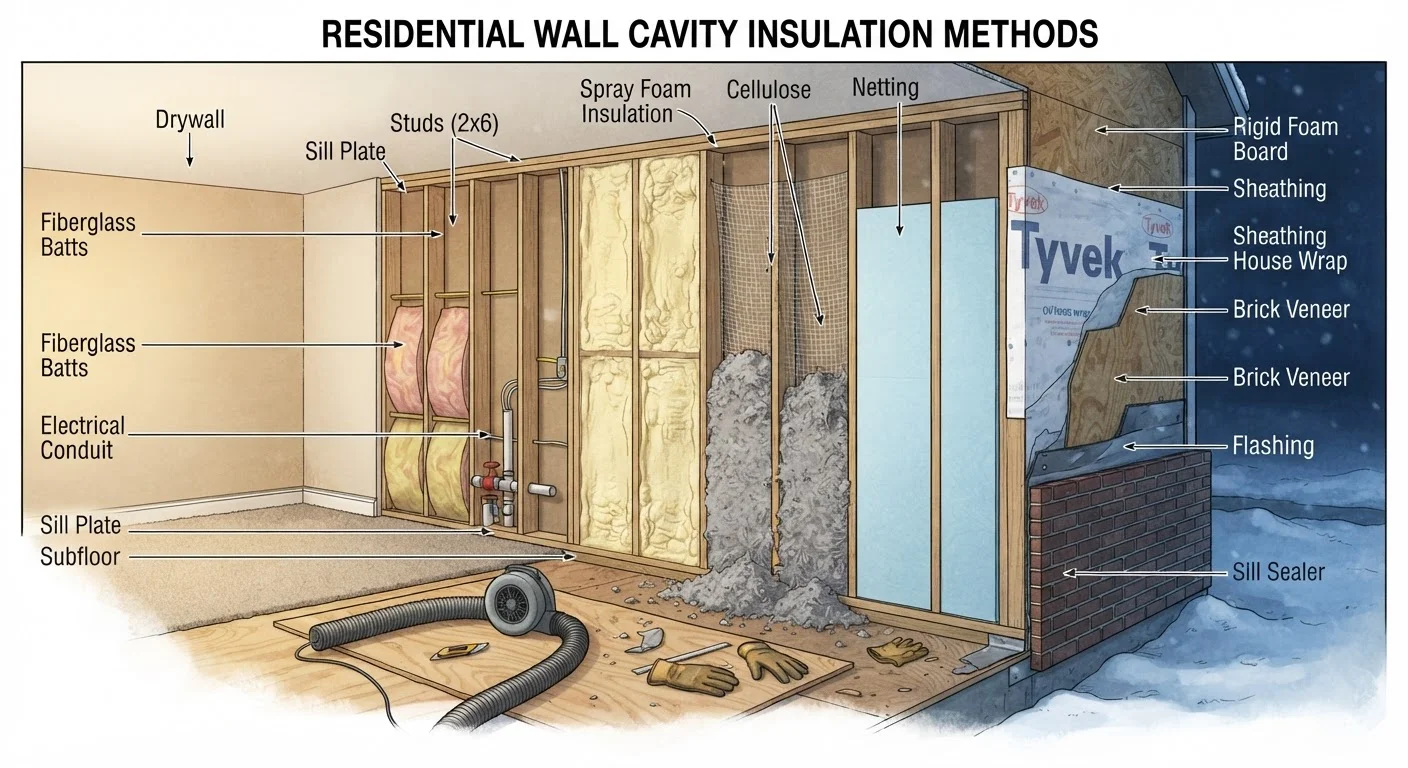
The four insulation types most commonly used in retrofit projects are blown-in (loose-fill), batt, rigid foam board, and spray foam. Each has distinct strengths, and each is better suited to certain locations in the home.
Blown-In (Loose-Fill) Insulation
Blown-in insulation — made from cellulose, fiberglass, or mineral wool — is installed using a hose that fills a space with loose material. It's a strong choice for existing attics because it can be added on top of current insulation without removing drywall or opening wall cavities. It conforms well to irregular spaces and around obstructions like joists and pipes.
Typical R-value: R-2.2 to R-3.8 per inch, depending on material. Cellulose tends to perform slightly better at air resistance than fiberglass loose-fill.
Limitations: Blown-in insulation can settle over time, particularly cellulose, which may reduce its effective R-value. It also requires proper air sealing beneath it — insulation alone does not stop air movement.
| Blown-In | Batt/Roll | Rigid Foam Board | Spray Foam | |
|---|---|---|---|---|
| Best retrofit location | Attics, closed walls | Open wall cavities | Basements, crawl spaces | Rim joists, gaps, crawl spaces |
| R-value per inch | R-2.2 to R-3.8 | R-3.1 to R-4.3 | R-3.8 to R-6.5 | R-3.5 to R-7.0 |
| Air sealing benefit | Low (needs separate sealing) | Low | Moderate (with taped seams) | High (especially closed-cell) |
| Moisture resistance | Low–Moderate | Low | High | High (closed-cell) |
| DIY friendliness | Moderate (rentable blower) | High | Moderate | Low (pro recommended) |
| Relative cost | Low–Moderate | Low | Moderate | High |
| Disruption to home | Low | High (open walls needed) | Low–Moderate | Low–Moderate |
Batt and Roll Insulation
Fiberglass or mineral wool batts are the familiar pink or yellow rolls found in most hardware stores. They fit between standard-spaced studs and joists, making them well-suited for open wall cavities during a renovation. For existing homes, their use is largely limited to situations where walls or ceilings are already open — such as during a remodel or when finishing a basement.
Typical R-value: R-3.1 to R-4.3 per inch for fiberglass; mineral wool batts trend slightly higher.
Limitations: Batts must be cut and fitted carefully to avoid gaps and compression, both of which significantly reduce performance. They offer minimal air-sealing benefit on their own and are impractical in closed wall cavities without major demolition.
Don't Skip Air Sealing First
Insulation slows heat transfer but does not stop air movement. Before adding any insulation type, seal gaps around electrical boxes, plumbing penetrations, and attic bypasses with caulk or expanding foam sealant. Air sealing and insulation work together — neither performs as well without the other.
Rigid Foam Board Insulation
Rigid foam panels — typically extruded polystyrene (XPS), expanded polystyrene (EPS), or polyisocyanurate — are cut to size and adhered or mechanically fastened to surfaces. They're commonly used in basement walls, crawl spaces, and the exterior sheathing of homes during a re-siding project. Their moisture resistance makes them particularly valuable in below-grade environments.
Typical R-value: R-3.8 to R-6.5 per inch, with polyisocyanurate offering the highest values.
Limitations: Rigid foam requires careful seaming and taping at joints to perform well. Some foam types are flammable and must be covered with a thermal barrier (such as drywall) per most building codes. Verify local code requirements before installing.
Spray Foam Insulation
Spray polyurethane foam (SPF) comes in two forms: open-cell and closed-cell. Open-cell foam is softer and expands significantly, making it useful for filling irregular cavities. Closed-cell foam is denser, provides a higher R-value per inch, and acts as both an insulator and a vapor barrier — valuable in climates with extreme temperature swings.
Typical R-value: R-3.5 to R-3.7 per inch (open-cell); R-6.0 to R-7.0 per inch (closed-cell).
Limitations: Spray foam is the most expensive option and is typically best installed by a professional due to the chemicals involved and the precision required. Improper mixing can result in off-gassing issues. It also cannot be easily removed or adjusted after curing.
It's worth noting that not every insulation upgrade delivers the payback homeowners expect. Understanding realistic performance gains helps set appropriate expectations before investing.
Permits and Professional Assessment Matter
Many insulation projects in existing homes — particularly spray foam in enclosed spaces or any work touching electrical, structural, or HVAC elements — may require permits or inspections depending on your municipality. Always check local building codes before starting work. When in doubt, consult a licensed insulation contractor or energy auditor to evaluate your home's specific needs.