

Key Takeaways
Start here
What Makes Yellowstone Different From Other Family Parks
Essential knowledge
Safety Rules Every Family Must Know
Match to your family
What Ages Actually Enjoy Yellowstone
In the field
Wildlife Etiquette With Kids in Tow
Before you go
Practical Logistics: Planning Your Visit
What Makes Yellowstone Different From Other Family Parks
Yellowstone isn't a conventional family park with gentle trails and shaded picnic lawns. It's an active volcanic system — a genuinely wild, unpredictable landscape that happens to be accessible to families willing to engage on its terms. The payoff is extraordinary: geysers erupting on schedule, prismatic springs glowing with impossible color, bison grazing roadside, and wolves visible from designated pullouts. No other park in the US delivers this combination.
That said, Yellowstone demands more preparation than most destinations. The elevation sits between 7,700 and 8,000 feet across much of the park, meaning altitude adjustment is real for families arriving from sea level. Distances between major sites are significant — the Grand Loop Road covers roughly 142 miles. And the thermal features that make the park magical are also genuinely hazardous. Understanding both sides of that equation before you arrive is what separates a memorable trip from a stressful one.
For a broader comparison of how Yellowstone stacks up against other national parks for families with young children, see our guide to national parks that work well for families with young kids.
Geothermal feature
A natural formation powered by heat from the earth's interior, including geysers, hot springs, fumaroles, and mud pots. At Yellowstone, these features can reach scalding temperatures and are surrounded by fragile crust.
Grand Loop Road
The main figure-eight road system inside Yellowstone that connects the park's major districts and attractions, covering approximately 142 miles total.
Junior Ranger Program
A National Park Service activity program for children that involves completing an age-appropriate booklet and earning an official badge from a park ranger — available at Yellowstone visitor centers.
Wildlife buffer distance
The legally required minimum distance visitors must keep from animals in the park: 25 yards for most wildlife, 100 yards for bears and wolves.
Bear spray
A canister of capsaicin-based deterrent spray designed to stop a bear attack. It is recommended — and widely considered essential — for hiking in Yellowstone's backcountry and many front-country trails.
Safety Rules Every Family Must Know
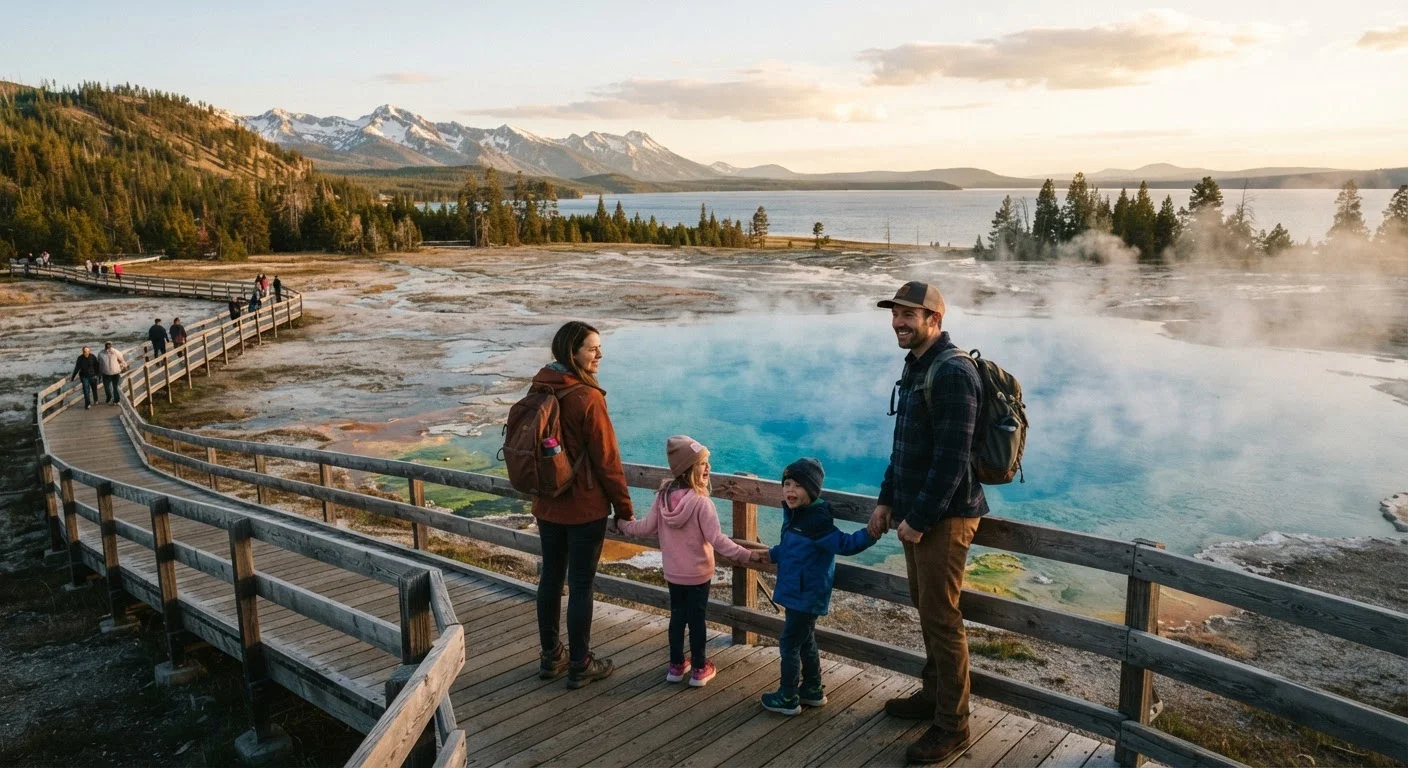
Thermal areas are the park's most serious hazard. The ground near hot springs and geysers can be thin crust over scalding water, and staying on designated boardwalks isn't just recommended — it's essential. Children should be kept within arm's reach at all times in these zones, and strollers should remain on paved or boardwalk surfaces only.
Thermal Ground Is Dangerously Unstable
Each year, visitors sustain serious injuries by stepping off boardwalks near thermal features. The crust can give way instantly, and the water below reaches temperatures that cause severe burns within seconds. Children should never run near geothermal areas, and adults should hold hands with young children at all times on boardwalk sections.
The rule of thumb is simple: if there's no boardwalk, there's no safe access. This applies even when ground looks firm or other visitors appear to be walking off-trail — don't follow their lead.
Beyond thermals, wildlife poses a separate but equally serious consideration. Bear spray should be carried by adults on any trail away from geyser boardwalks, and families should know how to use it before setting out. Keep food in bear-resistant containers or vehicle trunks. Never feed any wildlife, even ground squirrels — it habituates animals in ways that create danger for future visitors.
What Ages Actually Enjoy Yellowstone
Honest answer: school-age children from about 6 onward tend to get the most out of Yellowstone. They can walk reasonable distances, retain what they observe, and engage meaningfully with the Junior Ranger program. The experience connects in a way that sticks.
Toddlers and preschoolers can absolutely visit — Old Faithful's predictable eruptions, the vivid colors of Grand Prismatic Spring viewed from the overlook trail, and roadside bison sightings all register as genuine wonder for small children. But the experience needs to be structured around very short excursions with frequent rest, snacks, and flexibility when meltdowns arrive on cue.
Teenagers, particularly those with interest in geology, ecology, or photography, often find Yellowstone unexpectedly engaging. The park's scale and complexity hold up against adolescent skepticism better than many expect. Our age-by-age guide to what children get out of travel offers useful framing for calibrating expectations to your kids' specific developmental stages.
Wildlife Etiquette With Kids in Tow
Wildlife sightings are a highlight families talk about for years — but they require discipline in the moment. The mandatory minimums are 25 yards from bison, elk, and most other animals, and 100 yards from bears and wolves. These aren't suggestions: rangers issue fines for violations, and the animals are unpredictable regardless of how calm they appear.
Bison are the most commonly encountered large animal and also the most frequently involved in visitor incidents. They move quickly and without warning. If your child wants to photograph a bison near the road, pull safely off the road, stay inside or immediately beside your vehicle, and use a zoom lens or phone telephoto setting.
Use the 'wildlife rotation' strategy
When sightings draw a crowd and younger kids are flagging, designate one adult as the watcher while another keeps smaller children occupied with snacks or a simple scavenger hunt nearby. Swap every five minutes so no one misses the moment. This keeps the experience positive for everyone without forcing toddlers to stand still for twenty minutes.
For mixed-age families where older kids want longer wildlife viewing and younger ones are losing patience, having a clear rotation plan — five minutes watching, then back to a snack in the car — keeps everyone regulated. See our resource on pacing and activities for mixed-age families for more on managing that dynamic.
Practical Logistics: Planning Your Visit
Accommodation inside and near the park books up many months in advance for peak summer dates. Lodging options range from cabins within the park to full hotels and campgrounds — each has different trade-offs around space, kitchen access, and proximity to major sites. Our comparison of hotels versus vacation rentals for families with young kids walks through what to weigh when children are involved.
Cell coverage inside Yellowstone is limited and unreliable. Download offline maps before entry, carry a printed park map, and plan driving routes around your chosen sites the night before. Gas up outside the park when possible — options inside are limited and lines can form.
Finally, build in more time than you think you need. Traffic jams caused by bison herds, geyser viewing waits, and tired children all compress schedules unexpectedly. A well-paced three-day itinerary covering two park districts will deliver more family satisfaction than an exhausting five-district dash. Yellowstone rewards patience — and so does traveling with kids.
NPS Yellowstone Official Website
The National Park Service's official Yellowstone site provides current road conditions, geyser eruption predictions, entry fee information, and safety guidelines — the most reliable source before and during your visit.
Junior Ranger Activity Booklet
Available at Yellowstone visitor centers and downloadable from the NPS website, the Junior Ranger booklet gives school-age children age-appropriate activities tied directly to what they'll see in the park.
Yellowstone Association Institute
Offers family-oriented educational programs and field seminars inside the park, including wildlife observation courses that teach responsible viewing skills useful for parents and older children alike.