

Key Takeaways
Why Family Overpacking Happens (and What It Actually Costs You)
Overpacking is almost never careless — it comes from love and anxiety. Parents want to be prepared for every scenario: a blowout, a rainy afternoon, a fancy dinner that gets spontaneously added to the itinerary. The result is luggage that's too heavy to lift into the overhead bin, checked bags that cost real money, and a physical burden that makes navigating airports, train stations, and city sidewalks significantly harder.
The financial side adds up fast. Checked baggage fees for a family of four on a round trip can easily reach $200–$300 depending on the airline and route. That's money that could cover a museum admission, a nice dinner, or two extra nights of gas money on a road trip. Beyond fees, heavy bags slow everyone down and amplify the stress of travel days — exactly the opposite of what a family vacation is supposed to feel like.
If you're new to family travel, our practical first family vacation guide covers how to set realistic expectations from the very beginning, including packing scope relative to trip length.
What you will need
What You Need Before You Start Packing
Efficient packing starts well before a bag is opened. The decisions you make in the planning phase — destination type, accommodation, transportation mode, trip length — determine what actually belongs on your list. A family heading to a national park has gear requirements that look nothing like a family spending a week at a beach rental with a fully stocked kitchen.
Think through your accommodation carefully. Hotels versus vacation rentals each have implications for what you need to bring: a vacation rental with a washer/dryer cuts your clothing needs in half, while a hotel stay typically means more toiletries and fewer kitchen supplies.
Gather the tools that make efficient packing possible before you start.
Packing cubes
Compress and organize clothing by person or category, making it easy to find items without unpacking everything.
Hanging toiletry bag
Keeps shared toiletries consolidated and accessible in hotel bathrooms without cluttering counter space.
Luggage scale
Confirms bag weight before departure so you avoid airline overweight fees at check-in.
Child-sized daypack
Gives each child their own carry-on space for a comfort item, snacks, and entertainment, reducing pressure on parent bags.
Reusable zip-top bags
Contain liquids, organize small accessories, and handle unexpected spills or wet swimwear.
Step-by-Step: How to Pack Light Without Leaving Essentials Behind
The steps below form a repeatable framework you can use for any trip, regardless of your family's size or ages. Work through them in order — each one builds on the last. Skipping ahead typically leads to the same overpacking habits you're trying to break.
Build a trip-specific master list before touching a single bag
Open a shared notes app or grab a piece of paper and draft one list per family member. Ground every entry in the specific trip: a beach week has completely different requirements than a national park hike or a city long weekend. For each person, think through three categories: clothing, toiletries and health, and activity-specific gear. Resist the urge to copy a generic internet checklist wholesale — those are starting points, not finished plans.
Apply the capsule wardrobe rule to every family member
For each person, select a core palette of two or three coordinating colors so that every top works with every bottom. As a general guideline, plan for roughly one outfit per two days for trips longer than four nights — with access to laundry — or one outfit per day for shorter trips. Lay every clothing item out on a bed before packing. If it doesn't pair with at least two other pieces already in the pile, set it aside.
Decide what to buy at the destination instead of packing
Heavy or bulky items — sunscreen, beach toys, diapers, bottled water, and certain snacks — are almost always available at your destination, often at comparable prices. Make a short list of these items and plan to purchase them on arrival rather than hauling them from home. This is especially valuable for families flying, where weight limits make every ounce count. Factor this into your travel budget upfront so it doesn't feel like an unexpected expense.
Assign each child their own bag with clear ownership
Children ages four and up can typically manage a small backpack comfortably. Let each child pack their own comfort item, one small activity (a book, a tablet, a travel game), and any snacks you've pre-approved. This does two things: it reduces how much you have to carry, and it gives children a stake in the trip. Older kids can also handle a small rolling carry-on with their own clothing if the trip warrants it.
Use packing cubes to load bags efficiently
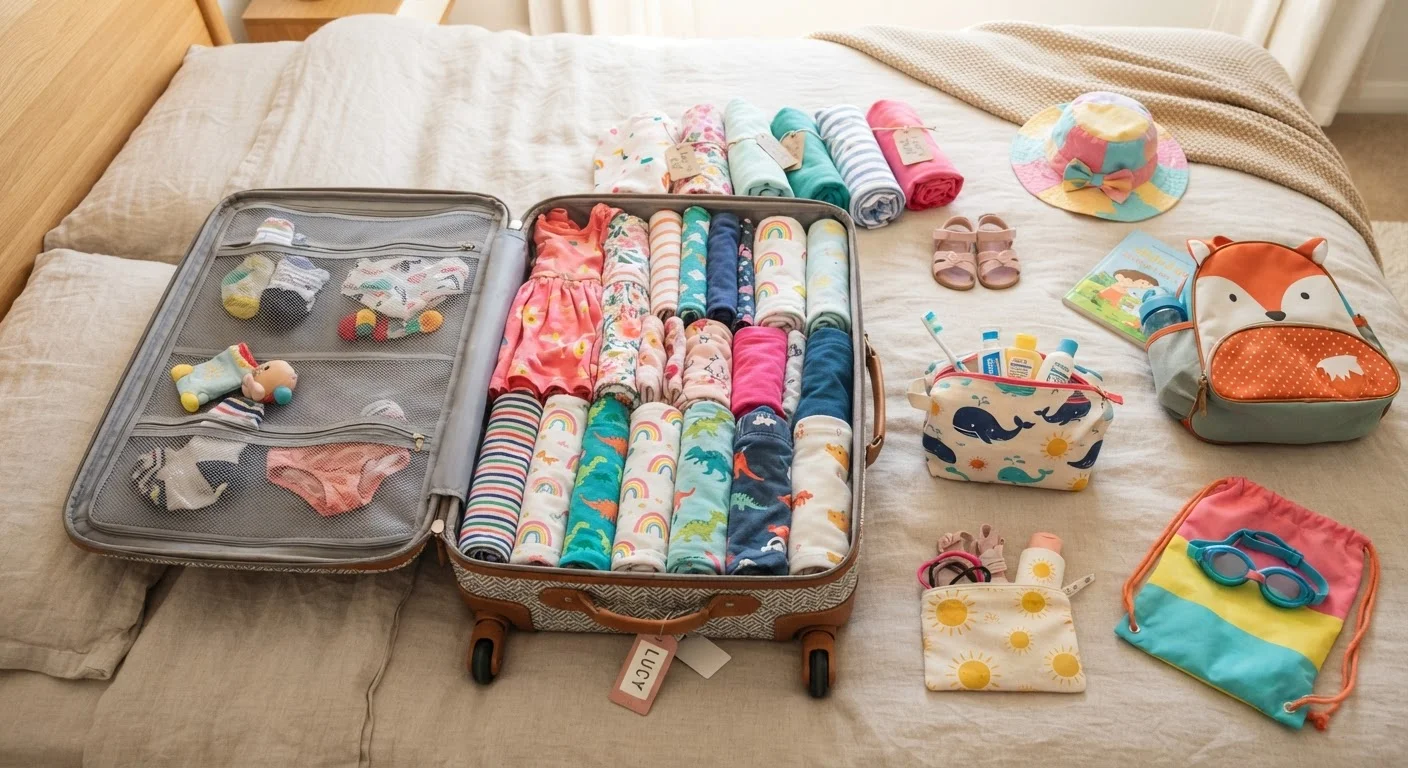
Assign one cube per person or one cube per clothing category (tops, bottoms, sleepwear). Roll clothing rather than folding it — rolling typically reduces wrinkles and saves space. Pack heaviest items closest to the wheeled base of a rolling bag, and place frequently needed items (like a child's change of clothes) in an outer pocket for easy access during travel days. Weigh each bag with a luggage scale before leaving home.
Do a final pass: the "challenge every item" edit
With bags fully packed, go through each one item by item and ask: Would I miss this if it weren't here? and Could I borrow, buy, or do without it at the destination? If the answer to both is no, remove it. This edit typically surfaces at least three to five items per bag that crept in out of habit rather than necessity. Return those items to the drawer, zip your bags, and you're genuinely ready.
Laundry Access Changes Everything
If your accommodation has an in-unit washer/dryer or a laundromat nearby, you can cut your clothing count nearly in half. When comparing hotels versus vacation rentals, laundry access is one of the most underrated factors for families on trips longer than four nights.
Don't Pack Medications Without a Plan
Always bring any prescription medications in their original labeled containers, in sufficient supply for the entire trip plus a buffer of a few extra days. Keep them in your carry-on, never in checked luggage. Consult your child's healthcare provider before travel if you have questions about managing medications on the road — this is especially important for time-zone changes or temperature-sensitive medications.
Carry-On vs. Checked: Know Before You Pack
TSA rules for liquids apply to all carry-on bags, including children's bags. Containers over 3.4 oz (100 ml) must go in checked luggage or be purchased after security. Verify current TSA guidelines at tsa.gov before you finalize your packing — rules can and do change, and screening agents follow the policy in effect on the day you fly.
For a broader pre-departure checklist that goes beyond packing — covering documents, home security, and health prep — see our complete family travel prep checklist.
After the Trip: Building a Smarter List for Next Time
Within a day or two of returning home, do a quick audit while the trip is fresh. What did you pack and never touch? What did you wish you'd brought? Write it down and save it as a template for your next trip. Families who travel regularly tend to refine this list over several trips until it becomes nearly automatic — a habit that experienced family travelers consistently rely on. You can explore more of those smart habits that experienced family travelers use to keep every trip smoother than the last.
Children's needs shift as they grow, so revisit your template before each trip rather than assuming last year's list still applies. A toddler's packing list looks almost nothing like a ten-year-old's — and a teenager's is different again. The family travel resource from baby to teen is a helpful reference as your family moves through different stages. The goal isn't a perfect list on the first try — it's a progressively better list every time you travel together.