

Key Takeaways
Why Screen Time Debates Feel So Charged
Few parenting topics generate as much worry - or as many conflicting headlines - as screen time. One study links heavy use to attention difficulties; the next suggests educational apps boost early literacy. For families trying to make thoughtful decisions, sorting signal from noise is genuinely hard.
The honest starting point is that screen time is not a single behavior. Watching a nature documentary with a parent, video-chatting with a grandparent, or playing an open-ended puzzle game are all categorized as "screen time," yet they have almost nothing in common in terms of how a child engages with them. Research that lumps these experiences together produces conclusions that are difficult to apply at home.
For a broader look at what the evidence actually shows across sleep, attention, and development, see our in-depth review of screen time and children's health.
Myth
Any screen time under age two causes developmental harm.
Fact
The AAP makes an exception for video chatting even for infants, and its guidance focuses on quality and context rather than a flat prohibition.
The original AAP recommendation to avoid screens entirely before age two has been updated. Current guidance acknowledges that live video calls - with a grandparent, for example - involve real social interaction and are treated differently from passive background television. The concern with very young children centers on passive, fast-paced content that offers no interactive or responsive element, not screens categorically.
Myth
More screen time always leads to worse social skills in children.
Fact
The relationship between screens and social development depends heavily on the type of content and whether a caregiver is involved.
Some research does find associations between very high volumes of passive screen use and reduced social interaction, but the effect sizes are often modest and confounded by other factors. Interactive video calls and cooperative games that involve real communication with peers can actually support social connection. The displacement hypothesis - that screens replace social time - is more meaningful when checking whether children have adequate opportunities for face-to-face play, not whether they've touched a screen at all.
Myth
Educational apps and programs reliably teach young children the same way in-person instruction does.
Fact
Young children under about age two-and-a-half typically learn less from screens than from live human interaction - a phenomenon researchers call the 'video deficit effect.'
Studies have found that toddlers have more difficulty transferring what they observe on a screen to real-world tasks compared to seeing the same demonstration in person. This effect diminishes as children get older and better understand that screen representations relate to real objects. For older preschoolers and school-age children, well-designed interactive programs can provide genuine learning value - but even then, caregiver involvement significantly improves outcomes.
Myth
Screen time is the primary cause of childhood obesity.
Fact
Screen time is one factor among many associated with sedentary behavior, but it doesn't operate in isolation from diet, sleep, physical activity, and family environment.
The concern is largely about displacement - time spent on screens is time not spent on physical activity - and about exposure to food marketing. These are real considerations. However, treating screens as the single lever for childhood weight is not consistent with the evidence. Families who maintain regular physical activity, consistent sleep, and balanced eating patterns tend to see better outcomes regardless of screen time levels. The more useful question is whether movement and active play are well-represented in a child's day.
Myth
A strict no-screens policy is the gold standard for raising healthy children.
Fact
No broad evidence base supports total screen avoidance as the healthiest approach for families; what matters more is intentional, engaged use.
Health guidelines from bodies like the AAP and the World Health Organization emphasize quality, context, and balance over elimination. In a world where screens are tools for learning, communication, and creative expression, developing children's ability to use them thoughtfully may be more valuable long-term than avoiding them. The goal most evidence-informed approaches share is ensuring screens don't consistently crowd out sleep, movement, outdoor time, or face-to-face connection - not removing technology from family life entirely. For more on this balance, see our piece on digital wellness versus digital detox.
What the Evidence Does - and Doesn't - Say
A few findings from the research hold up consistently across multiple well-designed studies. Evening screen exposure - particularly from devices held close to the face - is associated with delayed sleep onset in both children and adults. This is plausible given what we know about short-wavelength light and melatonin suppression, and the sleep connection is one area where a practical household habit (a screen-free wind-down period) has a reasonable evidence base behind it.
On the other hand, panic-driven claims that screens categorically damage developing brains, ruin social skills, or cause lasting emotional harm are not well supported by the current body of research. The American Academy of Pediatrics (AAP) updated its guidance partly in recognition that early strict time-limit recommendations were not sufficiently nuanced for how families actually use technology today.
~60%
Children ages 8-12 using screens 4+ hours daily
Common Sense Media's research on children's media use has found a substantial portion of tweens regularly exceed four hours of daily screen time across devices.
2+ hours
Recommended daily physical activity for school-age children
The WHO recommends at least 60 minutes of moderate-to-vigorous activity daily for children aged 5-17; screen habits that displace movement are the primary concern, not screens themselves.
Stress from feeling out of control of technology habits can itself affect family wellbeing. Our explainer on how household stress spreads covers practical ways to ease that tension at home.
Building Sustainable Habits Around Technology
Rather than chasing an arbitrary daily minute count, families generally benefit more from focusing on what screens are replacing. If device use is consistently crowding out sleep, physical activity, face-to-face conversation, or outdoor play, those are the concrete gaps worth addressing - regardless of the total time involved.
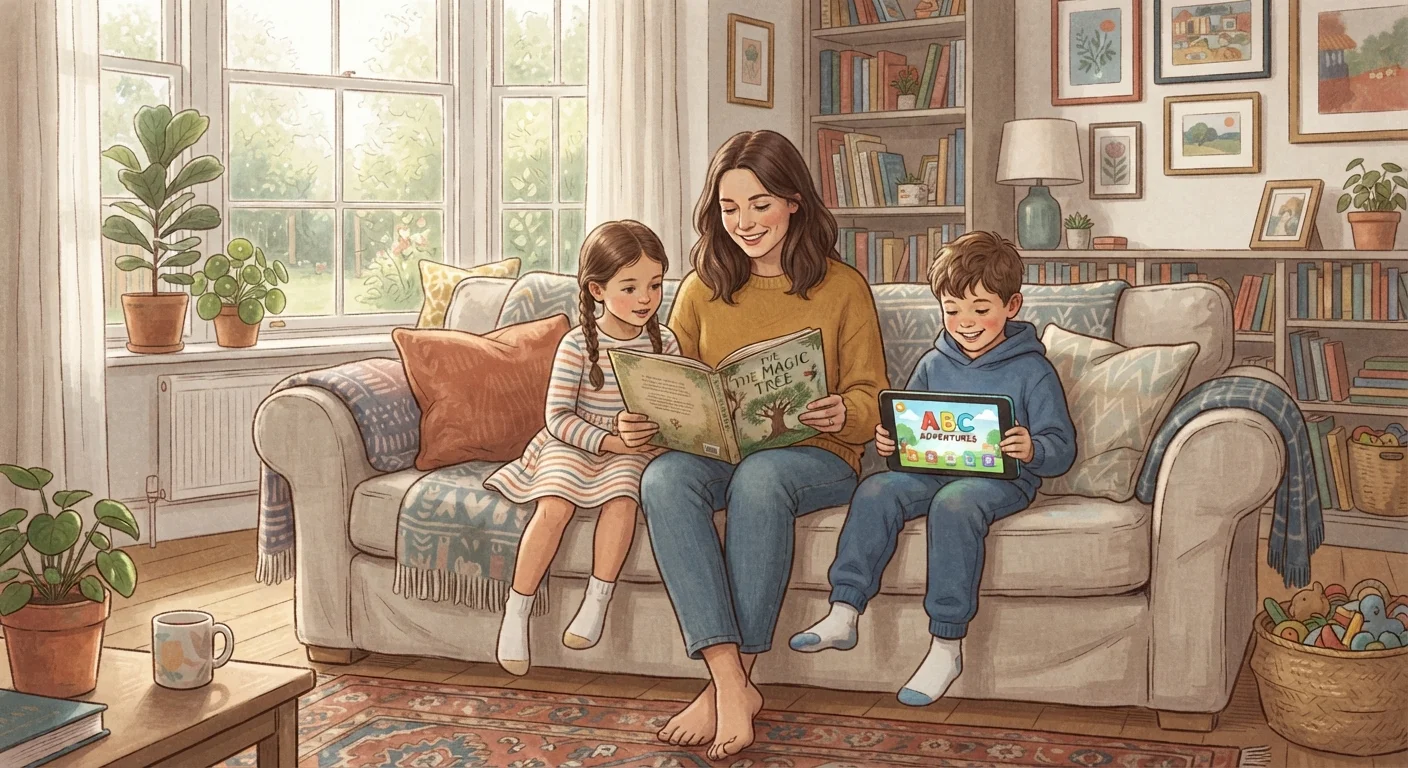
Co-viewing and co-playing - where a caregiver watches or plays alongside a child and talks about what they're experiencing - is consistently associated with better outcomes than passive, unattended screen use. This kind of active engagement transforms a screen from a babysitter into a conversation starter.
Evening Screens and Sleep Deserve Attention
One of the more consistently supported findings is that screen use in the hour or two before bedtime can delay sleep onset, particularly for children and adolescents. Short-wavelength blue light emitted by close-held devices like phones and tablets may suppress melatonin production. Establishing a screen-free wind-down period before bed is a practical, low-cost habit that aligns with current sleep health guidance. If your child is showing signs of persistent sleep difficulty, consult their pediatrician rather than adjusting routines on your own.
If you're looking to take stock of your family's overall routine, our family wellness audit provides a structured way to review habits around sleep, movement, and nutrition alongside tech use. And if more time outdoors is a goal, the evidence behind nature and outdoor time for families may offer useful motivation.
This article is for general informational purposes only and is not a substitute for professional medical advice. Consult a qualified healthcare provider for guidance specific to your child or family's health needs.