

Key Takeaways
Option A
Envelope Budgeting
The tactile, zero-ambiguity cash system.
Best for: Households that overspend in specific categories and need a physical barrier to stop impulse purchases.
Option B
Digital Tracking Apps
The automated, data-rich spending monitor.
Best for: Families who use cards for most purchases and want real-time visibility across all accounts in one place.
If your household regularly overshoots a specific category like groceries or dining out
Envelope Budgeting
Physical cash creates a hard stop that digital notifications rarely replicate. When the grocery envelope is empty, the decision is made for you.
If your family primarily uses debit or credit cards and earns income from multiple sources
Digital Tracking Apps
Apps can sync across accounts and categorize transactions automatically, giving you a complete financial picture without manual data entry.
If you're new to budgeting and want to build awareness of where money actually goes
Digital Tracking Apps
Automated categorization makes it easy to see spending patterns quickly, which is often the most revealing first step for households without a budget history.
If one or more household members are skeptical of budgeting and need something concrete
Envelope Budgeting
Physical envelopes make abstract budget numbers tangible and easy for every household member to understand, regardless of financial background.
If you want to manage both day-to-day spending control and long-term financial planning in one system
Digital Tracking Apps
Many apps include goal-tracking, savings projections, and net worth monitoring - capabilities that go well beyond what envelopes alone can provide.
How Each Method Actually Works
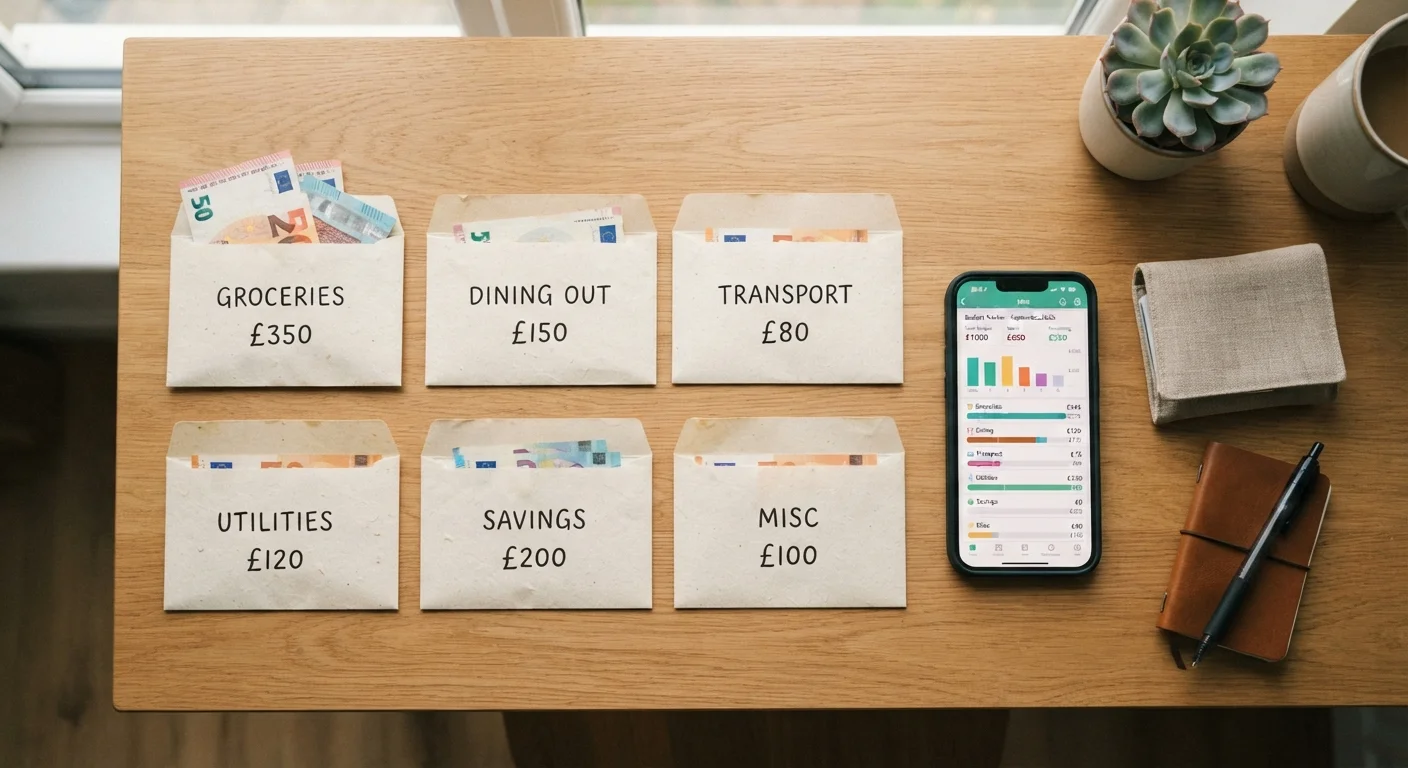
Envelope budgeting is a cash-based system: you divide your take-home pay into labeled physical envelopes - groceries, gas, entertainment, and so on - and spend only what's inside each one. When an envelope empties before the month ends, you either stop spending in that category or consciously move cash from another envelope. The constraint is built in.
Digital tracking apps connect to your bank accounts and credit cards, pulling in transactions automatically and sorting them into categories. You set spending limits, and the app alerts you as you approach or exceed them. The data is always current, and most apps generate charts and trends that can reveal patterns you'd otherwise miss.
Both methods answer the same core question - where is my money going? - but they use fundamentally different mechanisms to influence behavior. Envelopes work through friction; apps work through information. Understanding that distinction is the key to choosing what fits your household. For a broader look at where these systems fit within other budgeting philosophies, see our overview of four major budgeting frameworks.
| Criterion | Envelope Budgeting | Digital Tracking Apps |
|---|---|---|
| Spending control mechanism | Physical cash limit - hard stop | Alerts and notifications - soft stop |
| Setup time | 30-60 min per pay period | 20-30 min one-time, then automated |
| Works with online purchases | Poorly - requires workarounds | Yes - all card transactions tracked |
| Multi-member household access | Limited to envelope holder | Shared dashboard via multiple devices |
| Data and trend reporting | None built in | Charts, history, projections available |
| Best for problem-category control | Very effective | Moderate - requires active engagement |
| Tech comfort required | None | Basic smartphone proficiency |
| Cost | Free | Free to $15+/month depending on app |
The Overspending Problem: Friction vs. Feedback
The most important job of any budget is stopping overspending before it happens - and the two methods differ dramatically here.
With envelopes, the feedback is immediate and zero-ambiguity. There is no cash left. That physical reality is harder to rationalize around than a push notification saying you've hit 90% of your dining budget. Research in behavioral economics consistently supports the idea that paying with cash produces more deliberate spending decisions than card transactions, because the loss of physical money registers more strongly psychologically.
Apps rely on you noticing and acting on the feedback they provide. A spending alert is only useful if someone in the household checks it and adjusts behavior accordingly. Families who review their app dashboards weekly - ideally together - get much closer to the friction that envelopes provide naturally. Those who glance at the app occasionally tend to use it more as a spending diary than a spending control tool.
~18%
Reduction in spending when paying with cash vs. card
Multiple behavioral economics studies have found consumers tend to spend less when transactions involve physical cash rather than card payments.
~1 in 3
US adults who report having a detailed household budget
Surveys by the National Foundation for Credit Counseling have consistently found that a minority of American adults maintain a formal written or tracked budget.
Weekly
Review frequency linked to stronger budgeting outcomes
Financial planning research suggests households that review spending at least weekly are more likely to stay within budget targets than those who check monthly.
For households struggling in one or two specific areas (restaurants, Amazon, clothing), a hybrid approach is often the most practical path: use cash envelopes for those problem categories and an app to monitor everything else. This captures the behavioral benefits of cash where it counts most without the logistical challenge of running your entire financial life in physical currency.
Visibility, Setup, and Day-to-Day Maintenance
Setup effort differs considerably. Envelope budgeting requires you to withdraw cash regularly - often weekly or biweekly aligned with pay periods - divide it, and carry the right envelopes when you shop. This works smoothly for households with predictable, local spending but becomes awkward for online purchases, automatic bill payments, and travel.
Apps typically take 20-30 minutes to set up connections and category rules, then run largely on autopilot. The ongoing commitment is a weekly or biweekly review session rather than physical cash management. The tradeoff is that you're trusting categorization algorithms, which occasionally misfile transactions and require manual correction.
A Note on App Security and Data Sharing
Most budgeting apps access your financial accounts through read-only connections using aggregation services. They generally cannot move money. That said, you are sharing account credentials or access tokens with a third party, so it's worth reviewing the app's privacy policy and understanding how your data may be used or shared before connecting accounts. Look for apps that use bank-level encryption and are transparent about data practices.
From a whole-household visibility standpoint, apps have a clear edge: multiple family members can access the same dashboard from their own phones. With physical envelopes, visibility is limited to whoever holds them. Coordinating a two-income household where both adults spend across categories is significantly easier with a shared digital system. Our article on budgeting as a household explores frameworks for keeping all adults aligned regardless of the system you choose.
To understand what spending categories typically need the most attention in a family budget, The Anatomy of a Family Budget provides a useful baseline before you decide how to allocate envelopes or set app limits.
Which One Will Your Household Actually Stick With?
Consistency beats perfection in budgeting. A slightly imperfect system used every month outperforms an ideal system abandoned after six weeks. So the right question isn't which method is theoretically better - it's which one your household will actually maintain.
Envelope budgeting tends to stick for households where at least one person finds tangible, visible systems motivating. It's also a strong fit when a specific spending habit - not overall financial complexity - is the core problem to solve. The system's simplicity is a feature, not a limitation.
Digital apps tend to stick for households that are already comfortable managing finances digitally and who will genuinely engage with the data the app produces. The risk is passive use: the app runs in the background while spending habits don't actually shift. If your household is exploring how saving fits into a broader strategy, Pay-Yourself-First vs. Traditional Expense-Tracking offers a useful comparison of two foundational approaches that work alongside either system. And for the habits that underpin any budgeting method's long-term success, core principles that hold up across every savings approach are worth reviewing before committing to a new system.
This article is for general informational and educational purposes only and does not constitute personalized financial advice. Consult a qualified financial professional for guidance tailored to your specific situation.